
Netleaf hackberry is a tremendous tree in many ways. It supports bees, birds, and butterflies and becomes extremely drought tolerant with age. But it’s not right for every situation. Here’s everything you need to know about growing this Western US native as a desert landscape tree.

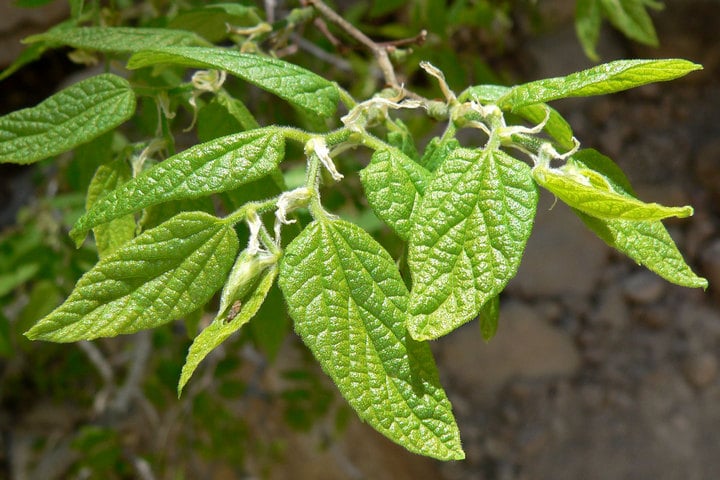
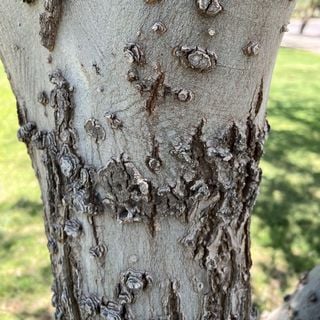
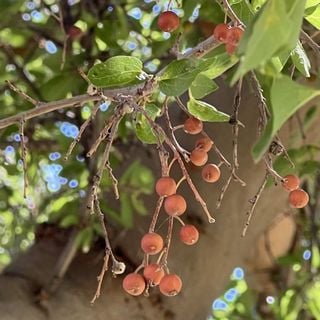
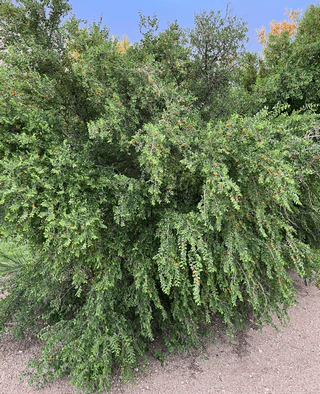
Netleaf hackberry (Celtis reticulata) is a large, rugged deciduous tree with character. It has scratchy green leaves and inconspicuous flowers that are followed by small, orange-red berries. As it matures, its smooth gray bark turns corky and develops distinctive knobs and fissures.
This Western US native withstands the desert’s full sun, heat, drought, and cold. In its native habitat, it survives on as little as 7 inches of annual rainfall. This tough tree can live 100 to 200 years!
This is an excellent tree for attracting bees, birds, and butterflies. It is mostly pollinated by bees. Birds enjoy its fruit, and it’s a host plant for many species of butterflies.
Why I Like This Plant
- Colorful berries
- Interesting bark
- Resilient, long-lived native
- Low maintenance
- Supports bees, birds, butterflies
Things to Watch Out For
Netleaf hackberry has shallow roots and only needs 12 inches of soil to grow. These shallow roots can become a problem when trees are planted too close to buildings, garden walls, or other structures.
Arizona State University’s plant library calls it an exceedingly tough but homely tree that’s more suitable for mid-elevation areas like Prescott and Payson than low desert areas like Phoenix.
If you’re looking for a tree with colorful fall foliage, netleaf hackberry is not it. It loses its leaves in the fall, but they are not particularly colorful.
This is a large tree that could overwhelm typical urban and suburban yards.
While the fruits are technically edible, they are bland with more seed than flesh, and better left for wildlife.
Optimal Growing Conditions
If you’re thinking of adding a netleaf hackberry to your garden, you need to find a suitable place that will keep your plant healthy and looking good… while minimizing maintenance for you.
Here are the key factors to keep in mind.
Temperature
Netleaf hackberry should be grown in USDA Hardiness Zones 5 to 10. It tolerates heat but may exhibit leaf damage during the high temperatures of a low desert heat wave. It’s extremely cold hardy down to a frigid -20℉.
Sun Exposure
Netleaf hackberry performs best in full sun but will accept some light shade or reflected sun.
Size and Growth Rate
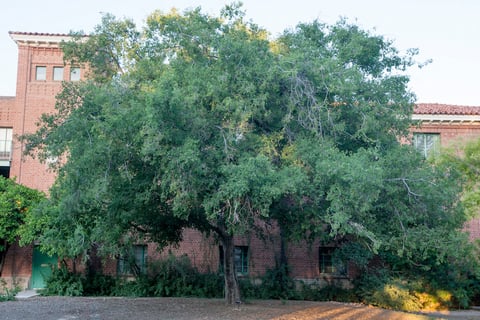
Netleaf hackberry has a moderate growth rate and typically reaches a mature size of 30 feet tall and wide in desert gardens, but it can grow much larger, up to 50 feet. Its ultimate size depends somewhat on how much water it receives.
Soil
In its native habitat, netleaf hackberry grows in poor, rocky soil. In desert gardens, it’s not particular and grows well in any native desert soil, provided it’s well-draining.
Other Location Considerations
Native along stream beds and hillsides, this tree is tolerant of a wide range of conditions. It is a good choice for retention basins, as it can tolerate periodic flooding and drought.
Netleaf Hackberry:
The Essentials
| Common Name | Netleaf hackberry |
| Scientific Name | Celtis reticulata |
| Origin | Western US, Mexico |
| Plant Type | Deciduous tree |
| USDA Zones | Zones 5 – 10 |
| Cold Hardiness | To -20℉ |
| Flowers | Inconspicuous |
| Flower Season | Spring |
| Mature Size | 30′ tall & wide |
| Growth Rate | Moderate |
| Sun Tolerance | Full, part sun |
| Water Needs | Low to moderate |
| Pests & Diseases | None |
| Wildlife | Supports bees, birds, butterflies |
How to Plant
The rule of thumb when planting any tree in the desert is to dig a hole three times as wide as the root ball but no deeper.
Amending the soil is not recommended. Counterintuitively, backfilling with the same native soil you just dug up helps your plant develop a stronger root system.
When to Plant
The best time to plant netleaf hackberry is in the fall. This gives it three seasons to grow roots and get established before the following summer.
The second best time is in spring, the earlier the better. This still gives it time to get established before the intense heat of June arrives.
How to Care for Netleaf Hackberry
Whether you’ve recently planted a netleaf hackberry or have an existing plant in your yard, here’s how to take care of it to keep it healthy and looking its best.
How to Water New Plants
Once you’ve got your tree in the ground, watering is your most immediate concern. Here is the recommended watering schedule for new trees planted in the spring or fall.
| Weeks 1 & 2 | Every 3 – 4 days |
| Weeks 3 & 4 | Every 5 – 7 days |
| Weeks 5 & 6 | Every 7 – 10 days |
| Weeks 7 & 8 | Every 10 – 14 days |
After week 8, gradually revise your watering schedule, depending on the season.
How to Water Established Plants
Netleaf hackberry starts as a moderate water use plant that gradually becomes extremely drought tolerant as it gets established. In its native habitat, it survives on as little as 7 inches of annual rainfall, but yours will look better with supplemental water.
As your tree becomes established, there are two watering factors to consider.
- First is how often to water. This will vary with the seasons.
- Second is how much water to give your tree with each watering. This depends on its current size.
To determine the ideal watering schedule for any desert tree, you’ll find everything you need to know, including easy-to-use charts, at How to Water Desert Trees: How Often? How Much?
Should You Fertilize?
There is no need to fertilize netleaf hackberry. This plant has evolved to get all the nutrients it needs from poor, rocky soil.
How to Prune
In its native habitat, netleaf hackberry grows as a rather wild, sprawling, multi-trunk tree. If you want to grow yours as a single-trunk tree, it will require careful selective pruning to develop the shape you want. Unless you’re experienced in training desert trees, I suggest you have an arborist train your young tree to get it off to the best possible start.
Don’t Confuse Netleaf Hackberry With…
Netleaf hackberry (Celtis reticulata) is sometimes confused with desert hackberry (Celtis pallida). They have similar common and scientific names, and both have red berries that birds adore.
But that’s where the similarities end. Desert hackberry is a semi-deciduous shrub that grows to around 12 feet tall. It has thorns and smaller leaves.
How to Buy a Netleaf Hackberry on a Budget
If you live in Tucson, netleaf hackberry is among the selections offered in the TEP (Tucson Electric Power) Trees for You Program. If you’re a TEP customer, you’ll have the opportunity to order two 5-gallon trees for $5 in spring and fall.
Plant Lover Facts
Netleaf hackberry also goes by the common names canyon hackberry, sugar hackberry, and Western hackberry. It’s sometimes referred to as Celtis laevigata or Celtis laevigata var. reticulata, but those are no longer the correct scientific names.
It’s native to much of the Western US and can be found growing in Arizona, California, Colorado, Idaho, Kansas, Nevada, New Mexico, Oklahoma, Oregon, Texas, Utah, Washington, and Wyoming. It’s also native to much of Mexico.
Native Americans have used this tree as a source of food, medicine, dye, and fibers.
Did you enjoy this article?
Sign up for our weekly newsletter
where you’ll find more great info on creating &
maintaining a beautiful, carefree desert landscape.
Author Bio
Deane Alban is the creator of Southwest Gardener. She is a science writer with a bachelor’s degree in botany from the University of South Florida. Gardening is her lifelong passion. She’s been gardening in Tucson for over 16 years.

Photo Credits
Stan Shebs, CC BY-SA 3.0, via Wikimedia Commons