
If TEP (Tucson Electric Power) is your electricity provider, you can take advantage of their “Trees for You” program. Here’s a review of the trees available through this program to help you decide which would be a good fit for your yard.

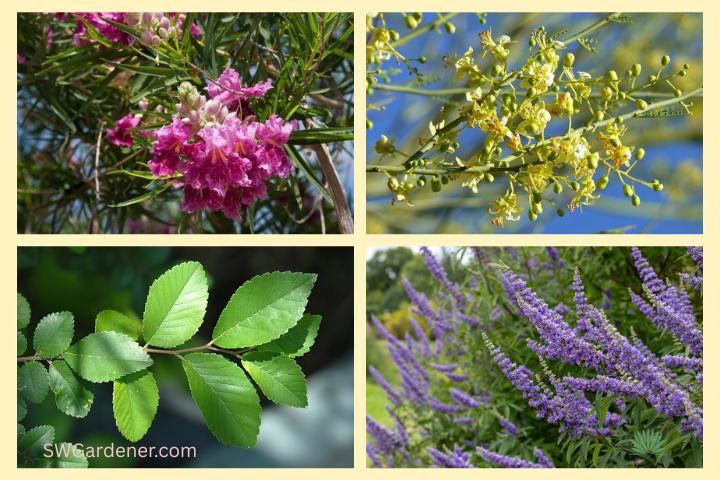
Everyone loves a bargain, and one of the best bargains Tucson gardeners can count on is TEP’s Trees for You Program. Amazingly, TEP has distributed more than 175,000 trees since this program began in 1992.
How the “Trees for You” Program Works
If you’re a TEP customer, you can buy bargain-priced trees through this program. In spring and fall, you can purchase one or two 5-gallon trees for $5 each. (Maximum 2 trees per customer per year.)
To order trees, you need an online account. To find the Trees for You program, log into your TEP account and look for the list of “Account Programs” at the bottom of your “Account Summary”.
This program opens in spring and in fall, and closes when the trees have run out. Trees are typically available for a few months.
Note that the TEP selections can change without notice and vary from season to season, but here are the trees that are usually available:
- Arizona ash
- Desert willow (cultivars)
- Foothills palo verde
- Joan Lionetti oak
- Lacebark elm
- Native mesquite
- Pomegranate
- Shoal Creek vitex
You can arrange to pick up your order at one of several nurseries around town. Trees are usually available for pickup around 2 weeks after you order.
As of September 7, 2026
the Trees for You program is open!
Choosing a Tree That’s Right for You
You should not plant a tree willy-nilly, even if it’s only $5. The wrong tree in the wrong spot can be a costly mistake if the tree eventually needs arborist care or removal.
These trees vary greatly in size (12 to 50 feet), water use (very low to moderate), and appearance. Some have beautiful flowers, while a few have colorful fall leaves. One is evergreen, while the others lose some or most of their leaves in the fall. And one provides edible fruit.
Here’s a summary of pertinent info for each of the current TEP trees, so you can decide which would be suitable for your situation. You can learn more about any of these trees by clicking on the link to see a comprehensive “Growing Guide”.
Arizona Ash
Arizona ash (Fraxinus velutina) is a large, deciduous shade tree that turns golden-yellow in the fall. As the name implies, it’s native to parts of Arizona, but also grows naturally in California, Utah, Nevada, and Texas.
It’s a substantial tree that needs plenty of room. It grows moderately fast and can reach a mature size of 40 feet tall by 30 feet wide.

Even though Arizona ash is a Southwest native, it grows in canyons and along streams, and is a riparian rather than a desert tree. So it is not a low water use tree, and requires more water than typical desert trees, especially when young.
Arizona Ash Summary
| Origin | Southwestern US |
| Ornamental Value | Large shade tree, fall color |
| Cold Hardiness | To -10℉ |
| Leaves | Deciduous |
| Mature Size | 40’ high x 30’ wide |
| Growth Rate | Moderate |
| Sun Tolerance | Full, part sun |
| Water Needs | Moderate |
Desert Willow (Cultivars)
Desert willow (Chilopsis linearis) is a medium size, deciduous, ornamental tree native to the Sonoran Desert. It’s not related to the typical thirsty willows (Salix), but is a very low water use tree that can survive on as little as 4 inches of annual rainfall in its native habitat.
The Trees for Your Program offers three cultivars:
- ‘Bubba’ (Chilopsis linearis ‘Bubba’)
- ‘Bubba Jones’ (Chilopsis linearis ‘Bubba Jones’)
- ‘Sweet Bubba’ (Chilopsis linearis ‘Sweet Bubba’)
Here’s a quick look at what makes each of these cultivars unique.
From spring through fall, desert willow ‘Bubba‘ is covered with large, two-tone, deep pink flowers that attract butterflies, bees, and hummingbirds. Compared to the parent plant, ‘Bubba’ has thicker, glossier leaves, lusher foliage, and produces fewer seed pods.
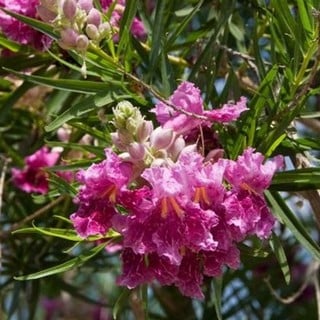
‘Bubba Jones‘ has the same attributes as ‘Bubba’, except its flowers are bright bubblegum pink.
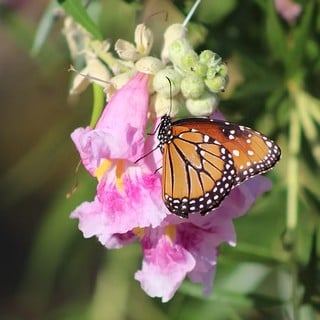
‘Sweet Bubba‘ has magenta flowers that are larger than those of the other ‘Bubba’ cultivars. Additionally, it’s seedless, making it a good choice for those who don’t want seed pods.
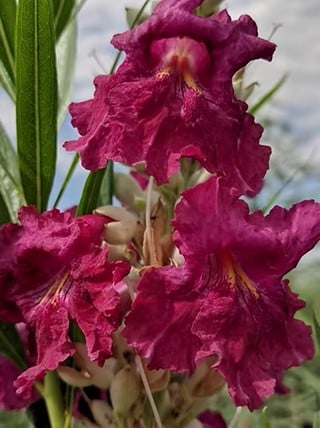
Desert Willow Summary
| Origin | Sonoran Desert (cultivars) |
| Ornamental Value | Pink flowers, long bloom season |
| Cold Hardiness | To -10℉ |
| Leaves | Deciduous |
| Mature Size | 25’ tall & wide |
| Growth Rate | Moderate to fast |
| Sun Tolerance | Full, part sun |
| Water Needs | Low |
Learn more about the ‘Bubba’ cultivars including
the story behind their unusual name here.
Foothills Palo Verde
NOTE: Foothills palo verde is not being offered in fall of 2026.
Foothills palo verde (Parkinsonia microphylla) is a medium size tree with bright green bark and creamy yellow flowers that have one distinctive white petal. It’s one of the most common trees in the Sonoran Desert and is considered a keystone species. It is an extremely low maintenance, low water use addition to desert gardens.
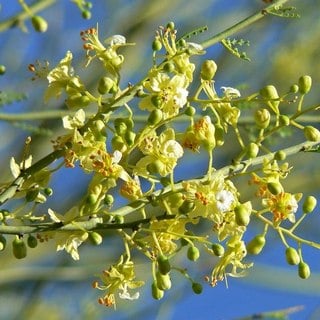
It’s a wonderful tree for attracting wildlife — hummingbirds, bats, butterflies, bees, and other insect pollinators feed on the nectar. It is a larval host for many species of moths. Birds and small mammals eat the seeds and use the tree for shelter.
It is semi-deciduous, losing its leaves in drought or cold, and is normally leafless for part of the year.
Foothills Palo Verde Summary
| Origin | Sonoran Desert |
| Ornamental Value | Yellow flowers, green bark, attracts wildlife |
| Cold Hardiness | To 15℉ |
| Leaves | Semi-deciduous |
| Mature Size | 25’ high x 15’ wide |
| Growth Rate | Slow |
| Sun Tolerance | Full sun |
| Water Needs | Very low |
‘Joan Lionetti’ Oak
‘Joan Lionetti’ oak (Quercus virginiana x fusiformis ‘Joan Lionetti’) is a medium size evergreen tree with leathery leaves. Inconspicuous spring flowers are followed by acorns in the fall. This oak hybrid has been selected for its tolerance of desert heat, drought, and alkaline soil.
It reliably grows as a “lollipop” tree — a straight, single trunk with a round, dense canopy. This is what most people who moved here from temperate regions think a tree should look like.
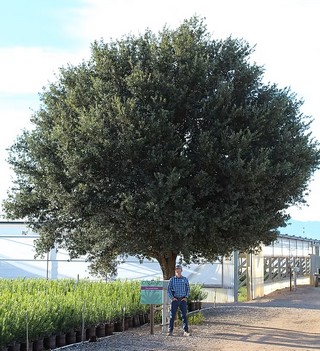
This tree’s growth rate is variable. I’ve heard it described as both fast and slow growing, but this almost certainly depends on how trees are cared for. Civano Growers, the supplier of TEP trees and the developer of this hybrid, claims these trees will grow 2 to 3 feet per year when properly irrigated.
‘Joan Lionetti’ Oak Summary
| Origin | Southeastern US (hybrid) |
| Ornamental Value | Shade tree |
| Cold Hardiness | To 0℉ |
| Leaves | Evergreen |
| Mature Size | 30’ tall & wide |
| Growth Rate | Variable |
| Sun Tolerance | Full, part sun |
| Water Needs | Moderate |
Lacebark Elm
Lacebark elm (Ulmus parvifolia), also called Chinese elm, is a deciduous tree with a large, umbrella-like canopy that can ultimately reach a size of 50 feet tall and wide. Even though it’s native to temperate regions of Asia, it withstands harsh desert conditions and is tolerant of urban settings, provided it receives adequate irrigation. Like Arizona ash, it needs a moderate amount of water.
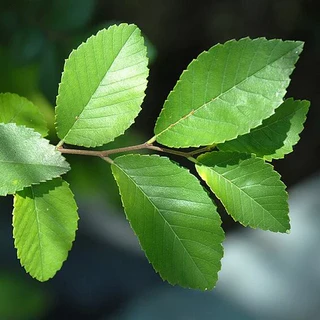
Lacebark evergreen provides dense shade. This might be just what you’re looking for, but keep in mind that few desert landscape plants thrive in deep shade. So this tree could adversely affect your existing landscaping if it includes sun-loving plants.
Lacebark Elm Summary
| Origin | Southeast Asia |
| Ornamental Value | Large shade tree, dense shade |
| Cold Hardiness | To 0℉ |
| Leaves | Deciduous |
| Mature Size | 30-50’ tall & wide |
| Growth Rate | Fast |
| Sun Tolerance | Full sun |
| Water Needs | Moderate |
“Native” Mesquite
TEP lists their mesquite selection as “native mesquite”, which is not very specific. So I’m going to assume that they mean velvet mesquite (Neltuma velutina) which is the most common of the 3 native mesquites.
People either love or hate this tree. It has some distinct benefits and drawbacks.
It has extremely low water use and needs no supplemental water after the first year. There is no better tree than this Sonoran Desert keystone species for supporting a wide variety of wildlife.
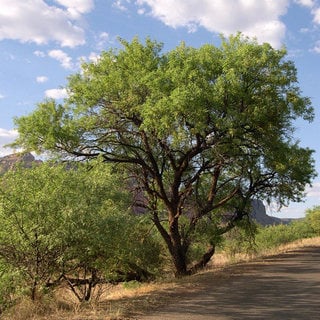
On the other hand, it is not a good choice for small urban or suburban yards. It’s messy! Mature trees drop thousands of seed pods. It drips dark, sticky sap that stains patios, sidewalks, and pavers. Its roots can be invasive when grown too close to structures and outdoor living areas.
So think carefully before choosing this tree.
Velvet Mesquite Summary
| Origin | Sonoran Desert |
| Ornamental Value | Large shade tree, supports wildlife |
| Cold Hardiness | To 10℉ |
| Leaves | Deciduous |
| Mature Size | 30’ tall & wide |
| Growth Rate | Moderate to fast |
| Sun Tolerance | Full, reflected sun |
| Water Needs | Low |
Pomegranate
Pomegranate (Punica granatum) is the only TEP selection that produces edible fruit. As a Middle Eastern native, it thrives in hot, dry desert gardens. And it also happens to be a stunning landscape plant that adds vibrant color year round.
In the spring, vivid orange-red flowers with ruffled petals appear. In the summer, glossy leaves turn deep green and large, red, apple-like fruits appear. As fall approaches, the leaves of this deciduous shrub turn golden yellow. Any fruit that hasn’t been harvested in the fall persists, hanging on trees like Christmas ornaments during the winter.
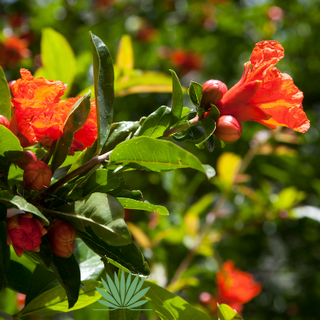
Pomegranate naturally grows as a multi-trunk shrub. While you can prune it to grow as a small tree, it will require more work for you, and your plant won’t be any happier.
Pomegranate Summary
| Origin | Greater Middle East |
| Ornamental Value | Orange-red flowers, fall color, fruit |
| Cold Hardiness | To 10℉ |
| Leaves | Deciduous |
| Mature Size | 10-15’ tall x 6-10’ wide |
| Growth Rate | Fast |
| Sun Tolerance | Full, part, reflected sun |
| Water Needs | Moderate |
Shoal Creek Vitex
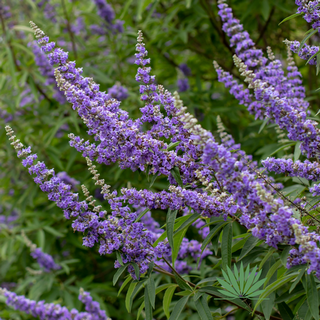
Chaste tree (Vitex agnus-castus) is a deciduous plant that naturally grows as a large shrub but is usually pruned to grow as a small, multi-trunk tree. It has aromatic, palm-shaped leaves the size of your hand.
From late spring through summer, this Mediterranean native explodes with a profusion of purple flowers that attract bees, butterflies, and hummingbirds.
Shoal Creek vitex (Vitex agnus-castus ‘Shoal Creek’) is the most popular chaste tree cultivar. It has a dense, compact form that stays under 15 feet tall. It produces large spikes of violet-blue flowers.
Shoal Creek Vitex Summary
| Origin | Mediterranean, Western Asia (cultivar) |
| Ornamental Value | Purple flowers |
| Cold Hardy | To 0℉ |
| Leaves | Deciduous |
| Mature Size | 10-15′ tall & wide |
| Growth Rate | Moderate |
| Sun Tolerance | Full, part, reflected sun |
| Water Needs | Low |
Caveats About Arizona Ash & Chinese Elm
Before you choose either the Arizona ash or the Chinese elm for your garden, there are a few things to consider.
Size
Both trees grow to be huge, up to 40 or 50 feet tall. If you live in a typical urban or suburban home, these trees can ultimately overwhelm the average yard. And if you live in a community with an HOA, these trees might not be on the approved list for this reason.
Water
Chinese elm and Arizona ash are not truly xeric and need moderate (rather than low) amounts of water. This should be a concern if you are watching your water bill. When these trees mature, they can require large amounts of water — to the tune of hundreds of gallons per watering.
These trees can also become a hidden problem when grown near desert plants. Watering a large tree could make the ground too wet for saguaros, ocotillos, or other truly desert plants in your yard, even if they don’t seem that close. Saguaro roots can extend over 100 feet beyond the base of the plant! Many people unknowingly kill their treasured desert plants this way.
Leaf Debris
These trees drop a lot of leaves, so be sure you won’t mind dealing with them. When your tree is small, you might find raking or blowing leaves an enjoyable pastime, but it could become an overwhelming chore when the tree matures.
My Final Thoughts
Trees for You is a great program if you’re looking for trees on a budget. If you’re expecting a typical, garden-center-size tree, you may be disappointed. TEP trees are typically quite small, usually a few feet tall. (Learn more ways to find desert landscape plants on a budget here.)
Growing these trees seems to be hit or miss. Some gardeners have great success, while others have found their trees failed to thrive or died. But for the price, you may find it worth a chance.
If you’re new to growing trees in the desert Southwest, the articles below can help you get your tree off to the best possible start by getting the basics right.
Recommended Reading:
How to Plant a Tree
How to Dig a Hole in the Desert
What to Plant in Spring (Month by Month)
5 Reasons to Plant in the Fall (not spring)
How to Water Desert Trees: How Often? How Much?
Did you enjoy this article?
Sign up for our weekly newsletter
where you’ll find more great info on creating &
maintaining a beautiful, carefree desert landscape.
Author Bio
Deane Alban is the creator of Southwest Gardener. She is a science writer with a bachelor’s degree in botany from the University of South Florida. Gardening is her lifelong passion. She’s been gardening in Tucson for over 16 years.

Photo Credits
Tmasjeg, CC BY-SA 4.0, Wikimedia Commons
Henderson County Master Gardener Association
Stan Shebs, CC BY-SA 3.0, via Wikimedia Commons
Douglas Goldman, CC BY-SA 4.0, Wikimedia Commons
Max Licher, CC BY-SA, SWBiodiversity.org
Peter Chadzidocev, CC BY-SA 4.0, via Wikimedia Commons