
Chaste “tree”, ironically, naturally grows as a large shrub, but it’s commonly trained to grow as a small tree. Either way, it really stands out in the summer when it’s covered with spikes of fragrant, purple flowers. Here’s everything you need to know about growing this native of the Mediterranean and beyond.

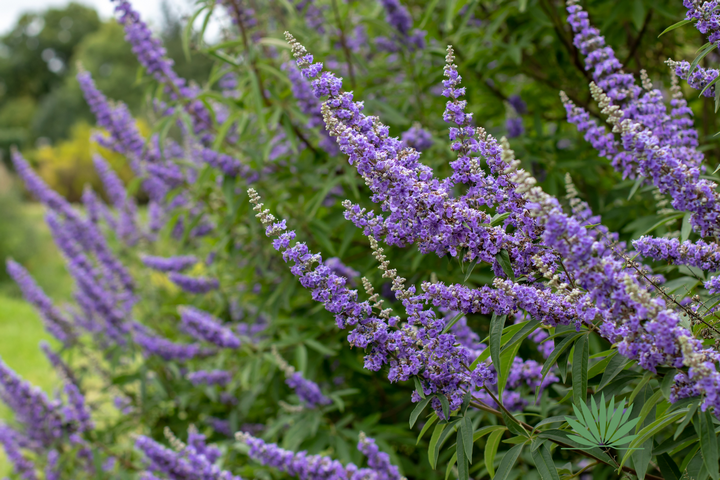
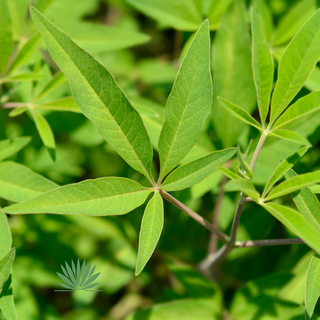
Spring through fall, chaste tree (Vitex agnus-castus) is a beauty. It has green, palm-shaped leaves the size of your hand. (It’s been noted that the leaves resemble those of marijuana.) The leaves are aromatic, with an herbal sage-like scent, especially when crushed.
From late spring through summer, plants explode with a profusion of 8 inch spikes of purple flowers. The flowers are followed by small black berries that resemble black pepper. The fragrant flowers attract bees, butterflies, and hummingbirds.
While not a desert native, it takes the desert’s sun, heat, and aridity in its stride.
Why I Like This Plant
- Profusion of fragrant purple flowers
- Thrives in desert heat and sun
- Attracts pollinators
Things to Watch Out For
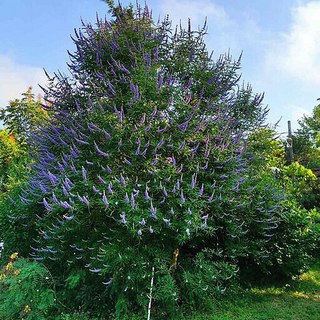
Chaste tree naturally grows as a large shrub. If you want a plant that looks more tree-like than shrub-like, you’ll need to train it to grow that way.
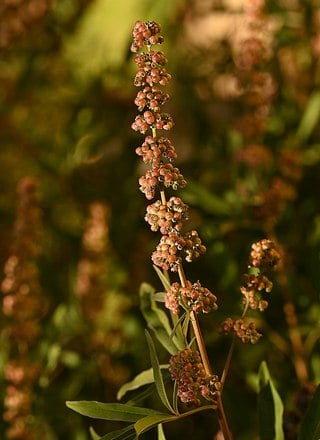
Chaste tree is fairly messy. It loses its leaves in the fall and drops flowers and seeds throughout the year. It doesn’t look like much during the winter. Persistent brown seed capsules, which not everyone finds attractive, remain on the branches. So, this is not an ideal choice for snowbirds or anyone who wants their garden to look its best during the cooler months.
It has been found to be invasive in some parts of the Southwest. This may or may not be a concern, depending on where you live. (I’ll discuss its invasiveness in detail later.)
Optimal Growing Conditions
If you’re thinking of adding a chaste tree to your garden, you need to find a suitable place that will keep your plant healthy and looking good… while minimizing maintenance for you.
Here are the key factors to keep in mind.
Temperature
Chaste tree should be grown in USDA Hardiness Zones 6 to 11. It thrives in extreme heat — the hotter it is, the more flowers it produces. It is extremely cold hardy down to at least 0℉ and possibly even colder.
Plants die to the ground in extreme cold and grow more like a woody perennial, but this is not a concern for Zone 9 gardeners.
Sun Exposure
This plant loves full sun and doesn’t mind the reflected heat off a hot wall. It will tolerate partial shade, but may have fewer flowers.
Size and Growth Rate
Chaste tree is a moderately fast grower. It typically reaches a size of 15 to 25 feet tall and wide, but its ultimate size will depend on how much water it receives and how it’s pruned.
Soil
Chaste tree prefers fertile soil, but it’s not particular and can grow well in any native soil — rocky, sandy, or clay — provided it’s well-draining.
Chaste Tree:
The Essentials
| Common Name | Chaste tree |
| Scientific Name | Vitex agnus-castus |
| Origin | Mediterranean, Western Asia |
| Plant Type | Deciduous shrub/tree |
| USDA Zones | Zones 6 – 11 |
| Cold Hardy | To 0℉ |
| Flower Color | Purple |
| Flower Season | Summer |
| Mature Size | 15-25 tall & wide |
| Growth Rate | Moderate |
| Sun Tolerance | Full, part, reflected sun |
| Water Needs | Low |
| Pests & Diseases | None |
| Wildlife | Supports butterflies, bees, hummingbirds |
How to Plant
The rule of thumb when planting any shrub or tree in the desert is to dig a hole three times as wide as the root ball but no deeper.
Amending the soil is not recommended. Counterintuitively, backfilling with the same native soil you just dug up will help your chaste tree develop a stronger root system.
When to Plant
The best time to plant chaste tree is in the fall. This gives it three seasons to grow roots and get established before the following summer.
The second best time is in spring, as soon as the risk of frost is over. This still gives it time to get established before the intense heat of June arrives.
How to Care for Chaste Tree
Whether you’ve recently planted a chaste tree or have an existing one in your yard, here’s how to take care of it to keep it healthy and looking its best.
How to Water New Plants
Once you’ve got your chaste tree in the ground, watering is your most immediate concern. Here is the recommended watering schedule for new shrubs and trees planted in the spring or fall.
| Weeks 1 & 2 | Every 3 – 4 days |
| Weeks 3 & 4 | Every 5 – 7 days |
| Weeks 5 & 6 | Every 7 – 10 days |
| Weeks 7 & 8 | Every 10 – 14 days |
After week 8, gradually revise your watering schedule, depending on the season.
How to Water Established Plants
As your chaste tree gets established, there are two watering factors to consider.
- First is how often to water. This will vary with the seasons.
- Second is how much water to give your shrub with each watering. This depends on its current size.
To determine the ideal watering schedule for your chaste tree, you’ll find everything you need to know, including easy-to-use charts, at How to Water Desert Trees: How Often? How Much?
Don’t overwater your chaste tree. It may grow faster with more water, but will produce fewer flowers. Additionally, it can develop root rot when not allowed to dry out between waterings.
Should You Fertilize?
Chaste tree doesn’t need fertilizer. They grow fast and flower profusely without it, but you may want to topdress with compost or mulch since they do prefer fertile soil.
How to Prune
The common name chaste tree is somewhat misleading, since this plant naturally grows as a large shrub.
If you plan to let it grow as a shrub, little pruning is required other than to remove dead or damaged branches. Additionally, you can prune it to control its size and shape.
However, if you want it to grow as a tree, you’ll need to train it when it’s young by pruning the lowest branches and any suckers. Unless you are experienced in training desert trees, I suggest you have an arborist train your young tree to get it off to the best possible start.
The best time to prune is in early spring before new growth appears, since flowers appear on new wood.
Is Chaste Tree Invasive?
I was surprised to learn that chaste tree has invasive potential since it’s sold just about everywhere. Here in Tucson, it’s often included in the Tucson Clean & Beautiful program and TEP’s Trees for You program.
And yet, there’s evidence that chaste tree is invasive in pockets of the desert Southwest.
In Texas
Both the Texas Native Plant Society and TexasInvasives.org list chaste tree in their databases of invasive plant species.
In Southern Nevada
The Nevada Department of Agriculture lists chaste tree as a “priority weed species” in southern Nevada.
The Southern Nevada Water Authority states this about chaste tree on their website:
The chaste tree (Vitex angus-castus) is currently listed by the Southern Nevada Cooperative Weed Management Area as “EDRR non-urban” or Early Detection Rapid Response. While it is currently sold in local nurseries, it will soon be listed by the Nevada Department of Agriculture as a noxious weed and removed from the SNWA plant list.
In National Parks
And finally, chaste tree has been found invasive in many Southwest parks, monuments, and recreation areas:
- Organ Pipe National Monument (AZ)
- Chiricahua National Monument (AZ)
- Death Valley National Park (CA)
- Glen Canyon National Recreation Area (UT)
If you live in or near any of these areas, I suggest you research chaste tree further before deciding whether you want to grow this plant.
Chaste Tree Cultivars
Not all chaste trees have purple flowers. If you’d prefer a different flower color, you’re in luck. Check out the many Vitex cagnus-castus cultivars. ‘Rosea’ has pink flowers and ‘Alba’ has white flowers.
The most popular cultivar, ‘Shoal Creek’ has a dense, compact form and stays under 15 feet tall. It produces larger spikes of violet-blue flowers.
How to Buy ‘Shoal Creek’ on a Budget
If you live in Tucson, Shoal Creek vitex is often one of the selections offered in the TEP (Tucson Electric Power) Trees for You Program. If you’re a TEP customer, you’ll have the opportunity to order two 5-gallon trees for $5 in spring and fall.
Plant Lover Facts
Chaste tree goes by many common names including chasteberry, monk’s pepper, lilac chastetree, and Texas lilac.
Its native range extends from India west through Central Asia to the Mediterranean regions of both Northern Africa and Southern Europe.
Monks who resided in chaste tree’s natural range reportedly used its seeds as a pepper substitute that quieted their libido. Hence, the common name monk’s pepper.
Its unusual hyphenated species name, agnus-castus, means ‘chaste’ in Greek and in Latin. (Whoever named this plant wanted to make sure we got the point! 😉)
Chaste tree was traditionally used to treat gynecological disorders. Today, it is a popular herbal remedy for symptoms of premenstrual syndrome and menopause.
Did you enjoy this article?
Sign up for our weekly newsletter
where you’ll find more great info on creating &
maintaining a beautiful, carefree desert landscape.
Author Bio
Deane Alban is the creator of Southwest Gardener. She is a science writer with a bachelor’s degree in botany from the University of South Florida. Gardening is her lifelong passion. She’s been gardening in Tucson for over 16 years.

Photo Credits
Peter Chadzidocev, CC BY-SA 4.0, via Wikimedia Commons
Krzysztof Ziarnek, CC BY-SA 4.0, via Wikimedia Commons