
If you’re looking to add shade to your desert garden fast, Chinese elm is one to consider. It’s a beautiful, resilient tree, but it’s not ideal for every situation. Here’s what you need to know to determine whether this Asian native would be a suitable addition to your yard.
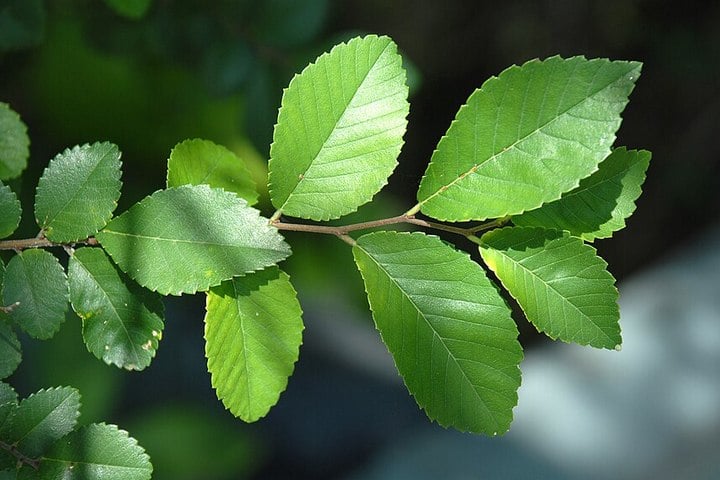
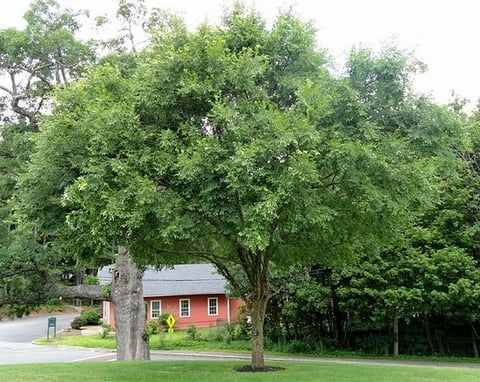
Chinese elm (Ulmus parvifolia) is a deciduous tree with a large, umbrella-like canopy. Even though it’s native to temperate regions of Asia, it withstands harsh desert conditions and is tolerant of urban settings, provided it’s adequately irrigated.
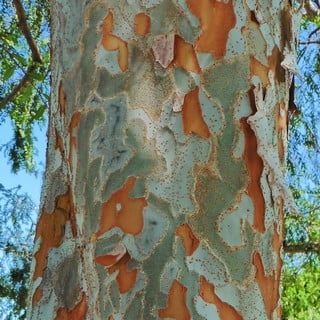
It has small, glossy, true-green leaves and distinctive mottled, peeling patchwork bark. Inconspicuous flowers form in the summer and are followed by small papery seeds in the fall.
Why I Like This Plant
- Large tree provides dense shade
- Fast growing
- Unusual bark
- Tolerant of urban conditions
- Resistant to Dutch elm disease
Things to Watch Out For
Chinese evergreen provides dense shade. This might be just what you’re looking for, but keep in mind that few landscape plants thrive in deep shade. So this tree could adversely affect the rest of your desert landscaping.
It will ultimately be a huge tree, up to 50 feet tall and wide. If you live in a typical urban or suburban home with a small yard, it will almost certainly overwhelm its space.
It is not a low-maintenance tree. It’s not desert-adapted and requires a moderate amount of water. And obviously, a deciduous tree of this size is not low-litter.
If you’re looking for a large tree with beautiful fall foliage, Chinese elm isn’t it. (Consider Arizona ash or Red push pistache instead.) Its leaves change color, but are muted rather than bright.
Chinese elm can reseed to the point of being a nuisance in irrigated settings and is considered invasive in some parts of the southwest.
This tree is among the plants most susceptible to Texas or cotton root rot, a soil-borne fungus that’s inevitably fatal.
If you prefer plants that support birds, bees, and other wildlife, this non-native seems to offer little-to-no value to local wildlife.
Optimal Growing Conditions
If you’re thinking of adding a Chinese elm to your garden, you need to find a suitable place that will keep your tree healthy and looking good… while minimizing maintenance for you.
Here are the key factors to keep in mind.
Temperature
Chinese elm should be grown in USDA Hardiness Zones 6 to 11. It withstands desert heat and survives cold down to 0℉.
In the hottest spots like Phoenix, trees often look worse for wear by the end of summer due to heat stress.
Sun Exposure
Chinese elm should be planted in full sun, but will tolerate some light shade.
Size and Growth Rate
Chinese elm is a fast grower that typically reaches a mature size of 30 to 50 feet tall and wide in desert landscapes. However, it can grow much taller — up to 70 feet — under the right conditions.
Soil
Chinese elm prefers rich, moist soil, but will grow in any kind of desert soil — sand, rocky, or clay — as long as it’s well-draining.
Pests & Diseases
Chinese elm has good resistance to Dutch elm disease, a fatal fungal disease usually spread by bark beetles. However, it’s highly susceptible to another fatal fungal disease, Texas root rot. This fungus is indigenous to the poor, alkaline soils of the US southwest and Mexico.
Chinese Elm:
The Essentials
| Common Names | Chinese elm, lacebark elm |
| Scientific Name | Ulmus parvifolia |
| Origin | Southeast Asia |
| Plant Type | Deciduous tree |
| USDA Zones | Zones 6 – 11 |
| Cold Hardiness | To 0℉ |
| Flowers | Inconspicuous |
| Flower Season | Summer |
| Mature Size | 30-50’ tall & wide |
| Growth Rate | Fast |
| Sun Tolerance | Full sun |
| Water Needs | Moderate |
| Pests & Diseases | Texas root rot |
| Wildlife | None |
How to Plant
The rule of thumb when planting any tree in the desert is to dig a hole three times as wide as the root ball but no deeper.
As tempting as it is to add amended soil, this is not recommended. Counterintuitively, backfilling with only native soil helps your plant develop a better root system.
When to Plant
The best time to plant Chinese elm is in the fall. This gives it three seasons to grow roots and get established before the following summer.
The second best time is in spring, the earlier the better. This still gives it time to get established before the intense heat of June arrives.
How to Care for Chinese Elm
Whether you’ve recently planted a new Chinese elm or have an existing one in your yard, here’s how to take care of it to keep it healthy and looking its best.
How to Water New Plants
Once you’ve got your Chinese elm in the ground, watering is your most immediate concern. Here is the recommended watering schedule for new trees planted in the spring or fall.
| Weeks 1 & 2 | Every 3 – 4 days |
| Weeks 3 & 4 | Every 6 – 7 days |
| Weeks 5 & 6 | Every 7 – 10 days |
After week 6, gradually revise your watering schedule, depending on the season.
How to Water Established Plants
As your tree becomes established, there are two watering factors to consider.
- First is how often to water. This will vary with the seasons.
- Second is how much water to give your tree with each watering. This depends on its current size.
To determine the ideal watering schedule for any desert tree, you’ll find everything you need to know, including easy-to-use charts, at How to Water Desert Trees: How Often? How Much?
Since it’s a moderate rather than low water use plant, use the “High Water Use” schedule.
Should You Fertilize?
Chinese elm is a resilient tree that doesn’t need fertilizer.
How to Prune
Chinese elm is almost always grown as a single trunk, “lollipop” tree that needs to be trained and staked when young. If you’re unsure about how to shape your tree as it grows, I strongly urge you to hire a professional. Hiring an arborist (not a so-called “landscaper”) to get your tree off to the right start is an excellent investment that will result in a beautiful, healthy tree for years to come.
Note that pruning is not recommended for the first two to three years after being planted.
Fun Fact!
Chinese elm makes an excellent bonsai.
How to Get a Chinese Elm on a Budget
If you live in Tucson, Chinese elm is often one of the offerings in the TEP (Tucson Electric Power) Trees for You Program. (Note, that TEP calls it lacebark elm, but it’s the same plant.) If you’re a TEP customer, you’ll have the opportunity to order two 5-gallon plants for $5 in spring and fall.
Plant Lover Facts
Chinese elm (Ulmus parvifolia) also goes by the common names lacebark elm for its distinctive bark, and evergreen elm — an odd choice for a deciduous tree.
It’s native to China, Taiwan, Vietnam, Japan, and Korea. It has naturalized in pockets around the world, including in the US.
It has escaped cultivation in a handful of scattered states with varying climates — California, Alabama, Arkansas, Georgia, Kentucky, Virginia, Maryland, Massachusetts, and Maine. This is a testament to this tree’s adaptability.
Did you enjoy this article?
Sign up for our weekly newsletter
where you’ll find more great info on creating &
maintaining a beautiful, carefree desert landscape.
Author Bio
Deane Alban is the creator of Southwest Gardener. She studied journalism and received a bachelor’s degree in botany from the University of South Florida. Gardening is her lifelong passion. She’s been gardening in Tucson for over 16 years.

Photo Credits
Douglas Goldman, CC BY-SA 4.0, Wikimedia Commons
Arizona State University’s Virtual Library of Phoenix Landscape Plants
Daderot, Public Domain, Wikimedia Commons