
If you’re looking for a shrub to attract and support birds and butterflies, you won’t find a better plant than desert hackberry. Here’s everything you need to know about growing this native of the Sonoran and Chihuahuan Deserts as a wildlife habitat and landscape plant.
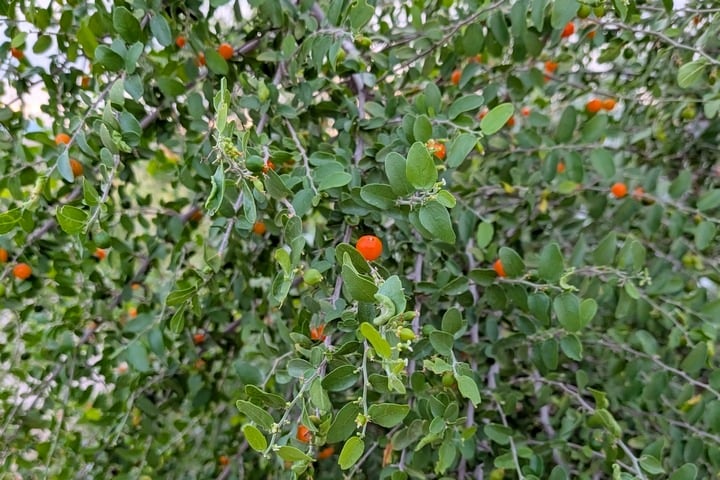
Desert hackberry (Celtis pallida) is a large shrub with small, leathery, dark green leaves and thorny, wiry stems. Its inconspicuous, yellow-green flowers are followed by small, bright berries in shades of orange and red.
As a Southwest desert native, it makes an extremely low maintenance addition to your yard. It withstands the desert’s full sun, heat, drought, and cold. In its native habitat, it survives on as little as 8 inches of annual rainfall.
Don’t judge this plant by its looks alone. Desert hackberry admittedly does not make the most elegant landscape shrub — it’s definitely wild-looking. But there is no better shrub for bringing your garden to life with birds and butterflies.
Grow it because you love birds.
While humans consider the edible berries bland, birds relish the fruit. Berries usually persist on the plant until eaten, providing a source of food much of the year. Its dense, thorny branches provide a safe haven for birds to rest and nest.
Dozens of species are known to visit this plant, including Gambel’s quail, cactus wrens, cardinals, cedar waxwing, thrashers, phainopepla, mockingbirds, warblers, sparrows, and flycatchers.
Grow it because you love butterflies.
Desert hackberry is a host plant for the larvae of many butterfly species, especially for snout nose butterflies. In Texas, desert hackberry is the host plant for occasional explosions of snout nose butterflies, which can number in the billions!
Additionally, the flowers are pollinated by bees. Desert hackberry also provides food and/or shelter for small mammals, jackrabbits, coyotes, and deer.
Why I Like This Plant
- Colorful berries
- Extremely low maintenance
- Important for supporting birds, butterflies, & more
Things to Watch Out For
While the fruits are considered edible, they are bland and better left for wildlife. If you want to support wildlife and have fruit for personal consumption, consider growing wolfberry instead. Wolfberry fruits are highly nutritious and have many culinary uses.
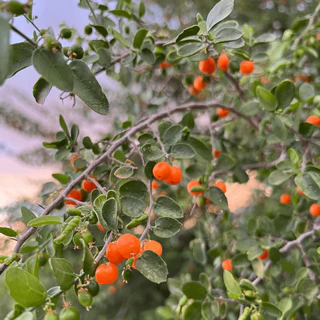
Beware of its substantial, 1 inch thorns.
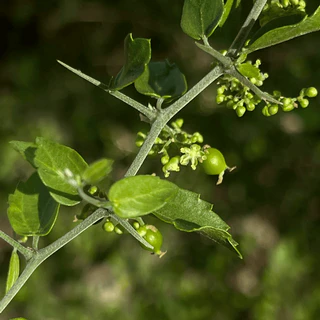
Desert hackberry is generally evergreen but is drought deciduous, which means it may lose its leaves during extreme drought, but quickly leafs out with rain.
If you live in an urban or suburban area, it might not conform to your neighborhood’s norms or your HOA’s rules. In that case, it might be a better choice for your backyard than your front yard.
This plant needs room to spread and does not appreciate regular pruning. Even when it looks its best, it’s not a typical, manicured landscape shrub, but more of a wild-looking thicket. If you haven’t got room to let it grow naturally, plant a more manageable shrub instead.
Optimal Growing Conditions
If you’re thinking of adding a desert hackberry to your garden, you need to find a suitable place that will keep your plant healthy and looking good… while minimizing maintenance for you.
Here are the key factors to keep in mind.
Temperature
Desert hackberry should be grown in USDA Hardiness Zones 7 to 10. This desert native loves the heat and tolerates cold down to 10℉.
Sun Exposure
Desert hackberry performs best in full sun. It tolerates some light shade, but too much will cause it to get leggy.
Size and Growth Rate
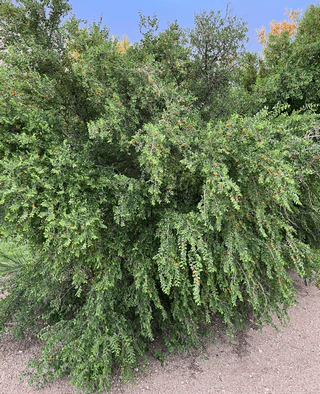
Desert hackberry is slow-growing and long-lived, ultimately reaching a size of 8 feet tall by 12 feet wide. But its size and growth rate depend somewhat on how much water it receives.
Soil
Desert hackberry is not particular about soil and grows well in most native soil — rocky or sandy — provided it’s well-draining.
Other Location Considerations
Desert hackberry is useful for erosion control and restoration projects. Since it grows as a thorny tangle, it makes a great deterrent for keeping others off your property.
Desert Hackberry:
The Essentials
| Common Name | Desert hackberry |
| Scientific Name | Celtis pallida |
| Origin | Sonoran, Chihuahuan Deserts |
| Plant Type | Semi-deciduous shrub |
| USDA Zones | Zones 7 – 10 |
| Cold Hardiness | To 10℉ |
| Flowers | Inconspicuous |
| Flower Season | Spring |
| Mature Size | 8’ tall x 12′ wide |
| Growth Rate | Slow |
| Sun Tolerance | Full, part sun |
| Water Needs | Low |
| Pests & Diseases | None |
| Cautions! | Thorns |
| Wildlife | Supports birds, butterflies |
How to Plant
The rule of thumb when planting any shrub in the desert is to dig a hole three times as wide as the root ball but no deeper.
Amending the soil is not recommended. Counterintuitively, backfilling with the same native soil you just dug up helps your plant develop a stronger root system.
When to Plant
The best time to plant desert hackberry is in the fall. This gives it three seasons to grow roots and get established before the following summer.
The second best time is in spring, the earlier the better. This still gives it time to get established before the intense heat of June arrives.
How to Care for Desert Hackberry
Whether you’ve recently planted a desert hackberry or have an existing plant in your yard, here’s how to take care of it to keep it healthy and looking its best.
How to Water New Plants
Once you’ve got your shrub in the ground, watering is your most immediate concern. Here is the recommended watering schedule for new shrubs planted in the spring or fall.
| Weeks 1 & 2 | Every 3 – 4 days |
| Weeks 3 & 4 | Every 5 – 7 days |
| Weeks 5 & 6 | Every 7 – 10 days |
| Weeks 7 & 8 | Every 10 – 14 days |
After week 8, gradually revise your watering schedule, depending on the season.
How to Water Established Plants
In its native habitat, desert hackberry survives on rainfall alone, but plants look better with some supplemental water.
Once your plant is established, you can water it as little as once or twice per season. A good rule of thumb is every 2 to 3 weeks in summer and once per month in fall or spring. No supplemental water is required during the winter. Too much water results in weak growth and fewer flowers, which means less food for wildlife.
Should You Fertilize?
There is no need to fertilize desert hackberry. This plant has evolved to get all the nutrients it needs from the desert soil.
How to Prune
When planted in a spot where it has room to grow, desert hackberry should rarely need pruning, except to remove any damaged or “deranged” branches.
Desert hackberry should be allowed to grow wild. Do not shear this plant or try to create an unnatural shape. If you must prune, selectively remove branches in the spring.
If your plant is getting too big for its space, you can cut back on water to help control its size.
Don’t Confuse Desert Hackberry With…
Desert hackberry is sometimes confused with Celtis reticulata, which goes by the common names netleaf hackberry, western hackberry, and canyon hackberry.
These two plants are sometimes confused because they have similar common and scientific names. Additionally, they both have red berries that birds love.
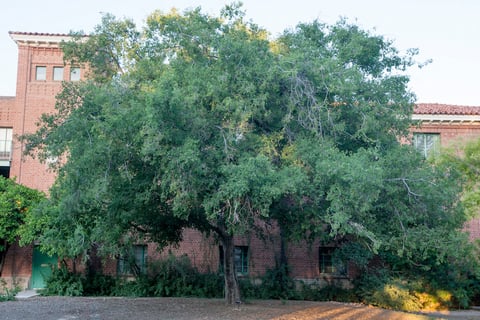
But that’s where the similarities end. Netleaf hackberry is a large deciduous tree that can grow 30 to 40 feet tall with an equal spread. It has larger leaves and no spines or thorns.
Plant Lover Facts
Desert hackberry (Celtis pallida) also goes by the common names spiny hackberry, shiny hackberry, and granjeno. It’s sometimes referred to as Celtis ehrenbergiana, but that is not the correct scientific name.
In the US, it’s native to Arizona, New Mexico, and Texas. Its native range also includes northwest Mexico and several South American countries.
I could not find a history of traditional uses for the berries, but the wood has been used for fuel and fence posts.
Did you enjoy this article?
Sign up for our weekly newsletter
where you’ll find more great info on creating &
maintaining a beautiful, carefree desert landscape.
Author Bio
Deane Alban is the creator of Southwest Gardener. She is a science writer with a bachelor’s degree in botany from the University of South Florida. Gardening is her lifelong passion. She’s been gardening in Tucson for over 16 years.
