
Spotted spurge is a common, inconspicuous weed that loves the desert sun and heat. It may look innocuous, but it can cause big headaches. Learn why spurge is a scourge that should be discouraged, and the best ways to get rid of it.

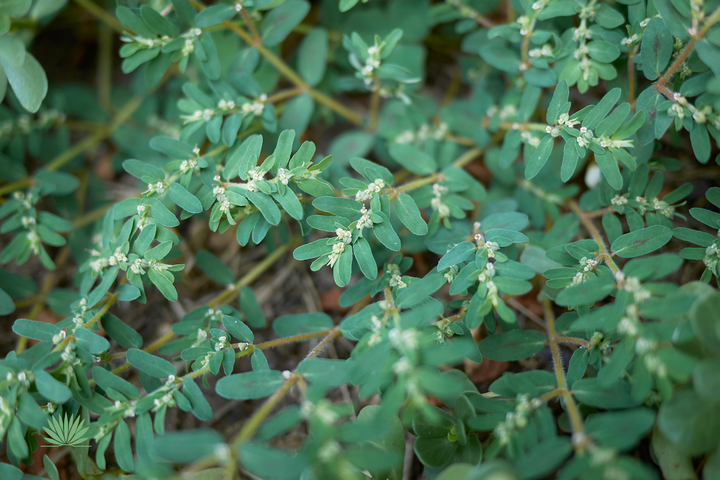
Spotted spurge (Euphorbia maculata), which is usually just called “spurge”, is a low-growing, weedy ground cover that forms round mats. It’s native to most of the US and has naturalized on all inhabited continents.
It’s a small plant that has tiny leaves, inconspicuous flowers and seeds, and thin, thread-like stems and roots. And yet it can be a big headache in desert gardens.
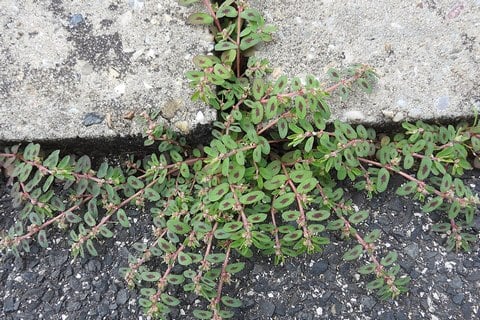
This opportunistic plant happily grows in the most inhospitable places — in sidewalk cracks, alongside driveways and sidewalks, and in the hell strip.
The Problems with Spurge
I’ve been asked whether spurge could be left to grow as a ground cover in areas where little else will grow, thinking it’s better than nothing. But there are many problems with letting this plant take over any part of your yard. Here’s why spurge is a scourge that should be discouraged.
Spurge is Toxic
Spurge, like other members of the Euphorbia genus, exudes white sap that is very irritating to the skin, eyes, and mouth. It’s considered mildly toxic to humans and pets. It can cause a nasty rash. Getting sap in your eyes should be considered a medical emergency.
Spurge in Super Sticky
The sap is incredibly sticky. If you get some on your hands, it can be difficult to wash off. (I’ve resorted to removing the sap with Goo Gone adhesive remover when soap and water didn’t cut it.) It’s hard to get off garden tools. And if pets walk on it, it will stick to their paws. They, in turn, may ingest it trying to lick it off their paws.
Spurge Attracts Ants
Spurge has a symbiotic relationship with ants. Spurge has specialized structures that produce nectar ants love. In return, ants aggressively defend “their” plant from being disturbed.
So you can expect to find biting ants wherever you find spurge. This is bad news when you try to weed it or garden near them. They’ll also bite your pets’ paws if they walk on spurge.
Spurge is Prolific & Hard to Eradicate
Like all successful weeds, spurge reproduces like crazy and is hard to get rid of. It grows fast and can complete its growing cycle in as little as two weeks. Each plant can produce thousands of seeds that can remain viable for years.
Seeds are dispersed by wind, rain, and ants. They can spread by sticking to shoes, pet paws, and garden tools. Spurge often hitches a ride into your garden in nursery plants.
Spurge thrives in desert heat and sun. It pops up seemingly overnight after summer rains.
It’s tricky to weed. It has a surprisingly thin main stem that often breaks at the base when you pull it. It readily regrows from the roots you left behind.
How to Get Rid of Spurge
Here are some of the ways gardeners try to get rid of spurge.
- Hand pull (works best when the ground is wet)
- Smother with a thick layer of organic mulch (spurge seeds need light to germinate)
- DIY weed killers (vinegar, salt, dish detergent, boiling water, rubbing alcohol, etc.)
- Chemical weed killer
- Pre-emergent to prevent germination
- Propane torch (have your hose on standby!)
My first choice for getting rid of weeds is to pull them. I find it oddly satisfying to pull a weed with the root intact. Frustratingly, that rarely happens with spurge. Hand pulling spurge is more successful when the ground is wet.
I won’t try pulling spurge by hand if I see ant activity. When I notice ants, I spray with straight household vinegar (10%). This needs to be done in hot, full sun to work. Within hours, the spurge usually fries to a crisp. If I see any signs of life, I repeat as needed until I don’t.
Fortunately, spurge is an annual that dies with winter freezes.
Important Tip!
Get rid of spurge as soon as you see it.
Never give it a chance to reseed.
Don’t Confuse Spurge with Purslane
Spurge is sometimes confused with purslane (Portulaca oleracea). Like spurge, purslane is a common weed in the Southwest. But purslane is particularly nutritious, and some gardeners “forage” it from their yard.
This misidentification can have serious consequences since purslane is edible. You don’t want to eat spurge!
Here’s how to tell them apart.
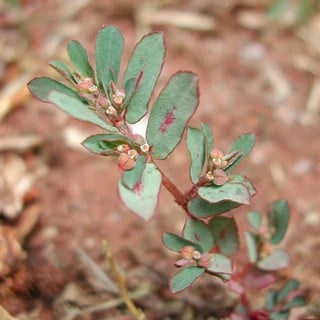
Spurge is a smaller plant. Its leaves are very small (around 1/4″) and have red splotches and margins. Spurge flowers are inconspicuous. Even in this close-up, you can barely see them nestled among the leaves.
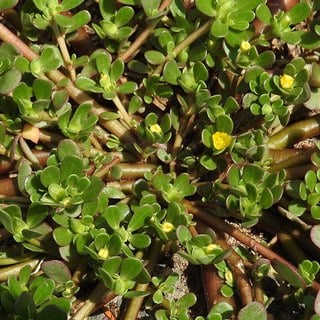
Compared to spurge, purslane is an overall bigger plant. It has larger, fleshy leaves that are uniformly green. Its flowers are small but obvious and look like buttercups.
Still unsure? Break off a small piece. Spurge exudes white sap, purslane does not.
As an Amazon Associate, Southwest Gardener earns from qualifying purchases, at no cost to you.
See our Terms of Use for details.
Did you enjoy this article?
Sign up for our weekly newsletter
where you’ll find more great info on creating &
maintaining a beautiful, carefree desert landscape.
Author Bio
Deane Alban is the creator of Southwest Gardener. She is a science writer with a bachelor’s degree in botany from the University of South Florida. Gardening is her lifelong passion. She’s been gardening in Tucson for over 16 years.

Photo Credits
Robert Flogaus-Faust, CC BY 4.0, via Wikimedia Commons
Max Licher, CC BY-SA, SWBiodiversity.org
Robert Flogaus-Faust, CC BY 4.0, via Wikimedia Commons