
There are three plants commonly grown as annuals that go by the interchangeable common names “purslane”, “portulaca”, and “moss rose” — it can be confusing! Learn the difference between them, once and for all. Knowing the correct name can be important, since one of these plants doesn’t have the same attributes as the others.

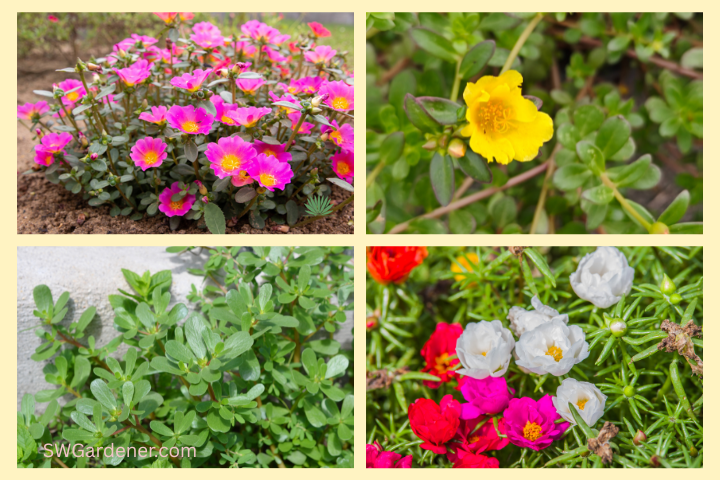
Ever since I was a teen in Florida, one of my favorite summer-time annuals was moss rose. I lived near a house that had a front yard full of them instead of a lawn! I thought it was the prettiest thing I’ve ever seen. 😍
Moss rose was the only common name I was familiar with. After I moved to Tucson, I heard them called purslane and portulaca, and discovered that other plants went by those common names, too. It was confusing!
So let’s do a quick rundown of the three plants with interchangeable common names — moss rose, portulaca, and purslane.
By the time you’ve finished this article, I guarantee you’ll know the difference between these three distinct plants, even when there’s a crossover between their common names. Then you can use this information to annoy impress your friends! 😉
Purslane, Portulaca, & Moss Rose Compared
The one thing these plants all have in common is that they all belong to the genus Portulaca, which is why they’re sometimes called portulaca as their common name.
Let’s start with the two that are highly valued ornamentals — moss rose and ornamental purslane. Then we’ll look at the edible species, common purslane.
Note that all are toxic to dogs, cats, and horses due to the presence of calcium oxalates.
Moss Rose (Portulaca grandiflora)
Moss roses are low-growing annuals that love heat and sun, and are usually grown in groups in containers. They have small, ruffled rose-like flowers that come in an array of vivid colors.
Their leaves are fine and needle-like, which sets them apart from the other Portulacas.
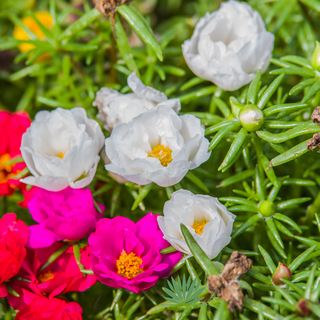
While most moss roses sold at nurseries are hybrids, the parent plant is native to the southern half of South America.
Ornamental Purslane (Portulaca oleracea)
Like moss rose, ornamental purslane is a low-growing, sun loving annual usually grown as a container plant. But if you look closely, you’ll see it differs in some noticeable ways.
Purslane has small, brightly colored buttercup-like flowers. And their leaves are oval and fleshy rather than thin.
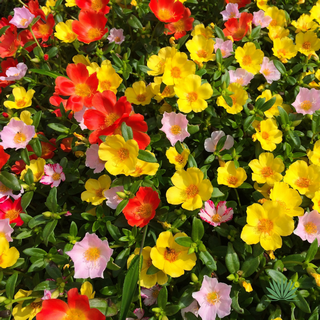
Ornamental purslane comes in a variety of cultivars which are often patented and/or trademarked, such as Monrovia’s Mega Pazzaz™ series.
The parent plant of these cultivars is almost always common purslane. However, there are a few exceptions. Some ornamental purslanes are cultivars of wingpod purslane (Portulaca umbraticola), such as Proven Winners Mojave® Pink.
When you go shopping for purslane, you’ll often see a label that looks like this.
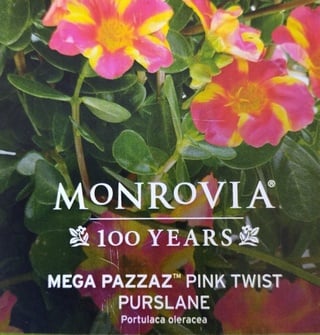
You’ll notice that the cultivar name — Mega Pazzaz Pink Twist Purslane — takes priority over the scientific name, which is in very fine print.
Common Purslane (Portulaca oleracea)
Common purslane (Portulaca oleracea) goes by many other common names including garden purslane, purslane, wild portulaca, duckweed, little hogweed, and pursley. It’s unlikely that you’d mistake it for its ornamental offspring. It has smaller leaves and flowers that are always yellow and would never be called “showy”.
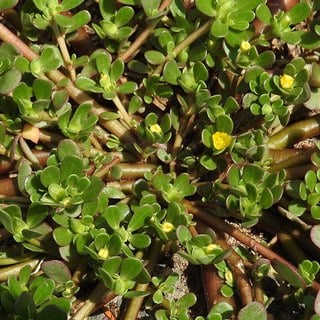
It’s understandably confusing that this unimpressive-looking weed and the floriferous ornamental are the same species, but different-looking plants belonging to the same species is not unheard of. For example, all cruciferous vegetables — broccoli, cauliflower, cabbage, Brussels sprouts, kale, and collards — are varieties of the same species, Brassica oleracea.
Common purslane is native to Europe, Africa, and the Middle East, and has naturalized in almost every country in the world, and in every state in the continental US.
Here in desert gardens, it’s considered both an annual weed and a summer crop. It is sometimes grown as a particularly nutritious green leafy vegetable that can be eaten raw or cooked. Some gardeners “forage” it from their yard, since it literally grows like a weed.
And yet, paradoxically, it’s also considered a noxious and invasive pest.
Here’s what the University of Arizona has to say about this plant:
This plant is a nuisance in landscapes, gardens and agricultural fields. It easily outcompetes more desirable native species, reducing native plant diversity and the pollinators and wildlife, which are dependent on them.
The National Park Service reports invasive pockets of purslane in the southwest at Chiricahua National Monument (AZ), Death Valley National Park (CA), and Lake Mead National Park (NV).
Common purslane was on the Arizona Noxious Weed List, but as of 2023, has been dropped from the list.
A Final Word
Note that if you plant or encourage existing purslane in your garden, it may become an aggressive pest. (Reseeding is not a problem with ornamental purslane or moss roses, which are well-behaved in desert gardens.)
If you’re growing purslane to eat, stick with common purslane. Ornamental purslanes were bred for their beauty, not their flavor or nutritional content.
I suggest you look into growing golden purslane, a cultivated variety that was developed to be particularly tasty, nutritious, and easy to harvest. Native Seeds/SEARCH and Spadefoot Nursery sell golden purslane seeds. You can order them online and have them shipped, no matter where you live. If you’re in Tucson, you can stop by and pick them up.
Did you enjoy this article?
Sign up for our weekly newsletter
where you’ll find more great info on creating &
maintaining a beautiful, carefree desert landscape.
Author Bio
Deane Alban is the creator of Southwest Gardener. She is a science writer with a bachelor’s degree in botany from the University of South Florida. Gardening is her lifelong passion. She’s been gardening in Tucson for over 16 years.

Photo Credit
Robert Flogaus-Faust, CC BY-SA 4.0, via Wikimedia Commons