
Looking to add more shade to your desert garden but are daunted by the potential mess? Enjoy your garden more and stress less with this assortment of trees that thrive in the desert and are very low litter.

Having lived in homes with some seriously messy trees, I can appreciate the desire to have low litter trees, especially if you have a pool.
First, let’s set some realistic expectations. Low litter does not mean no litter. Any living tree will produce some litter. Even a tree that is evergreen will still shed some older leaves from time to time.
Obviously, if you want low litter, avoid deciduous trees. By definition, they lose all their leaves every year. However, not all leaves are equally messy. Many desert trees have tiny leaves (i.e., mesquites, palo verdes) that are inconspicuous and disintegrate into gravel or ground covers, barely noticed. But you will notice them if they land on pavers or in your pool. Other trees have large, leathery leaves that get stuck on every rock and spikey plant, and can take many seasons to break down if not removed.
But leaves aren’t the only source of litter…
More than Leaves: Flowers, Fruits, & Pods
If you’ve previously lived where large deciduous trees were the norm, you may equate tree debris with leaves. But here in the desert Southwest, leaves aren’t the only source of litter. Many trees produce messy flowers, seed pods, or fruits as well.
Texas olive is an example of a messy evergreen tree. It has large flowers and olive-like fruit that stain hard surfaces and attract insects when left on the ground.
Palo verdes have inconspicuous leaves, but some people don’t want to contend with the blanket of yellow flowers in the spring.
And as anyone who has grown a native velvet mesquite will attest, they drop pods by the thousands.
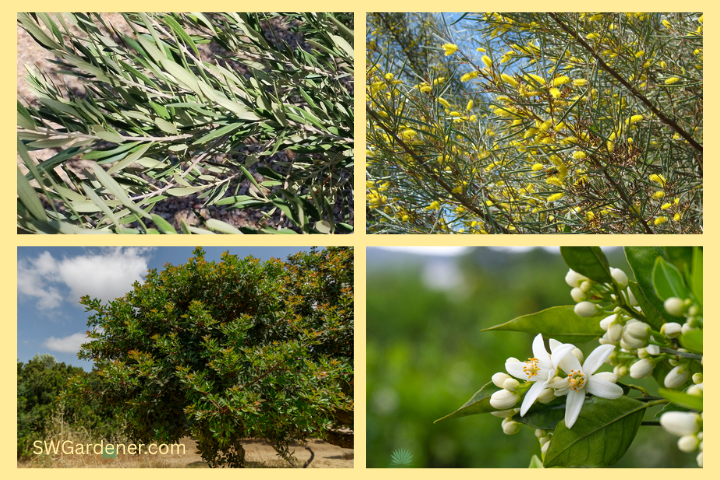
So, with that in mind, here are some trees that pass the test of being “clean” and readily handle the desert’s temperature extremes, sun, and aridity.
To learn more about any of these trees,
click on the link to find a comprehensive “Growing Guide”.
Mastic Tree
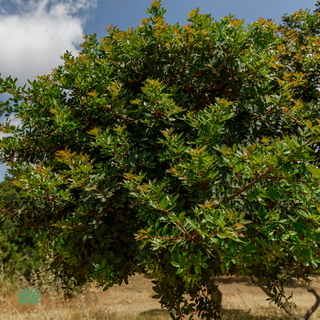
Mastic tree (Pistacia lentiscus) is widely considered the “cleanest” tree you can grow in the desert Southwest. It also happens to be beautiful!
In its native habitat, dry regions of the Mediterranean, it grows as a large, evergreen shrub. But here, it’s commonly trained to grow as a medium size, multi-trunk tree.
Mastic has small, leathery, deep green leaves and a dense, rounded crown. Its flowers are inconspicuous, and since it’s dioecious (i.e., separate male and female plants), you’ll only get berries if you have a female plant and there’s a male plant nearby. This is easy to avoid.
Mastic Tree Summary
| Common Names | Mastic tree, mastic |
| Scientific Name | Pistacia lentiscus |
| Origin | Mediterranean |
| USDA Zones | Zones 9 – 11 |
| Cold Hardiness | To 15℉ |
| Mature Size | 15-25’ tall & wide |
| Sun Tolerance | Full, reflected sun |
| Water Needs | Low |
Fruitless Olive
Fruitless olive (Olea europaea ‘Wilsonii’) is a medium size evergreen tree with silvery-green leaves that shimmer in the breeze. It has sterile, inconspicuous flowers that don’t produce olives, making it non-allergenic and nearly litter-free.
It’s a cultivar of “true” olive trees (Olea europaea) that was developed largely in response to regional bans. Olive trees have been banned for decades in Pima County (Tucson), Clark County (Las Vegas), and several municipalities in the Phoenix area due to their being highly allergenic.

Fruitless Olive Summary
| Common Name | Fruitless olive |
| Scientific Name | Olea europaea ‘Wilsonii’ |
| Origin | Mediterranean, Asia, Africa (cultivar) |
| USDA Zones | Zones 9 – 11 |
| Cold Hardiness | To 15℉ |
| Mature Size | 25’ tall & wide |
| Sun Tolerance | Full, reflected sun |
| Water Needs | Low |
Mulga Acacia
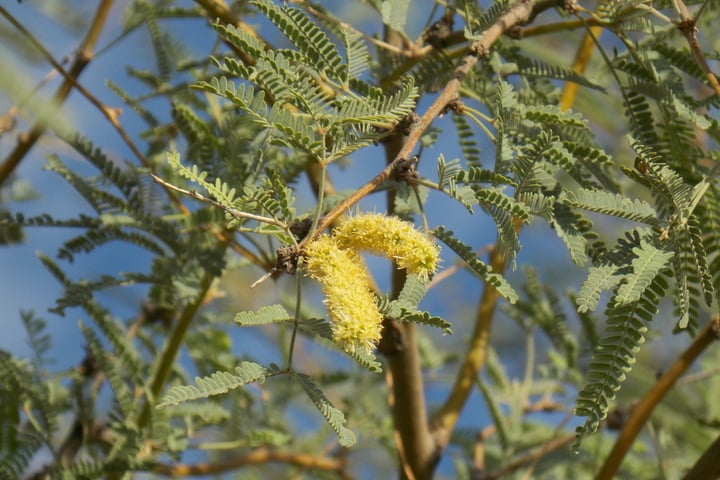
Mulga acacia (Acacia aneura) is an evergreen tree native to Australia. It has thin silver-gray leaves that almost look like they’re coated with frost. Fuzzy yellow flowers (catkins) are followed by small, flat “barely there” seed pods that are less than an inch long.
This tree is native to the harsh, dry outback, and is as tough as you’d expect. Here it thrives in the harshest conditions, such as parking lots and median strips.
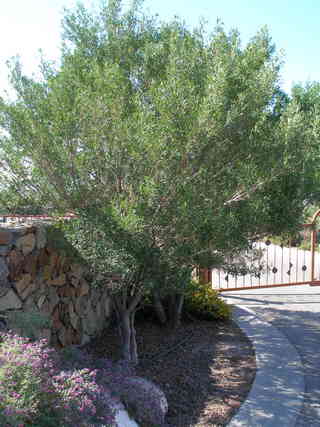
It can be trained to grow as a single-trunk tree, as in the picture below.

Mulga Acacia Summary
| Common Names | Mulga, mulga acacia |
| Scientific Name | Acacia aneura |
| Origin | Australia |
| USDA Zones | Zones 8 – 11 |
| Cold Hardiness | To 15℉ |
| Mature Size | 20’ tall x 15’ wide |
| Sun Tolerance | Full, part, reflected sun |
| Water Needs | Low |
Little Leaf Ash
Little leaf ash (Fraxinus greggii) has small, bright green leaves, inconspicuous flowers, and small winged fruit. It makes a lovely, low litter, low maintenance addition to desert gardens. It needs minimal pruning and is drought-tolerant once established.
While ashes are normally thought of as trees, this species can be grown as either a small tree or a shrub, depending on how it’s pruned.
This Chihuahuan Desert native attracts bees and butterflies. It’s a larval host plant for a few species of butterflies, and birds enjoy the seeds.
Little Leaf Ash Summary
| Common Name | Little leaf ash |
| Scientific Name | Fraxinus greggii |
| Origin | Texas, Mexico |
| USDA Zones | Zones 7 – 10 |
| Cold Hardiness | To 10℉ |
| Mature Size | 15-20’ tall x 10-15’ wide |
| Sun Tolerance | Full, part sun |
| Water Needs | Low to moderate |
‘Leslie Roy’ Mesquite
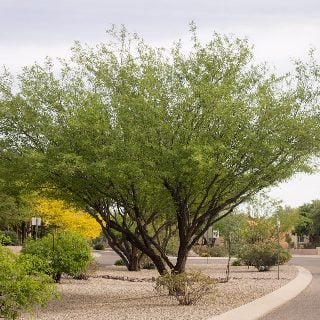
‘Leslie Roy’ mesquite (Prosopis ‘Leslie Roy’) is a cross between velvet mesquite, a Sonoran Desert native, and Chilean mesquite. It was developed by Tucson’s Civano Growers, and provides a few significant benefits over either of the parent trees.
Unlike most mesquites, this patented hybrid is thornless and has very few seed pods. (Some mesquites drop thousands of pods every summer.)
Its fern-like foliage casts dappled shade, a welcome feature in any desert garden. It grows fast by several feet per year, which is important when you’re longing for shade.
‘Leslie Roy’ is the mesquite I chose to be the centerpiece of my backyard.
‘Leslie Roy’ Mesquite Summary
| Common Name | ‘Leslie Roy’ mesquite |
| Scientific Name | Prosopis ‘Leslie Roy’ |
| Origin | Sonoran Desert/ South America (hybrid) |
| USDA Zones | Zones 7 – 11 |
| Cold Hardiness | To 10℉ |
| Mature Size | 25’ tall & wide |
| Sun Tolerance | Full sun |
| Water Needs | Low |
‘Civano Seedless’ Mesquite
Civano Growers has recently introduced another mesquite hybrid called ‘Civano Seedless’ (Prosopis chilensis ‘Civano Seedless’ PPAF) that produces no flowers or pods. (The PPAF means a patent has been applied for.)
I’ve seen these trees at their nursery. They look almost identical to ‘Leslie Roy’ and have the same care requirements. You can learn more about this tree on the Civano Growers website.
Citrus Trees
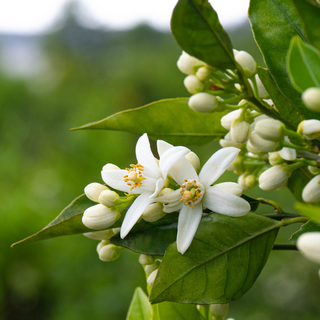
You might be surprised to see citrus trees on this list, but they are surprisingly low litter. They’re evergreen, and the only litter they occasionally produce is to shed immature fruit they can’t support in the spring.
Citrus trees (Citrus x spp.) — lime, lemon, orange, & grapefruit — make a nice change of pace from the other low litter trees. They have relatively large, true-green leaves, fragrant flowers, and, if all goes well, edible fruit.
And of course, you’ll have to harvest the fruit when it’s ripe. But if picking fruit isn’t your idea of fun, you’ll have no problem finding someone to harvest your fruit for you. Here in Arizona, Iskashitaa Refugee Network will come to your home, harvest your fruit, and distribute it to hunger relief organizations across the state.
When you go citrus tree shopping, you’ll find dozens of types to choose from. If you’re new to growing citrus, you’ll find expert advice from an Arizona Master Gardener in How to Grow Citrus in Arizona: A Complete Guide.
It’s important that you pick a tree that’s right for the spot you have in mind. Variables to consider include mature tree size, sun exposure, cold-hardiness, and whether or not you enjoy the fruit.
Low Litter Tree Roundup
You may have noticed some things these low litter trees have in common that may or may not be to your liking:
- They’re small to medium size, not large shade trees.
- They’re naturally multi-trunk rather than single trunk trees.
- They usually have small leaves.
- Except for little leaf ash, they are not Southwest natives and do little to support native wildlife.
After reviewing these options, you may find that these trees might not meet your other criteria or conclude that sticking with truly low litter trees may be too restrictive. If you were hoping for a large, single-trunk shade tree, showy flowers, colorful fall leaves, or really have your heart set on a native tree, you may have to expand your search and accept that you’ll have to contend with some litter.
For more tree options,
check out our Desert Plant Library.
Did you enjoy this article?
Sign up for our weekly newsletter
where you’ll find more great info on creating &
maintaining a beautiful, carefree desert landscape.
Author Bio
Deane Alban is the creator of Southwest Gardener. She is a science writer with a bachelor’s degree in botany from the University of South Florida. Gardening is her lifelong passion. She’s been gardening in Tucson for over 16 years.
