
Flame acanthus is a delightful, colorful shrub that isn’t as well-known as similar-looking shrubs, but it’s worth seeking out. Its orange-red flowers make it wildly attractive to hummingbirds. Here’s everything you need to know about growing this Chihuahuan Desert native in this complete care guide.

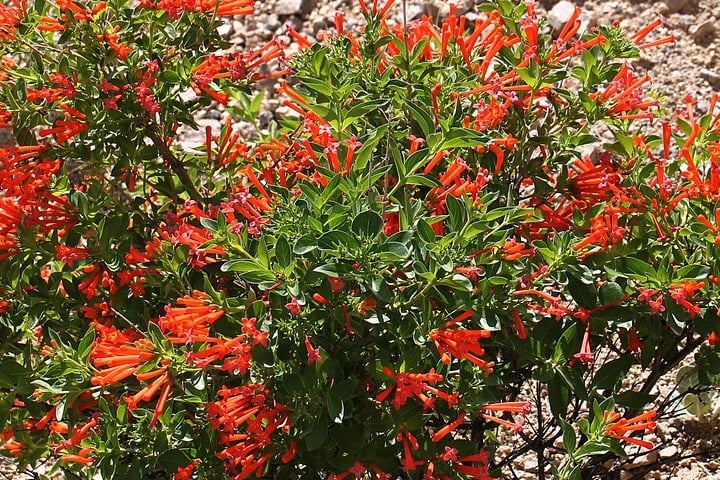
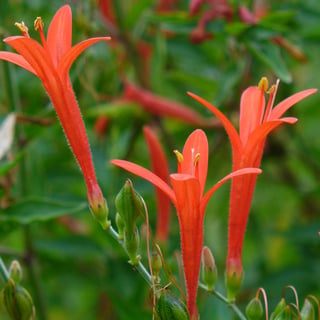
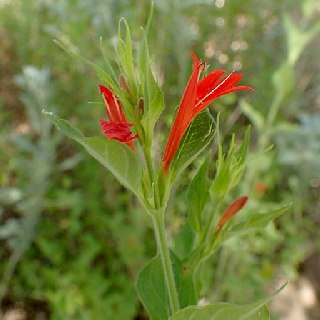
Flame acanthus (Anisacanthus quadrifidus) is a medium size, deciduous shrub that has an upright, airy form. Spring through fall, its vivid, red-orange tubular flowers make a striking contrast against the backdrop of bright green leaves.
Hummingbirds are so attracted to this plant’s red-hot flowers that one of its other common names is hummingbird bush.
As a native of the Chihuahuan Desert, it’s well-equipped to handle desert temperature extremes and drought. It makes a lively, low maintenance addition to desert gardens.
Deer, rabbits, and javelinas usually leave this plant alone.
Why I Like This Plant
- Vivid red-orange flowers spring through fall
- Low maintenance
- No thorns, non-toxic
- Attracts hummingbirds, butterflies
Things to Watch Out For
Flame acanthus drops its leaves in fall and doesn’t look like much until the following spring, so plant it where its visual presence won’t be missed in the winter.
It grows well in most well-draining soils, but it doesn’t like heavy clay.
Optimal Growing Conditions
If you’re thinking of adding a flame acanthus to your garden, you need to find a suitable place that will keep your plant healthy and looking good… while minimizing maintenance for you.
Here are the key factors to keep in mind.
Temperature
Flame acanthus should be grown in USDA Hardiness Zones 7 to 10. It’s tolerant of extreme heat and can handle the intense heat of Phoenix. It survives cold down to the 10℉ or even lower. It is deciduous, but during mild winters, it may keep its leaves. In the coldest parts of its range, it will die back to the roots and reemerge in the spring.
Sun Exposure
Flame acanthus grows in full sun to part shade, but it blooms best in full sun.
Size and Growth Rate
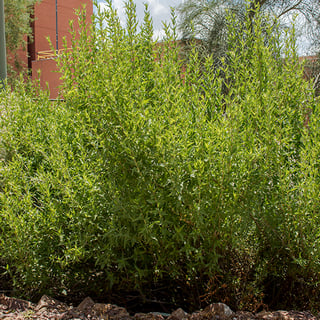
Flame acanthus grows at a moderate rate and typically reaches a size of 3 to 5 feet tall and wide. Its growth rate and ultimate size depend on how much water it receives and whether it dies back in the winter.
It generally blooms from June to October, most heavily in spring and then again in late summer. As with other xeric plants, it will bloom in response to rain.
Soil
In its native habitat, flame acanthus grows along rocky banks and in floodplains. In desert gardens, it grows in any soil type — loam, sand, gravelly, clay, and even caliche — provided it’s well-draining. But avoid planting in heavy clay.
Flame Acanthus:
The Essentials
| Common Name | Flame acanthus |
| Scientific Name | Anisacanthus quadrifidus |
| Origin | Texas, Mexico |
| Plant Type | Deciduous shrub |
| USDA Zone | Zone 7 – 10 |
| Cold Hardiness | To 10℉ |
| Flower Color | Red-orange |
| Flower Season | Spring, summer, fall |
| Mature Size | 3-5’ tall & wide |
| Growth Rate | Moderate |
| Sun Tolerance | Full, part sun |
| Water Needs | Low to moderate |
| Pests & Diseases | None |
| Garden Friendly | No thorns, non-toxic |
| Wildlife | Attracts butterflies, hummingbirds |
How to Plant
The rule of thumb when planting any shrub in the desert is to dig a hole three times as wide as the root ball but no deeper.
Amending the soil is not recommended. Counterintuitively, backfilling with the same native soil you just dug up helps your plant develop a stronger root system.
When to Plant
The best time to plant flame acanthus is in the fall. This gives it three seasons to grow roots and get established before the following summer.
The second best time is in spring, the earlier the better. This still gives it time to get established before the intense heat of June arrives.
Where to Buy
You almost certainly won’t find this plant at big box stores, but you should find it for sale at nurseries that specialize in native plants or that have a native plant section. I’ve seen them for sale at Spadefoot Nursery (Tucson) and Four Arrows Garden (Vail).
If you can’t find this plant near you and enjoy starting plants from seeds, you can find seeds at PlantFlowerSeeds.com.
How to Care for Flame Acanthus
Whether you’ve recently planted a flame acanthus or have an existing plant in your yard, here’s how to take care of it to keep it healthy and looking its best.
How to Water New Plants
Once you’ve got your shrub in the ground, watering is your most immediate concern. Here is the recommended watering schedule for new shrubs planted in the spring or fall.
| Weeks 1 & 2 | Every 3 – 4 days |
| Weeks 3 & 4 | Every 5 – 7 days |
| Weeks 5 & 6 | Every 7 – 10 days |
| Weeks 7 & 8 | Every 10 – 14 days |
After week 8, gradually revise your watering schedule, depending on the season.
How to Water Established Plants
As your shrub gets established, water every one to two weeks from late spring to early fall and every three to four weeks in winter. While flame acanthus is drought tolerant, it looks better and has more flowers and a longer bloom season with appropriate supplemental water.
Should You Fertilize?
There is no need to fertilize flame acanthus, but you may want to top dress with organic mulch or compost to improve drainage and soil fertility. This is especially helpful if you’re trying to grow it in clay soil.
How to Prune
Flame acanthus doesn’t need regular maintenance pruning. Remove any cold damage and lightly trim to shape in late winter to early spring. If your plant dies back in the winter, cut it down to 6 to 12 inches to promote bushiness and flowering.
All plants benefit from a severe rejuvenation prune every few years. Do this in the spring just before new growth appears. Don’t prune it in late summer, which can reduce the number of fall flowers.
Don’t Confuse Flame Acanthus With…
Flame acanthus is sometimes confused with other shrubs with small, tubular, red flowers, especially chuparosa (Justicia californica) and red justicia (Justicia candicans).
It also gets confused with firecracker bush (Hamelia patens), with which it shares the common name hummingbird bush.
If one of your gardening goals is to support hummingbirds, you won’t go wrong with any of these shrubs. All are highly attractive to hummingbirds.
Recommended Reading:
The Best Hummingbird Plants for Desert Gardens
Plant Lover Facts
Flame acanthus goes by a mind-boggling number of common names including flame anisacanthus, hummingbird bush, desert honeysuckle, Wright’s desert honeysuckle, Wright’s acanthus, Wright acanthus, Wright’s Mexican flame, Mexican flame, and Texas firecracker. Phew!
Flame acanthus is native to west and south-central Texas and adjacent northern Mexico. It’s referred to by two scientific names — Anisacanthus quadrifidus and Anisacanthus quadrifidus var. wrightii — depending on where it grows.
The species, Anisacanthus quadrifidus, is native to southern Mexico. The variety Anisacanthus quadrifidus var. wrightii is found in the northern part of this plant’s range — from Texas into northern Mexico. At one time, the variety was known as Anisacanthus wrightii, in honor of Charles Wright, an American surveyor, teacher, and botanist.
Did you enjoy this article?
Sign up for our weekly newsletter
where you’ll find more great info on creating &
maintaining a beautiful, carefree desert landscape.
Author Bio
Deane Alban is the creator of Southwest Gardener. She is a science writer with a bachelor’s degree in botany from the University of South Florida. Gardening is her lifelong passion. She’s been gardening in Tucson for over 16 years.

Photo Credits
The University of Arizona Campus Arboretum
Scott, CC BY 2.0, via Wikimedia Commons
Vince Hale, CC0, iNaturalist
Krzysztof Ziarnek, Kenraiz, CC BY 4.0, via Wikimedia Commons