
Desert willow is a delightful, drought-tolerant ornamental tree with pink orchid-like flowers that attract bees and hummingbirds. Here’s everything you need to know about planting and caring for this native that grows along washes of the Southwest’s three deserts.

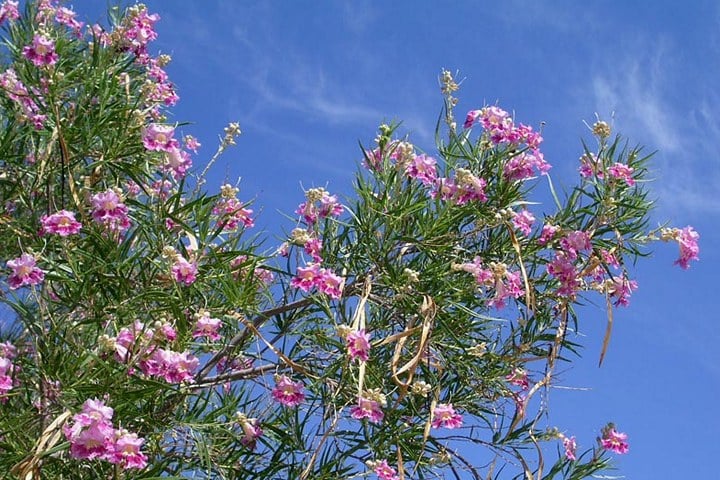
Desert willow (Chilopsis linearis) is a medium size, deciduous ornamental tree that looks too pretty to be a tough native of the Sonoran, Mojave, and Chihuahuan Deserts.
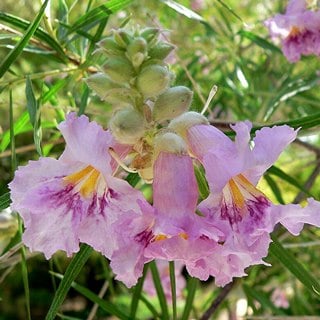
Desert willow has long, thin willow-like leaves, but it is not related to true willows. From spring through late summer, it’s covered with large, pink orchid-like flowers. Flowers are followed by skinny, dangling seed pods.
Desert willow needs little water. In its native environment, it survives on 4 to 33 inches of annual rainfall.
It’s an excellent tree for supporting wildlife. It’s a top tree for attracting hummingbirds. Quail and finches eat the seeds while orioles and verdins perch and nest in the branches. Deer and rabbits nibble on any new suckers that shoot up at the tree’s base.
Why I Like This Plant
- Exceptionally attractive native tree
- Lightly fragrant, orchid-like flowers
- Low water use
- No thorns, non-allergenic, non-toxic
- Attracts hummingbirds, bees
Things to Watch Out For
Even though desert willow naturally grows as a large shrub, when grown as a landscape plant, it is almost always grown as a tree.
This means you’ll have to prune it frequently to get and keep the shape you desire. And since plants produce copious numbers of suckers at the base as they try to revert to their natural shrub-like form, you can expect to be pruning these frequently, too.
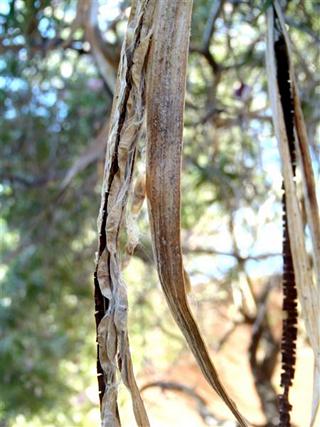
Desert willow is a messy deciduous tree. Besides losing leaves, it also drops flowers and large seed pods that are 6 to 10 inches long.
Be aware that while desert willow is a stunner in the spring and summer, it doesn’t look like much from November through March. I’ve heard it described as “sticks and seeds”. When the branches are bare, there’s nothing to hide the persistent seed pods, which some people find unattractive.
Optimal Growing Conditions
If you’re thinking of adding a desert willow to your garden, you need to find a suitable place that will keep your plant healthy and looking good… while minimizing maintenance for you.
Here are the key factors to keep in mind.
Temperature
Desert willow should be grown in USDA Hardiness Zones 5 to 10. It’s tolerant of desert heat and cold, and can withstand temperatures down to -10℉.
Desert willow is more cold hardy than originally thought and has naturalized as far north as Kansas and Oklahoma!
Sun Exposure
Desert willow thrives in full sun. It will tolerate some part shade from a building or neighboring tree, but ideally should get at least six hours of full sun per day.
Size and Growth Rate
Desert willow is considered a moderate to fast grower. It generally grows quickly when young and then slows down with age. When mature, desert willows are typically 25 feet tall and wide, but size can range from 15 to 35 feet, depending on how much water a plant receives.
Soil
Desert willow’s preferred soil is well-drained limestone soils, but it also grows well in sandy or rocky soils, and even caliche.
Desert willow can be grown in clay soil, but won’t grow as fast or get quite as large, and root rot can be a concern if overwatered.
Other Location Considerations
Desert willow has no thorns and is non-toxic, so you can feel comfortable planting it where it might come in contact with people and pets.
Since it’s a messy tree that sheds leaves, flowers, and pods, avoid planting near a pool, driveway, or any other area you want to stay litter-free.
Desert Willow:
The Essentials
| Common Name | Desert willow |
| Scientific Name | Chilopsis linearis |
| Origin | Sonoran, Mohjave, Chihuahuan Deserts |
| Plant Type | Deciduous tree |
| USDA Zones | Zones 5 – 10 |
| Cold Hardiness | To -10℉ |
| Flower Color | Pink |
| Flower Season | Spring, summer, fall |
| Mature Size | 25’ high & wide |
| Growth Rate | Moderate |
| Sun Tolerance | Full, part sun |
| Water Needs | Low |
| Pests & Diseases | Root rot if overwatered |
| Garden Friendly | No thorns, non-toxic, non-allergenic |
| Wildlife | Supports bees, hummingbirds |
How to Plant
The rule of thumb when planting any tree in the desert is to dig a hole three times as wide as the root ball but no deeper.
Amending the soil is not recommended. Counterintuitively, backfilling with the same native soil you just dug up helps your desert willow develop a stronger root system.
When to Plant
The best time to plant desert willow is in the fall. This gives it three seasons to grow roots and get established before the following summer.
The second best time is in spring, the earlier the better. This still gives it time to get established before the intense heat of June arrives.
How to Care for Desert Willow
Whether you’ve recently planted a new desert willow or have an existing one in your yard, here’s how to take care of it to keep it healthy and looking its best.
How to Water New Plants
Once you’ve got your desert willow in the ground, watering is your most immediate concern. Here is the recommended watering schedule for new trees planted in the spring or fall.
| Weeks 1 & 2 | Every 3 – 4 days |
| Weeks 3 & 4 | Every 6 – 7 days |
| Weeks 5 & 6 | Every 7 – 10 days |
| Weeks 7 & 8 | Every 10 – 14 days |
After week 8, gradually revise your watering schedule, depending on the season.
How to Water Established Plants
As your tree becomes established, there are two watering factors to consider.
- First is how often to water. This will vary with the seasons.
- Second is how much water to give your tree with each watering. This depends on its current size.
To determine the ideal watering schedule for any desert tree, you’ll find everything you need to know, including easy-to-use charts, at How to Water Desert Trees: How Often? How Much?
Overwatering desert willow can be surprisingly detrimental. It promotes overly rapid growth, resulting in a weaker tree that is more prone to root rot and insect damage. Too much water also results in fewer flowers.
Should You Fertilize?
Since the desert willow specimens you find at nurseries are often small, you might be tempted to hurry it along with fertilizer… but don’t. Just as too much water results in overly rapid growth, so does fertilizing.
Fertilizing, like overwatering, results in fewer flowers and a weaker tree that is more susceptible to wind damage.
Pro Tip!!
For maximum blooms, don’t pamper your desert willow.
Don’t fertilize it or give it too much water.
How to Prune
In their natural habitat, desert willows are multi-branched and look more like a shrub than a tree.
With the right pruning, a desert willow can be shaped into a multi-trunk tree (preferred) or even trained to grow as a more conventional single-trunk “lollipop” tree (not recommended).
Pruning is not recommended for the first two to three years after you plant your tree.
When you prune, do it when the tree is bare before new spring leaves appear.
If you’re unsure about how to create the shape tree you want, I strongly urge you to hire a professional. Hiring an arborist (not a so-called “landscaper”) to get your tree off to the right start is an excellent investment that will result in a beautiful tree that will be a source of joy for decades to come.
When the inevitable suckers sprout at the base, you can remove them whenever they appear. My arborist recommends pinching them off with your fingers when they are very small to minimize trunk scarring.
Desert Willow Cultivars
Desert willow is available in many cultivars, the most popular being the ‘Bubba‘ series. These trees vary in flower color, leaf shape, and the size and persistence of pods.
Desert willow ‘Bubba’ has large, fragrant pink and purple flowers, and produces fewer seed pods than the parent plant.
Desert willow ‘Bubba Jones’ is a patented cross of two desert willow cultivars — ‘Bubba’ and ‘Warren Jones’. It has brilliant bubblegum pink flowers.
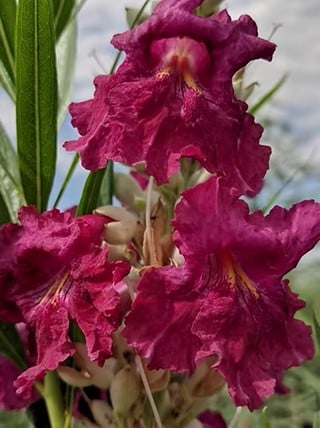
Desert willow ‘Sweet Bubba‘ has magenta flowers that are larger than those of the other cultivars. Additionally, it’s seedless, making it a great choice for those who don’t want seed pods.
If you’re wondering about the unusual cultivar name ‘Bubba‘, here’s the backstory…
Warren Jones was a key figure in the development of the University of Arizona Campus Arboretum. He discovered the first wild desert willow selection, which was named ‘Warren Jones‘ in his honor. The ‘Bubba‘ desert willows were named after his nickname “Bubba” in his honor, too.
But ‘Bubbas‘ aren’t the only desert willow cultivars. Here are some other less common ones you may come across, and their flower color:
- ‘Art’s Seedless‘ – rose pink (no seed pods)
- ‘Lois Adams‘ – pink flowers (few seed pods)
- ‘Lucretia Hamilton‘ – deep pink to purple
- ‘Regal’ – deep pink-purple
- ‘Warren Jones‘ – deep pink-purple
- ‘White Storm‘ – white
How to Buy a Desert Willow on a Budget
If you live in Tucson, desert willow ‘Bubba’ cultivars are among the selections offered in the TEP (Tucson Electric Power) Trees for You Program. If you’re a TEP customer, you’ll have the opportunity to order two 5-gallon plants for $5 in spring and fall.
Plant Lover Facts
Desert willow (Chilopsis linearis) is not related to willow trees (genus Salix). It gets this name from its long, thin willow-like leaves. Ironically, willows are known for being thirsty, while desert willow is particularly drought-resistant.
Chilopsis is a monotypic genus — Chilopsis linearis is its only member.
I’ve seen a few other common names for it in writing (flowering willow, willow-leaved catalpa, willowleaf catalpa, bow willow, etc.), but in real life I’ve never heard this tree called anything other than desert willow.
It is native to Arizona, California, Nevada, New Mexico, Texas, Utah, and Mexico. It grows in desert arroyos — dry creek beds that temporarily fill with water after heavy rains. Each rain gives the desert willow a good soaking, and it responds with a spurt of new growth and new flower clusters. In its native habitat, a desert willow can have two or three growth spurts during the summer.
Native Americans put this plant to good use. They used the wood and branches to make house frames, cradleboards, fence posts, bows, and baskets. They used the bark to make clothing and nets. They ate the blossoms and seeds, and made a medicinal tea from the bark.
Did you enjoy this article?
Sign up for our weekly newsletter
where you’ll find more great info on creating &
maintaining a beautiful, carefree desert landscape.
Author Bio
Deane Alban is the creator of Southwest Gardener. She is a science writer with a bachelor’s degree in botany from the University of South Florida. Gardening is her lifelong passion. She’s been gardening in Tucson for over 16 years.
