
Tired of moving heavy planters? Spending too much on potting soil? Pots having drainage problems? Try cachepots. This “pot within a pot” concept can solve these and many other problems when growing plants in containers.
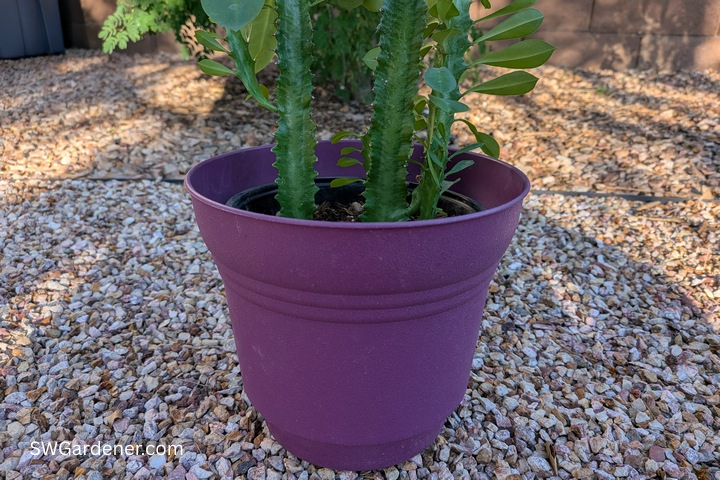
Potted plants are an important design feature in desert gardens. It’s common to see annual flowers, dwarf trees, and succulents of all kinds growing in containers as eye-catching focal points. But there are some problems with growing plants in pots.
The intense desert sun can easily overheat plants in pots, which is why large planters are recommended. But large planters are big and heavy, and require loads of potting soil to fill. Many potted plants, especialy annuals and succulents, have shallow root systems and don’t need all that soil. In fact, many low water use plants prefer relatively crowded roots, which helps prevent overwatering.
This is where cachepots come in handy. Cache means “to hide” in French. Their use dates back hundreds of years. You put your plant in a utilitarian inner pot that is “hidden” inside a larger, decorative pot. Voila! Many potted plant problems are instantly solved. They were used mainly to be decorative and prevent water stains on furniture, but now they have many additional benefits, especially in the desert Southwest.
Benefits of a Cachepot: A Real Life Example
I use cachepots for many of my outdoor potted plants and houseplants. Let’s take a look at a real life example that illustrates some of their benefits.
A neighbor gave me this century plant offset. At the time, it was about 1 foot across and had a very small root system. (It’s twice that size now.)
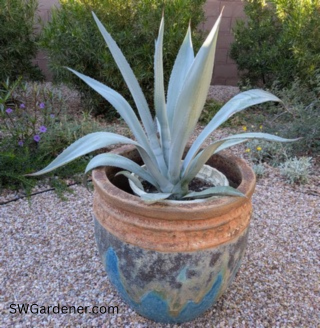
The usual way of planting would have meant filling this large, heavy, ceramic pot (18″ x 18″) with cactus & succulent mix. But instead, I planted it in a 4 gallon nursery pot, then placed it on a few old pavers to raise it to the level of the decorative pot.
Here’s a look at the benefits of using this cachepot setup compared to planting directly in a large pot:
🪴I used a fraction of the amount of potting soil. If you’re filling a large container with quality potting soil or cactus mix, you can easily spend as much on the soil as you did on the plant.
🪴The inner pot, a typical plastic nursery pot, has many drainage holes, compared to the one small hole in the bottom of the decorative pot. This greatly improves drainage and minimizes the chance of overwatering.
🪴The inner pot-plant combo is lightweight and flexible. I can easily pick it up if I want to check on the roots, move it to another location, or bring it under cover during bad weather.
🪴One day this century plant will outgrow the inner nursery pot. At that time I’ll decide whether to put it in a larger inner pot and/or move it to a different decorative pot. I may even plant it directly in the ground. But whatever I do, getting it out of its current pot will be a snap.
🪴This planter gets all day full sun. When the sun beats on the outer pot, it gets HOT — too hot to touch! But now there’s a layer of insulating air between the outer and inner pots, so the roots stay cooler in the summer. Additionally, I lined the edge of the inner pot with wide masking tape, because I didn’t want the new plant touching the hot black plastic. A more elegant and permanent solution would have been to spray paint it a light color, but so far this is working.
🪴This decorative pot is heavy. Even when empty, I can’t move it without help. So it stays where it is. I’ve had other plants in this pot, and when I want a change, I move the plant, not the pot.
You might be wondering, “Why not fill the bottom of the large pot with rocks, plastic bottles, or styrofoam peanuts, to take up space and then add cactus mix?” This is a popular, but misinformed idea that I’ll explain at the end of this article.
Pro Tip!
Garden centers & nurseries use cachepots to easily
switch out the plants they want to display, and so can you.
More Benefits of Cachepots
There are other situations where using a cachepot can provide additional benefits.
🪴Have you ever found a planter, or something you would love to use as a planter, that is inappropriate — no drainage holes, won’t hold water, or too valuable, fragile, or beautiful to fill with dirt? Use it as the outer, decorative pot.
🪴Have you ever had to choose between damaging a plant or breaking a pot when a plant has become too rootbound? I have. (I’m talkin’ about you, foxtail fern. 😉) That won’t happen with a cachepot setup. The worse case scenario is that you will have to cut the inner pot to get the plant out intact.
🪴Have you ever bought a plant and then didn’t have time to repot it or didn’t have the right planter for it? Or maybe you realized it was the wrong season to disturb it. Leave it in its original container and plop it in a decorative container. Your plant will look beautiful from the start, and neither you nor your plant will be stressed.
🪴Cachepots are particularly helpful for patio plants and houseplants. Some plants should be rotated for even growth. Rotating the inner pot is easy regardless of the size of the outer pot. Using a cachepot means no more unsightly plastic saucers that eventually get yucky with water, stains, and mineral deposits.
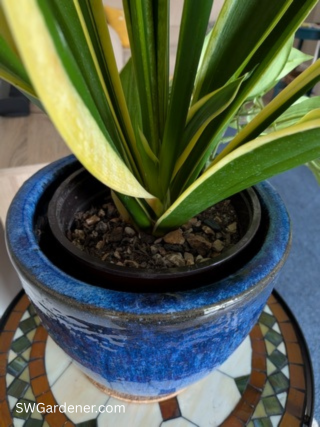
🪴You’ve probably heard that you should give succulents a good soak and then let them completely dry out. It’s easy to tell when the soil is dry with small pots — you can use your finger or a moisture meter. But when you’ve got a large pot, it’s hard to tell when the bottom has dried out. This can lead to overly wet conditions that can rot your plant.
🪴If your potted plant’s soil ever becomes hydrophobic (i.e., repels water), the remedy is to soak the whole pot in a bucket or large bin until it’s rehydrated. This is much easier to do with a smaller inner pot.
How to Make Your Cachepot Fit
Sometimes you’ll have two pots that are a perfect fit, and all you have to do is place one inside the other. This usually happens with smaller plants and pots, such as with my African milk tree below.
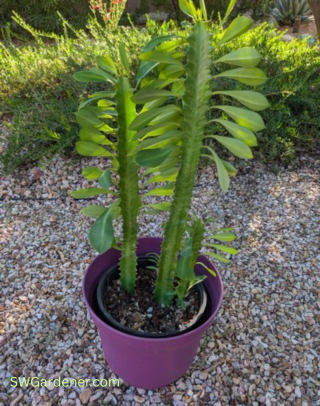
But if your decorative pot is large, you may need to raise the level of the inner pot or create a false bottom. Let’s take a look at both options.
Raise the Level
Think about the things that people already use as filler in their pots — plastic bottles, pieces of styrofoam, rocks, etc. You can use these to line the bottom of the outer pot and set the smaller pot on top. Be mindful that any lightweight materials such as plastic bottles may shift or crush from the weight if the plant is heavy.
I like to raise the level of the inner pot using nursery pots since I always have plenty of extras. You can nest your inner pot in a nursery pot or two until you get the height you want. Or you can place a sturdy nursery pot or an inexpensive terra cotta pot upside down and place the inner pot on top of it.
Create a False Bottom
Another option is to create a false bottom that acts as a shelf to set the inner pot on.
Depending on the size and shape of your pot, you can create your own false bottoms. Find something that fits snugly inside your pot to create a shelf that will hold the inner pot. I’ve used inexpensive plastic plates (Target sells 10″ plates for $.50), plant saucers, or Homer bucket lids. Note that if you use these, you’ll have to drill drainage holes.
If you aren’t into make-shift solutions, you can buy planter inserts designed specifically for that purpose. Bloem Up-a-Daisy planter inserts have drainage holes and come in a variety of sizes, both round and square.
Or you can buy pots with built-in false bottoms. I own a pair of these tall, square planters by Veradek. The one below is filled with happy lady slippers. You can set your inner pot on the built-in shelf, which is about one foot down and has pre-drilled drainage holes.
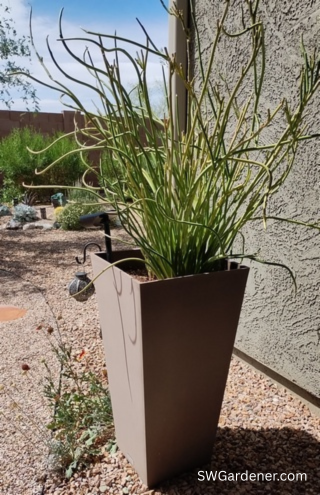
Tall narrow pots are attractive and very popular, but have a problem — they tend to blow over during strong winds. A simple solution is to put a few rocks, pavers, or bricks in the bottom to keep it upright. But don’t put them in the bottom of your inner pot. Here’s why…
Rocks in Pots — A Myth to Skip
As promised earlier, here’s a quick look at why you should skip putting rocks in the bottom of potted plants.

The theory is that putting rocks or gravel (or anything else) in the bottom of pots is “supposed” to increase drainage, but this is not what happens. It’s now understood that adding a layer of anything that isn’t potting soil actually impedes drainage and moves the wet zone up, closer to your plant’s roots. This is due to the competing forces of gravity and capillary action. For a deep dive into why this happens, check out my article Rocks in Your Pots: Don’t Do It!
As an Amazon Associate, Southwest Gardener earns from qualifying purchases, at no cost to you.
See our Terms of Use for details.
Did you enjoy this article?
Sign up for our weekly newsletter
where you’ll find more great info on creating &
maintaining a beautiful, carefree desert landscape.
Author Bio
Deane Alban is the creator of Southwest Gardener. She studied journalism and received a bachelor’s degree in botany from the University of South Florida. Gardening is her lifelong passion. She’s been gardening in Tucson for over 16 years.
