
African milk tree is a unique columnar succulent that’s lined with small leaves. It makes a particularly stunning container plant. Here’s everything you need to know about planting and caring for this low-maintenance African native.

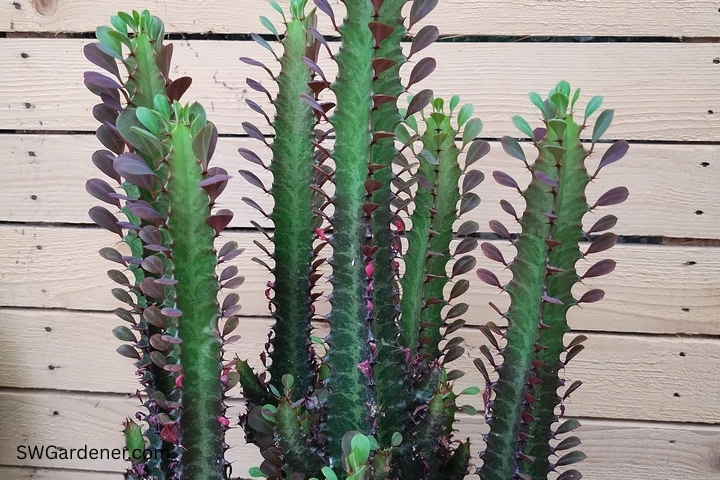
African milk tree (Euphorbia trigona) is a weirdly wonderful columnar succulent that makes an eye-catching focal point. Each 3 sided column is lined with short spines and small oval leaves. As it matures, it becomes tree-like, developing a corky trunk and a candelabra-shaped crown.
This low maintenance plant tolerates desert heat and aridity. It’s nearly litter free and rarely needs pruning. However, it’s not terribly cold hardy, which is why it’s often grown as a container plant.
It’s generally resistant to deer, rabbits, and javelinas.
Why I Like This Plant
- Dramatic specimen plant
- Adds architectural interest all year long
- Low maintenance
- Grows fast
- Spectacular container plant
- Deer, rabbit, javelina resistant
Things to Watch Out For
African milk tree does not like cold, and for this reason, is more commonly grown here as a potted plant than in the ground.
African milk tree gets its name from its milky white sap, which is toxic to humans, pets, and livestock, and can be irritating to the skin.
Large specimens are prone to falling over because they become top-heavy and have shallow root systems.
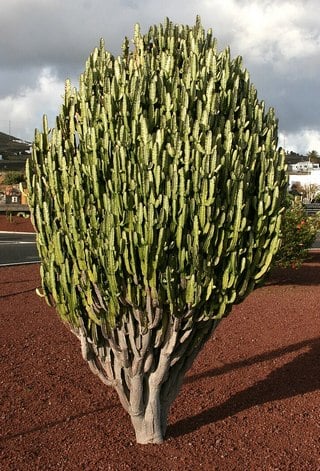
This plant offers no value to local wildlife. It rarely flowers in cultivation, and if it does, the flowers are inconspicuous and not attractive to our local pollinators. So if you want to support bees, hummingbirds, and other pollinators, there are better options such as tall slipper plant or Baja spurge. Both are native Euphorbias that support our local wildlife.
Optimal Growing Conditions
If you’re thinking of adding an African milk tree to your garden, you need to find a suitable place that will keep your plant healthy and looking good… while minimizing maintenance for you.
Here are the key factors to keep in mind.
Temperature
African milk tree can reliably be grown in USDA Hardiness Zones 10 and 11, and can be grown in Zone 9 (Tucson, Phoenix) with proper precautions. This heat lover is borderline cold tolerant in Zone 9. Even though it will survive brief dips into the upper 20s, it should be protected once the temperature hits freezing.
This plant’s ideal temperature range is a balmy 65 to 85℉(!) and some sources recommend bringing it indoors once the nighttime temperatures hit the 40s. But that is overly cautious. Many Southern Arizona gardeners successfully grow this plant on a protected patio.
Sun Exposure
African milk tree should be grown in full or part sun. It appreciates some filtered shade in the afternoon. If you grow one in a container, rotate it occasionally to keep it growing straight since it will lean towards the sun.
Size and Growth Rate
African milk tree is a fast grower. It typically reaches a size of 6 to 12 feet tall by 5 to 10 feet wide, but in its native habitat can grow much larger. When grown as a patio plant, its size will be somewhat controlled by the size of the container.
Soil
African milk tree prefers sandy soil but will grow in any desert soil, provided it’s well-draining.
If you grow one in a container, be sure it has good drainage and use specifically formulated cactus soil. Don’t be in a hurry to pot it up — it doesn’t mind being crowded.
Other Location Considerations
Since African milk tree is toxic and can be irritating to touch, keep it away from curious children and pets.
It makes an excellent patio plant. This lets you move it as needed during cold snaps. Some gardeners overwinter theirs inside near a bright, sunny window.
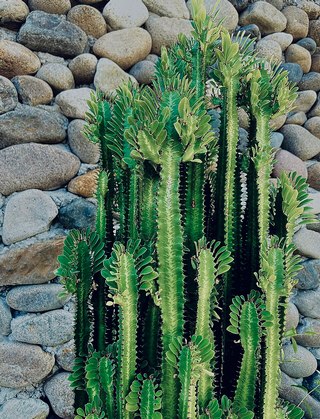
African Milk Tree:
The Essentials
| Common Name | African milk tree |
| Scientific Name | Euphorbia trigona |
| Origin | West Central Africa |
| Plant Type | Succulent |
| USDA Zones | Zones 9 – 11 |
| Cold Hardiness | To 30℉ |
| Flowers | Rare, insignificant |
| Mature Size | 6-12′ tall & 5-10′ wide |
| Growth Rate | Fast |
| Sun Tolerance | Full, part sun |
| Water Needs | Low |
| Pests & Diseases | Root rot if overwatered |
| Cautions! | Thorns, toxic to people, pets, livestock |
| Wildlife | Critter resistant |
How to Plant
To plant an African milk tree in the ground, dig a hole the same depth as the root system and twice as wide. Carefully remove the plant from the container, place it in the hole, and press the soil to remove any air pockets.
It’s generally recommended that you backfill with only native soil and not add any amendments. However, good drainage is critical. So if you know your soil is slow draining, amend with coarse sand or small gravel until you have a loose, well-drained mix.
When you plant or repot an African milk tree, some columns may tend to fall over. You can loosely tie them together and prop them up with rocks or gravel until they can stand on their own. It shouldn’t take long.
If you grow one in a container, be sure it has good drainage and use a cactus & succulent soil mix, not native soil. This plant gets big, so put it in a large container.
Protect Yourself!
When handling or pruning African milk tree, always wear gloves. When dealing with plants that exude toxic sap, I put a pair of inexpensive disposable gloves over my regular gardening gloves and then toss them when done. Note that most disposable gloves won’t be roomy enough to fit over gardening gloves. You’ll need oversize gloves like these.
If you get sap on your gardening tools, clean them thoroughly before putting them away. I use these disposable all-purpose cleaning wipes. I like them because they’re made with bamboo, smell like citrus, and are powerful enough to cut through the stickiest sap.
When to Plant
The best time to plant an African milk tree is in April or May, when warm soil encourages root development.
How to Care for African Milk Tree
Whether you’ve recently planted an African milk tree or have an existing plant in your yard, here’s how to take care of it to keep it healthy and looking its best.
How to Water
You’re probably used to giving a plant a good soaking immediately after transplanting, but that isn’t the best practice with succulents like African milk tree. Counterintuitively, it’s better to wait a week or two after planting to water. Then use the following schedule as a guide.
| Spring & Fall | Every 3-5 weeks |
| Summer | Every 2-4 weeks |
| Winter | Only if no winter rains |
If you’re growing yours in a container, use this watering schedule as a guide.
| Spring & Fall | Every 7-10 days |
| Summer | Every 5-7 days |
| Winter | Every 10-14 days |
Should You Fertilize?
There’s no need to fertilize an African milk tree planted in the ground. It should get all the nutrients it needs from the surrounding desert soil. But if you grow one in a pot, fertilize it lightly a few times per year when it’s actively growing.
Pruning & Propagation
This plant rarely needs pruning except to remove dead or damaged stems. You can do this anytime of year. You can also remove individual stems to control its width or height. Remove the tallest stems if they start bumping up against your eaves or patio roof.
If you prune any healthy stems, you can use them to grow new plants. Simply let the cut ends dry in the shade for a week or so, then stick them into cactus soil and water infrequently.
African Milk Tree Cultivar
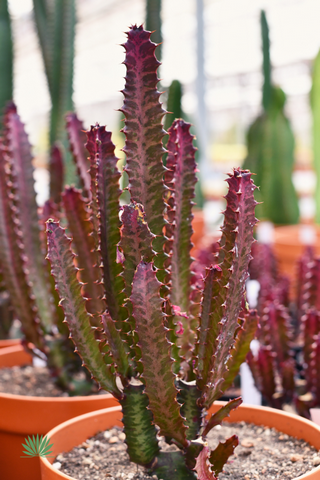
African milk tree is available as a very attractive cultivar, Euphorbia trigona ‘Rubra’, also known as Euphorbia trigona ‘Royal Red’. Its common name is red lucky plant. It has the same care requirements as the green version, but has red tones infused throughout its branches and leaves, making this plant a standout.
Plant Lover Facts
African milk tree (Euphorbia trigona) goes by several other common names, including African milk bush, candelabra cactus, cathedral cactus, good luck cactus, and green lucky plant. Don’t let these common names fool you — this plant is not a cactus. And I have not found a satisfactory answer as to why this plant is related to luck.
The species name trigona means “three angles”, referring to its triangular stems.
It’s native to the Central African countries of Angola, Congo, Democratic Republic of Congo, and Gabon. It has escaped cultivation in India and a few locations in Southeast Asia.
As an Amazon Associate, Southwest Gardener earns from qualifying purchases, at no cost to you.
See our Terms of Use for details.
Did you enjoy this article?
Sign up for our weekly newsletter
where you’ll find more great info on creating &
maintaining a beautiful, carefree desert landscape.
Author Bio
Deane Alban is the creator of Southwest Gardener. She is a science writer with a bachelor’s degree in botany from the University of South Florida. Gardening is her lifelong passion. She’s been gardening in Tucson for over 16 years.

Photo Credit
Frank Vincentz, CC BY-SA 3.0, via Wikimedia Commons
Nourish25, CC BY-SA 4.0, via Wikimedia Commons