
‘Baby Yoda’ is a new and different Texas ranger. It has green leaves, rosy purple flowers, and stays compact, requiring little-to-no pruning. Here’s everything you need to know about growing this Texas ranger cultivar in this complete care guide.
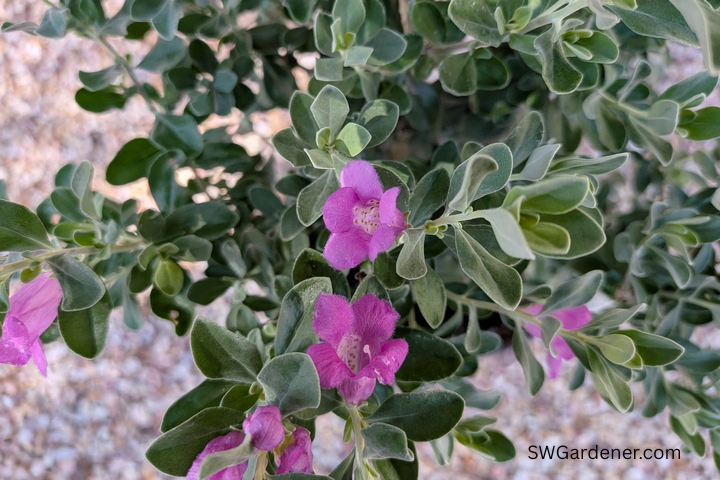
‘Baby Yoda’ (Leucophyllum frutescens ‘Baby Yoda’) is a new dwarf cultivar that’s as lovable as its name implies. It has medium green leaves tinged with silver. When in bloom, it puts on a show of flowers that are bright rosy purple rather than the usual “Texas ranger lavender”.
This cultivar stays a manageable 3 to 4 feet tall and wide, and solves a common problem that plagues most Texas rangers — their tendency to outgrow their space. (This leads them to be badly pruned into unnatural, unhealthy, and unattractive shapes.) But since ‘Baby Yoda’ stays compact, pruning for size control should not be necessary.
Like all Texas rangers, ‘Baby Yoda’ is extremely easy to grow. It thrives in the harshest conditions — full sun and poor soil — and needs very little water once established.
Why I Like This Plant
- Attractive even when not in bloom
- Evergreen foliage
- Beautiful, fragrant, rosy purple flowers
- Extremely low maintenance
- Compact, rarely needs pruning
- No thorns, low litter
- Supports hummingbirds, bees, butterflies
- Deer, rabbit resistant
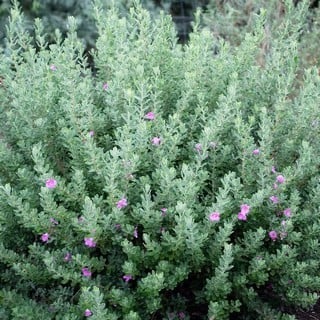
‘Baby Yoda’ has a naturally rounded form that makes an attractive addition to the garden, even when not in bloom.
Things to Watch Out For
Even though ‘Baby Yoda’ is a small, pretty shrub, don’t be tempted to pamper it. It will suffer more from too much attention (watering, pruning, fertilizing) than from neglect.
Because this is a new cultivar, it may be hard to find. You can find it at Tucson’s Civano Nursery and at the chain of Summer Winds Nurseries in the Phoenix area.
Optimal Growing Conditions
If you’re thinking of adding a ‘Baby Yoda’ Texas ranger to your garden, you need to find a suitable place that will keep your plant healthy and looking good… while minimizing maintenance for you.
Here are the key factors to keep in mind.
Temperature
‘Baby Yoda’ should be grown in USDA Hardiness Zones 7 to 11. It’s extremely tolerant of desert temperature extremes, and is cold-hardy down to 0℉.
Sun Exposure
‘Baby Yoda’ thrives in full sun and needs at least 6 hours of full sun per day to perform its best. With less, it will get leggy and have fewer flowers.
Size and Growth Rate
‘Baby Yoda’ exhibits a moderate growth rate and reaches a manageable size of 3 to 3 ½ feet tall by 3 to 4 feet wide when mature. It bursts forth in flowers intermittently from spring through fall after rain or during periods of high humidity.
Recommended Reading:
Why Isn’t My Texas Ranger Flowering?
‘Little Lynn’: Compact, Prolific Texas Ranger
Soil
‘Baby Yoda’ is not particular about soil. It grows well in any native soil type — rocky, sandy, clay, alkaline, or even caliche — provided it’s well-draining.
Other Location Considerations
Because it has no thorns, is non-toxic, and is nearly litter-free, ‘Baby Yoda’ is a plant you can feel comfortable placing near a pool, sidewalk, or anywhere it might come in contact with pets and people.
‘Baby Yoda’ Texas Ranger:
The Essentials
| Common Name | ‘Baby Yoda’ Texas ranger |
| Scientific Name | Leucophyllum frutescens ‘Baby Yoda’ |
| Origin | Chihuahuan Desert (cultivar) |
| Plant Type | Evergreen shrub |
| USDA Zones | Zones 7 – 11 |
| Cold Hardiness | To 0℉ |
| Flower Color | Rosy purple |
| Flower Season | Spring, summer, fall |
| Mature Size | 3-4’ tall & wide |
| Growth Rate | Moderate |
| Sun Tolerance | Full, reflected sun |
| Water Needs | Low |
| Pests & Diseases | Root rot if overwatered |
| Garden Friendly | No thorns, non-toxic |
| Wildlife | Supports butterflies, bees hummingbirds Deer, rabbit resistant |
How to Plant
The rule of thumb when planting any shrub in the desert is to dig a hole three times as wide as the root ball but no deeper. Amending the soil is not recommended. Counterintuitively, backfilling with the same native soil you just dug up helps your Texas ranger develop a stronger root system.
When to Plant
The best time to plant any Texas ranger is in the fall. This gives it three seasons to grow roots and get established before the following summer.
The second best time is in spring, the earlier the better. This still gives it time to get established before the intense heat of June arrives.
How to Care for ‘Baby Yoda’
Whether you’ve recently planted a ‘Baby Yoda’ or have an existing plant in your yard, here’s how to take care of it to keep it healthy and looking its best.
How to Water New Plants
Once you’ve got your ‘Baby Yoda’ in the ground, watering is your most immediate concern. Here is the recommended watering schedule for new shrubs planted in the spring or fall.
| Weeks 1 & 2 | Every 3 – 4 days |
| Weeks 3 & 4 | Every 5 – 7 days |
| Weeks 5 & 6 | Every 7 – 10 days |
| Weeks 7 & 8 | Every 10 – 14 days |
After week 8, gradually revise your watering schedule, depending on the season.
How to Water Established Plants
As your shrub gets established, there are two watering factors to consider.
- First is how often to water. This will vary with the seasons.
- Second is how much water to give your shrub with each watering. This depends on its current size.
To determine the ideal watering schedule for any Texas ranger, you’ll find everything you need to know, including easy-to-use charts, at How to Water Desert Shrubs: How Often? How Much?
Note that once established, your ‘Baby Yoda’ should not need supplemental water during the winter, provided you’ve had typical winter rainfall.
Should You Fertilize?
There is no need to fertilize ‘Baby Yoda’. This plant has evolved to get all the nutrients it needs from desert soil. Too much fertilizer can result in leggy growth and fewer flowers.
How to Prune
When planted with its mature size in mind, compact ‘Baby Yoda’ should rarely need pruning. But if it does need minor shaping, prune it late February to early March.
More About This Cultivar
‘Baby Yoda’ is a dwarf selection of ‘Green Cloud‘ Texas ranger cultivar (Leucophyllum frutescens ‘Green Cloud’). ‘Green Cloud’ is a cultivar of Leucophyllum frutescens which is native to the Chihuahuan Desert regions of Texas and Mexico.
If you go shopping for a ‘Baby Yoda’, you may see a plant label that states something like this: Leucophyllum frutescens ‘Baby Yoda’ PPAF. The PPAF indicates that this cultivar is “patent pending”. It was developed by Civano Growers of Tucson and became available to the public in the summer of 2025.
For Plant Lovers
Did you know that not all Texas rangers are the same species? Besides Leucophyllum frutescens, some Texas rangers are Leucophyllum laevigatum (i.e., ‘Purple Rain’), while others are Leucophyllum langmaniae (i.e., ‘Lynn’s Legacy’). And there are more species as well.
Texas rangers are sometimes called Texas sage, but are not botanically related to true sages, which are members of the Salvia genus.
Did you enjoy this article?
Sign up for our weekly newsletter
where you’ll find more great info on creating &
maintaining a beautiful, carefree desert landscape.
Author Bio
Deane Alban is the creator of Southwest Gardener. She is a science writer with a bachelor’s degree in botany from the University of South Florida. Gardening is her lifelong passion. She’s been gardening in Tucson for over 16 years.
