
Texas rangers are extremely popular desert landscape shrubs. When they burst forth in flowers, they are spectacular! But when they fail to bloom, it’s disappointing. Learn why they don’t bloom and how to encourage yours to produce flowers.

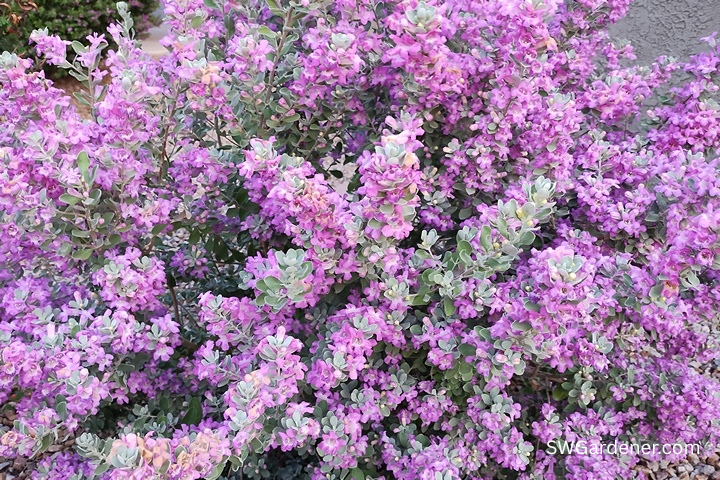
Texas rangers, also called Texas sage (Leucophyllum spp.), are extremely popular landscape shrubs throughout the desert Southwest. They are mainly planted for their explosions of purple flowers that appear intermittently throughout the summer, triggered by an increase in relative humidity.
But you may have a Texas ranger that’s a “dud” flower-wise and wonder why. Let’s look at the reasons your Texas ranger is not blooming as much as you’d like, and how to remedy the situation.
Improper Pruning (#1 Problem)
Improper pruning is by far the most common reason that Texas rangers don’t bloom. If you’ve lived elsewhere, you may regard shrub pruning as a routine maintenance task. But things are different in the desert! Here, frequent pruning is hard on your shrubs and won’t result in healthy, beautiful Texas rangers that flower optimally.
How Over-Pruning Stresses Your Shrubs
Shrubs should not be pruned as part of a routine maintenance schedule, despite what your “landscaper” tells you. There’s no need to prune a shrub if it’s healthy and you’re happy with its size and appearance.
Here’s why frequent pruning is stressful for your shrubs.
Every time you prune a shrub, it causes wounds that leave it more susceptible to diseases, infestations, and sun scald. Sadly, over-pruning can eventually lead to a shrub’s premature demise.
Regular pruning or shearing causes the insides of Texas rangers to get woody. And by continually removing leaves, you’re denying the plant the energy it needs to survive.
And since Texas ranger flowers appear on new wood, pruning removes any future flowers, one of the main reasons to grow this shrub.
Rejuvenation Pruning – The Easy Fix
If your Texas ranger has dead wood inside or has overgrown its spot, consider giving it a “rejuvenation prune”.
This involves cutting it down to 1 foot or so in late February to early March. Leave any low growing foliage that’s less than a foot tall.
Then put your shears and loppers away and let it grow naturally for the rest of the year. It will grow back in its natural attractive form and reward you with explosions of flowers throughout the summer.
Here’s a picture of my Texas ranger after a “rejuvenation prune” in March. You may understandably be thinking, “Yikes! She killed it!”
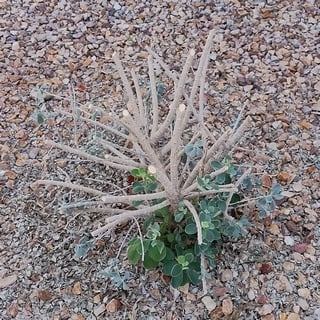
But here it is, four months later, 4 feet tall and wide, and flowering profusely.
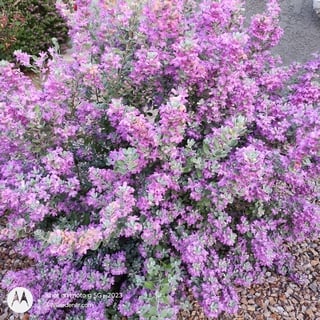
It’s that easy!
Note, that if your shrub is too far gone, there’s a chance it won’t rebound. And that will give you the opportunity to start over with one of the more floriferous Texas ranger cultivars.
Proper Pruning Routine
Once you’ve got your Texas ranger looking good, you don’t need to hard prune every year — every 3 to 5 years is usually adequate. The rest of the time, if yours has outgrown its space, you can cut it back by about half in the spring — but only if absolutely necessary. Your shrub will be healthier and flower more profusely when allowed to grow naturally.
Alternatively, you can use the “selective pruning” technique. Reach inside, and prune about one third of the branches back to a main branch or to the base. The yellow arrows indicate places you could cut.
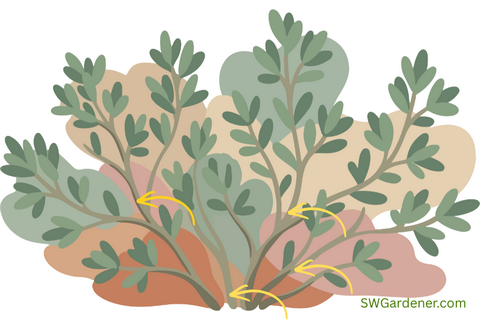
Selective pruning will keep your shrub’s natural form, open the interior to light, and reduce its size without removing too much flowering wood or causing unnecessary stress.
You can use this technique on most desert landscape shrubs, not just Texas rangers.
Example of Bad Pruning
Now let’s compare my Texas ranger with my neighbor’s. Their landscaper butchered pruned their Texas ranger into a perfect ball that is dead inside and has quit blooming. This is what theirs looked like the same day I took the picture of mine above.
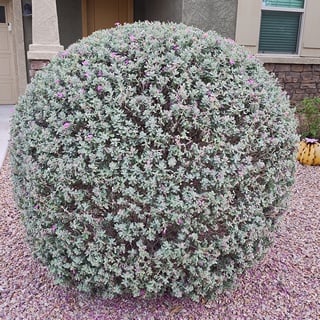
Not only is theirs not flowering, but it’s dead inside with only a thin outer shell of live growth. They could remedy this with rejuvenation pruning, but they probably won’t. 😢
Too Much Water
Texas rangers are low water use shrubs, native to the Chihuahuan Desert. Ask anyone who has spectacular specimens, and they’ll almost certainly tell you that they water theirs rarely, or not at all.
Overwatering Texas rangers or growing them in poor draining soil will diminish flowering. Too much water can also kill them.
Additionally, unnecessary water creates a vicious circle. More water means faster growth, which leads to overpruning, which leads to sad Texas rangers that don’t bloom.
If you live in a wetter area or have poor drainage, consider planting ‘Microburst‘ (Leucophyllum candidum ‘Microburst’), a cultivar that tolerates wet roots better than other Texas rangers.
Not all Texas rangers are the same species.
Most are Leucophyllum frutescens,
but some are L. laevigatum, L. langmaniae,
or a handful of other Leucophyllum species.
Too Little Sun
Texas rangers like full sun — and I mean full, Arizona “death star” sun. They need at least 6 hours of full sun. When they don’t get it, they get leggy and produce fewer, if any, flowers.
There may or may not be anything you can do if an existing shrub doesn’t get adequate sun. But if you’re thinking of planting a new Texas ranger, plant it in the sunniest spot in your yard. These shrubs don’t mind the reflective heat bouncing off a hot, sunny garden wall or building.
Soil Issues
Texas rangers evolved to get all the nutrients they need from sandy or rocky alkaline soil low in organic matter. Counterintuitively, many desert plants flower less when too many nutrients are available, either from rich soil or fertilizer.
So don’t top dress Texas rangers with compost or organic mulch. It’s OK to leave their leaf litter, as would occur in nature. Don’t fertilize. And when planting, don’t amend the hole with soil mix or compost.
Another soil-related problem can be soil pH. I was surprised to learn that Texas rangers are planted throughout Zone 9, far from their native habitat of Mexico and Texas. They are sold at nurseries from California to Florida and north into the Northwest. In some of these regions, the soil is acidic. Texas rangers evolved to grow in alkaline soil and may struggle in acidic soil.
The ‘Lynn’ Cultivars
Texas rangers come in a wide variety of cultivars that vary in size, leaf size and color, and flower color. And while they are all stunning in their own way, not all flower equally frequently.
So if you are thinking of planting a new Texas ranger or replacing an existing one, you may want to start with one of the ‘Lynn’ cultivars known for producing maximum blooms.
Texas rangers are dependent on increased humidity to bloom. But one selection, ‘Lynn’s Legacy‘ (Leucophyllum langmaniae ‘Lynn’s Legacy’), was found to be less dependent on changes in relative humidity for flowering, and consequently it blooms more often.
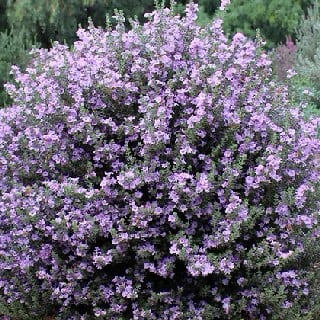
‘Little Lynn‘ (Leucophyllum langmaniae ‘Little Lynn’) is a compact cultivar derived from ‘Lynn’s Legacy’. Like its parent, this cultivar is less dependent on rain or humidity to flower. And because it stays small — around 4 feet tall and wide — it needs minimal pruning, which assures more flowers. According to the folks at Civano Growers who developed this cultivar, it flowers even more than ‘Lynn’s Legacy’.
I have one and can attest that it blooms more frequently and throughout a longer period than any other Texas ranger I’ve ever grown.
A Blooming Recap
If your Texas ranger isn’t flowering, the problem may be that you are giving it too much care rather than too little. If you want an existing shrub to be healthy and produce flowers, follow these simple steps:
- Stop frequent pruning NOW!
- Don’t overwater
- Don’t fertilize
- Give it a rejuvenation prune in the spring
If you’re thinking of planting a new Texas ranger, and want maximum blooms, follow these planting guidelines:
- Pick a hot, sunny location
- Plant in unamended, alkaline, well-draining desert soil
- Start with a cultivar known to bloom frequently
Did you enjoy this article?
Sign up for our weekly newsletter
where you’ll find more great info on creating &
maintaining a beautiful, carefree desert landscape.
Author Bio
Deane Alban is the creator of Southwest Gardener. She is a science writer with a bachelor’s degree in botany from the University of South Florida. Gardening is her lifelong passion. She’s been gardening in Tucson for over 16 years.
