
Twisted myrtle is a unique evergreen shrub with a bevy of attractive features — spiraling stems, starlike white flowers, and a gnarly, architecturally interesting form. Here’s everything you need to know about planting and caring for this “twist” on a legendary Mediterranean plant.
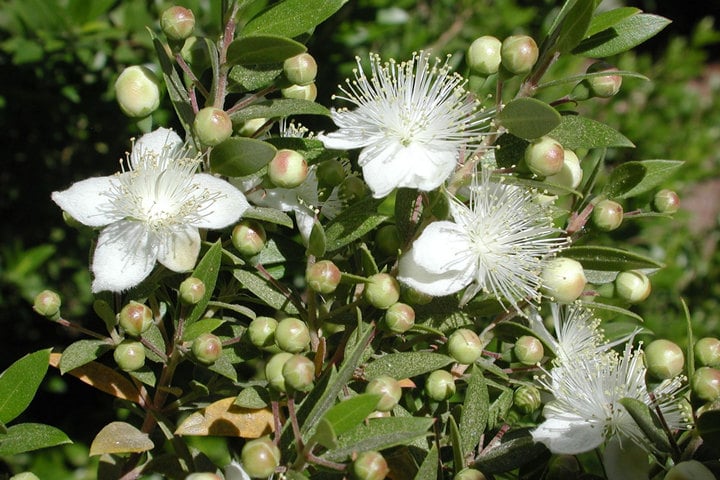
Twisted myrtle (Myrtus communis ‘Boetica’) may sound like the name of a rock band, but it’s one of the most architecturally interesting shrubs you can grow in the desert Southwest.
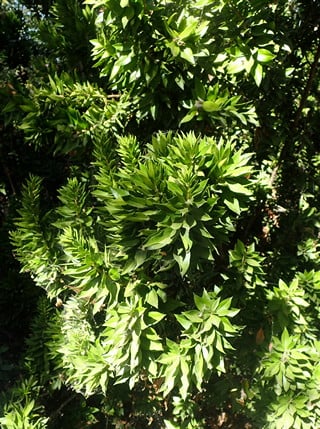
It has glossy, deep green, aromatic leaves that grow in whorls on spiraling stems. Spring through summer, it’s covered with white, star-shaped flowers. Flowers are followed by blueberry-like fruits that are edible, albeit not particularly tasty.
The twisted branches and trunks are covered with cinnamon-colored bark that peels as the plant matures.
It can be pruned to grow any way you like — as an informal shrub, small tree, formal hedge, or even as a topiary.
The fragrant flowers attract bees, and the berries are enjoyed by birds.
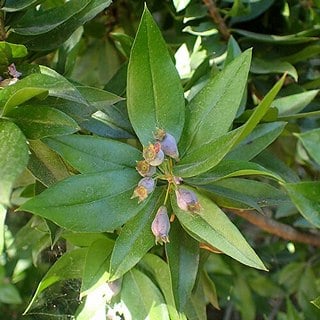
Twisted myrtle is a naturally occurring cultivar of “true” or “common” myrtle, a legendary plant that is frequently mentioned in Roman and Greek mythology and in the Bible. It symbolizes love, peace, and fertility. Ancient Greeks and Romans presented myrtle wreaths and garlands to poets and athletes.
Why I Like This Plant
- Architectural interest all year
- Unusual twisted, whorled form
- Fragrant white flowers
- Non-allergenic, low litter, low maintenance
- Versatile, accepts various pruning styles
- Supports bees, birds
Optimal Growing Conditions
If you’re thinking of adding a twisted myrtle to your garden, you need to find a suitable place that will keep your plant healthy and looking good… while minimizing maintenance for you.
Here are the key factors to keep in mind.
Temperature
Twisted myrtle should be grown in USDA Hardiness Zones 8 to 11. It tolerates extreme heat and can withstand cold down to 18℉.
Sun Exposure
Twisted myrtle grows well in either full sun or part shade. Its leaf arrangement is more tightly whorled in the sun and more loosely whorled in part shade.
Size and Growth Rate
Twisted myrtle is considered a moderate grower. In desert gardens, it typically reaches a size of 6 to 8 feet tall by 4 to 6 feet wide, but can get bigger. But its ultimate size depends on how it’s maintained and pruned. When it’s particularly happy in its setting, it can grow to be 15 feet tall and wide.
Soil
Twisted myrtle will grow in any type of soil — sandy, clay, loam, or rocky — as long as it’s well-draining. However, Arizona State University recommends that you avoid trying to grow it if your soil pH is above 8.3.
Other Location Considerations
It makes a perfect addition to a Mediterranean or Japanese-style garden where it lends a distinctly zen feel.
Since twisted myrtle has no thorns and is non-toxic, you can feel comfortable planting it where it might come in contact with people and pets.
Since it’s low litter, it’s a good choice to place near a pool, sidewalk, or patio.
Twisted myrtle can be grown in a large container.
Twisted Myrtle:
The Essentials
| Common Name | Twisted myrtle |
| Scientific Name | Myrtus communis ‘Boetica’ |
| Origin | Mediterranean (cultivar) |
| Plant Type | Evergreen shrub |
| USDA Zones | Zones 8 – 11 |
| Cold Hardiness | To 18℉ |
| Flower Color | White |
| Flower Season | Spring, summer |
| Mature Size | 6-8’ tall x 4-6′ wide |
| Growth Rate | Moderate |
| Sun Tolerance | Full, part sun |
| Water Needs | Low |
| Pests & Diseases | Iron chlorosis |
| Garden Friendly | No thorns, non-toxic, non-allergenic |
| Wildlife | Supports birds, bees |
How to Plant
The rule of thumb when planting any shrub in the desert is to dig a hole three times as wide as the root ball but no deeper.
Since it’s not native and is prone to iron chlorosis in highly alkaline soil, it’s generally recommended that you amend your hole with compost or a commercial soil mix and top dress with organic mulch.
When to Plant
The best time to plant twisted myrtle is in the fall. This gives it three seasons to grow roots and get established before the following summer.
The second best time is in spring, the earlier the better. This still gives it time to get established before the intense heat of June arrives.
How to Care for Twisted Myrtle
Whether you’ve recently planted a new dwarf olive or have an existing one in your yard, here’s how to take care of it to keep it healthy and looking its best.
How to Water New Plants
Once you’ve got your twisted myrtle planted, watering is your most immediate concern. Here is the recommended watering schedule for new shrubs.
| Weeks 1 & 2 | Every 3 – 4 days |
| Weeks 3 & 4 | Every 6 – 7 days |
| Weeks 5 & 6 | Every 7 – 10 days |
| Weeks 7 & 8 | Every 10 – 14 days |
After week 8, gradually revise your watering schedule, depending on the season.
How to Water Established Plants
As your shrub becomes established, there are two watering factors to consider.
- First is how often to water. This will vary with the seasons.
- Second is how much water to give your shrub with each watering. This depends on its current size.
To determine the ideal watering schedule for any desert shrub, you’ll find everything you need to know, including easy-to-use charts, at How to Water Desert Shrubs: How Often? How Much?
Avoid overwatering, which can contribute to iron chlorosis.
Should You Fertilize?
Twisted myrtle doesn’t need fertilizer, but you may want to top dress with organic mulch or compost to improve drainage, protect its roots, and reduce soil alkalinity.
This shrub can develop iron chlorosis when grown in alkaline desert soil. This deficiency is characterized by yellow leaves with distinctly green veins. If this happens, feed it a chelated iron supplement.
How to Prune
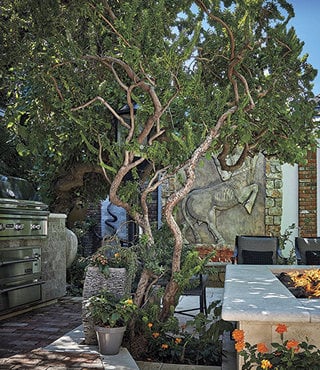
Unlike many desert shrubs, twisted myrtle responds well to regular pruning and can be shaped as a hedge, topiary, or as a specimen plant. Here’s an example of one that was trained to grow as a small, gnarly tree. Removing lower branches reveals its interesting bark and trunk.
The best time to prune twisted myrtle is in winter or early spring.
Plant Lover Facts
Twisted myrtle (Myrtus communis ‘Boetica’) is a cultivar of Myrtus communis which goes by the common names common myrtle, true myrtle, or simply “myrtle”. The parent plant is native to the Mediterranean regions of Europe, Africa, and the Middle East.
According to Arizona State University, the unique ‘Boetica‘ version is caused by a viral infection that contorts the stem and leaf growth patterns.
The leaves, which have a refreshing smell when crushed, contain an essential oil that acts as a natural sunscreen for the plant. Myrtle essential oil has a fresh, sweet, and camphor-like aroma.
The berries are edible but not particularly tasty. Dried flowers, leaves, and berries are used to flavor food. It was used medicinally to treat a wide range of ailments including digestive problems, urinary tract infections, sinusitis, and wounds.
As an Amazon Associate, Southwest Gardener earns from qualifying purchases, at no cost to you.
See our Terms of Use for details.
Did you enjoy this article?
Sign up for our weekly newsletter
where you’ll find more great info on creating &
maintaining a beautiful, carefree desert landscape.
Author Bio
Deane Alban is the creator of Southwest Gardener. She studied journalism and received a bachelor’s degree in botany from the University of South Florida. Gardening is her lifelong passion. She’s been gardening in Tucson for over 16 years.

Photo Credits
The University of Arizona Campus Arboretum
Krzysztof Ziarnek, CC BY-SA 4.0, via Wikimedia Commons
Krzysztof Ziarnek, CC BY-SA 4.0, via Wikimedia Commons