
Queen of the night is an elusive cactus that’s rarely seen in the wild. But it’s widely regarded for its nocturnal flowers that simultaneously bloom once per year. While you might be daunted at the prospect of growing one, this southwest native makes a virtually no-maintenance addition to desert gardens.
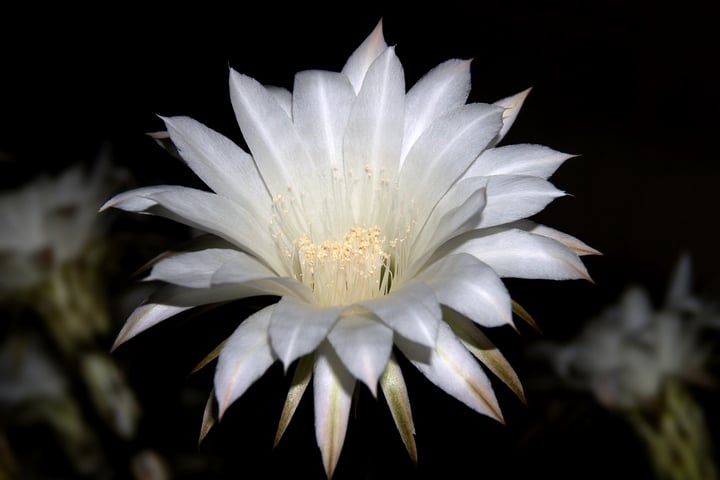
Most people have never seen a queen of the night (Peniocereus greggii) in the wild, since they are perfectly camouflaged in their native habitat. Yet here in Tucson, where Tohono Chul is home to the largest private collection in the world, they have rock star status. Every summer, Tohono Chul’s Bloom Night is a major event attended by plant lovers from near and far who come to admire this elusive desert beauty.
Growing this plant as a landscape plant will make you part of this enigmatic phenomenon. If you grow one in your garden, here’s what you can expect.
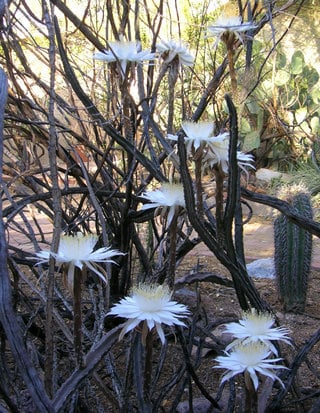
When not in bloom, this no maintenance plant resembles a dead stick. Then, sometime in late spring to early summer, it puts on a stunning display of nocturnal flowers that only last one night. These white beauties have an intense vanilla-like fragrance. Note that it will take several years for a new plant to start flowering.
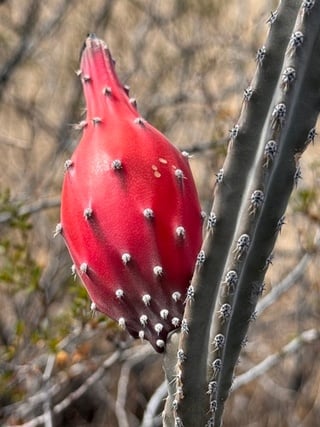
Flowers are pollinated by hawk moths, and oblong red fruits follow. Birds eat the fruit and disperse seeds in their droppings.
Why I Like This Plant
- Out of the ordinary cactus
- Rewarding for plant enthusiasts
- Fragrant white flowers
- Virtually no maintenance
Things to Watch Out For
This is not a plant for the average landscape or casual gardeners. It’s more for cactus or native plant enthusiasts who enjoy growing plants that are unusual. It adds little to the appearance of the average yard since, when not in bloom, it’s barely there.
When it blooms, it’s magnificent, but only for a few hours. Flowers emerge one evening and then wither when touched by the morning sun.
This is not a good choice if you’re usually away in June or July. Historically, the queen of the night blooms in late June or early July. But the past two years, Tohono Chul’s collection of 400+ plants has bloomed in early June.
Optimal Growing Conditions
If you’re thinking of adding a queen of the night to your garden, you need to find a suitable place that will keep your plant healthy and looking good… while minimizing maintenance for you.
Here are the key factors to keep in mind.
Temperature
Queen of the night should be grown in USDA Hardiness Zones 9 or 10. It tolerates desert heat, especially when grown in part shade, and can survive temperatures down to 10℉.
Sun Exposure
In its native habitat, queen of the night usually grows in the shade of a nurse shrub or tree. You’ll increase your chance of success if you can replicate this environment. While you can grow one in full sun, it will be happier in dappled shade.
Size and Growth Rate
Queen of the night grows slowly. A typical mature specimen can reach a size of 3 to 8 feet tall by 6 to 10 feet wide. Tall plants benefit from support.
Soil
Since its native habitat includes low altitude flats and washes, queen of the night prefers soil that is sandy or silty, rather than clay or rocky.
Other Location Considerations
Queen of the night can be grown in a container. Be sure it has good drainage and use specifically formulated cactus soil.
Since it doesn’t look like much when not in bloom, you’ve got a few options. You can keep it in an out of the way place it will love, such as under a tree, and then bring it to the forefront as it’s about to bloom. Or you can grow it in a container with other plants with similar growing requirements.
Queen of the Night:
The Essentials
| Common Name | Queen of the night |
| Scientific Name | Peniocereus greggii |
| Origin | Chihuahuan, Sonoran Deserts |
| Plant Type | Cactus |
| USDA Zones | Zone 9, 10 |
| Cold Hardiness | To 10℉ |
| Flower Color | White |
| Flower Season | Spring, summer |
| Mature Size | 3-8′ tall x 6-10′ wide |
| Growth Rate | Slow |
| Sun Tolerance | Filtered sun |
| Water Needs | Low |
| Pests & Diseases | None |
| Cautions | Spines |
| Wildlife | Attracts moths |
Planting Queen of the Night
To plant a queen of the night, dig a hole the same depth as the root system and twice as wide.
You might be surprised to discover that this spindly stick of a cactus has a large, tuberous root that looks like a parsnip on steroids. When mature, these tubers typically weigh 5 to 15 pounds, but can weigh up to 40 pounds!
Typical tubers look like this…

But take a look at this giant! 😮

You’re probably used to giving plants a good soaking immediately after transplanting, but that isn’t the best practice with cactus. The Arizona-Sonora Desert Museum advises not to water succulents for one to two weeks after planting.
The best time to plant queen of the night is in April or May when higher temperatures encourage root development.
Where to Find Queen of the Night?
Here in Tucson, the most obvious place to buy a queen of the night is at Tohono Chul’s Desert Corner Nursery. You might also find one at a nursery that specializes in native plants or cactus. Spadefoot Nursery, Green Things, Plants for the Southwest, and B&B Cactus periodically have them for sale. (You can find addresses and contact info for all in our Tucson Nursery Directory.)
Another option is to check locally for free plant stands or plant swaps — you may find seedlings or cuttings for sale or trade there. Learn more about unconventional places to find desert plants here.
If you’re interested in starting some from seed, you can order online from Phoenix Desert Seeds.
Note that if you order this plant online, be certain you’re getting the right species. I’ve heard of disappointed gardeners who ordered Peniocereus greggii but got Epiphyllum oxypetalum, a fairly common house plant, instead.
How to Care for Queen of the Night
When planted in the right spot, queen of the night is happy being neglected, so there’s not much care involved. It doesn’t need fertilizer. You only need to remove stems that have been damaged or that you want to propagate.
It can exist on rainwater alone, provided you’ve had normal seasonal rains. If not, be the rain — irrigate to make up for what’s lacking.
Consider protecting a young plant from damage from pets, people, or wildlife with a wire cage or basket. Plants can be gnawed on or accidentally stepped on since they’re so unobtrusive.
Don’t Confuse Queen of the Night With…
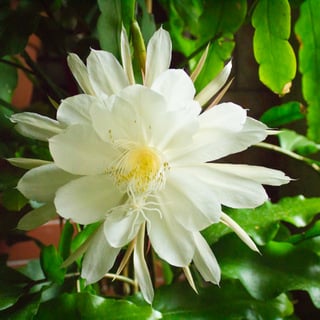
Don’t confuse queen of the night (Peniocereus greggii) with other plants that go by the same common name, most commonly Epiphyllum oxypetalum. This unrelated species also has white flowers, but it has flat, green, leaf-like stems that look nothing like the dried sticks of our desert queen.
Plant Lover Facts
Queen of the night also goes by the common names Arizona queen of the night, desert night-blooming cereus, and night blooming cereus.
It’s native to southern Arizona, New Mexico, and Texas, and adjacent northern Mexico, as well to Baja California.
Most people swoon over the flowers’ intense, vanilla-like fragrance, but oddly, some people can’t smell it at all.
The mild-tasting fruit is edible and contains small black seeds, and is sometimes compared to dragon fruit.
Queen of the night was used traditionally in religious ceremonies. The roots were used medicinally to treat diabetes, headaches, digestion, and respiratory problems.
Did you enjoy this article?
Sign up for our weekly newsletter
where you’ll find more great info on creating &
maintaining a beautiful, carefree desert landscape.
Author Bio
Deane Alban is the creator of Southwest Gardener. She is a science writer with a bachelor’s degree in botany from the University of South Florida. Gardening is her lifelong passion. She’s been gardening in Tucson for over 16 years.

Photo Credits
“Nightblooming Cereus Cactus” by Exia Photography is licensed under CC BY 2.0
Daniel McNair, CC BY-SA 4.0, iNaturalist.com
The University of Arizona Campus Arboretum
Cactivoraxixi, CC BY-SA 4.0, via Wikimedia Commons
P.Karpiński, CC BY-SA 3.0, via Wikimedia Commons