
With green bark and yellow flowers, palo brea is easily mistaken for one of the ubiquitous palo verde species, but it’s a valuable landscape tree in its own right. Discover how this tree is similar to and how it’s different from the palo verdes commonly grown as desert landscape trees.
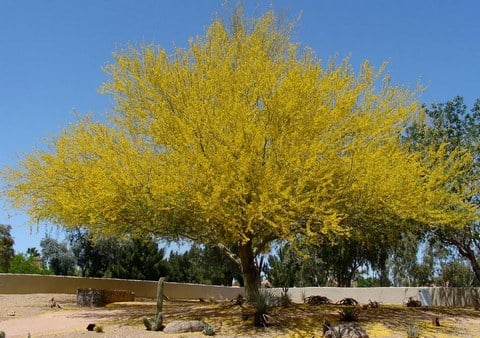
Palo brea (Parkinsonia praecox) is a medium size tree with green bark and small blue-green leaves that’s closely related to the more familiar palo verde species. This tree has a wide canopy, twisting trunk, and medusa-like branches that add sculptural interest to desert gardens.
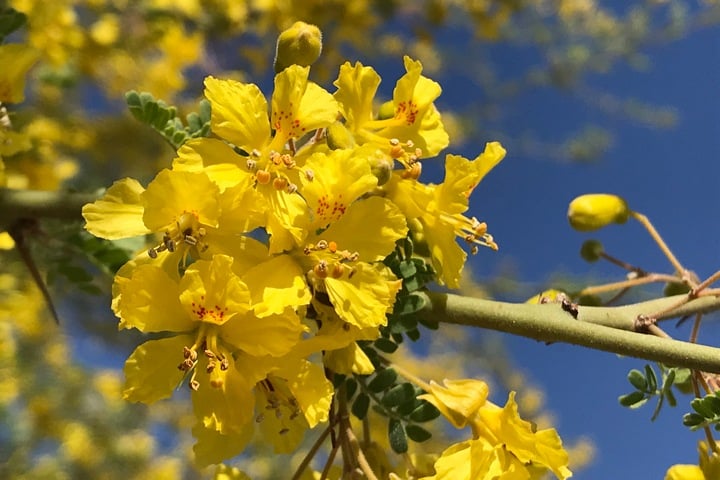
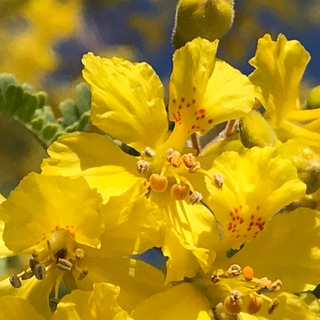
When in bloom, palo brea is adorned bright yellow flowers that appear in clusters along branches. Flowers have red-orange dots on just one petal.
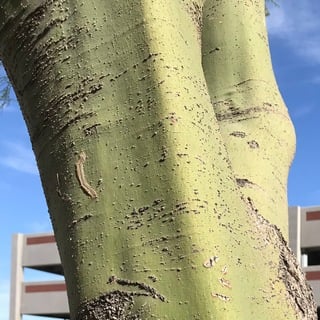
The trunk and branches of palo brea are covered with photosynthetic bark covered by a waxy coating. The bark of this tree remains green and smooth as it ages.
Palo brea is a great tree for attracting wildlife — butterflies, native bees, and other insect pollinators feed on the nectar. It’s a larval host for many species of moths. Birds eat the seeds and use the tree for shelter.
Things I Like About This Plant
- Eye-catching yellow flowers
- Unusual smooth green bark
- Low water use
- Supports wildlife
Things to Watch Out For
Some people don’t like the mess these trees make when they lose their flowers in the spring, while others marvel at the beautiful carpet of yellow. So know where you stand before planting. Abundant flowers make this a poor choice to grow near a pool or anywhere else you don’t want litter.
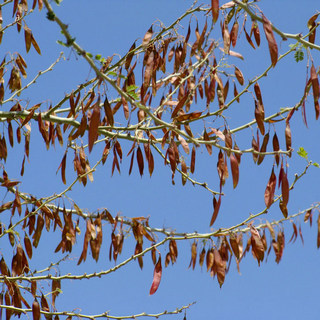
Some people find the multitude of flat, brown seed pods messy and unattractive.
Branches, especially new ones, are lined with thorns.
Palo brea loses its leaves during drought or cold and may be leafless part of the year.
This tree does not do well with frequent, shallow watering. So don’t plant it in a lawn or surround it with low-growing plants that need frequent watering.
Palo brea naturally has multiple trunks and a wide canopy, and looks its best when allowed to sprawl. This is not the right tree for small yards or if you’re looking for a single-trunk “lollipop” tree.
Optimal Growing Conditions
If you’re thinking of adding a palo brea to your garden, you need to find a suitable place that will keep your plant healthy and looking good… while minimizing maintenance for you.
Here are the key factors to keep in mind.
Temperature
Palo brea should be grown in USDA Hardiness Zones 9 to 11, although some specimens survive in zone 8. It tolerates extreme heat and will survive temperatures down to 20℉, but may drop some or all of its leaves in winter.
Sun Exposure
Palo brea thrives in full sun and tolerates the reflected sun off of buildings or walls.
Size and Growth Rate
Palo brea grows fast and typically reaches a size of 25 feet tall and wide. It normally blooms in April.
Soil
Palo brea grows well in any kind of native soil, provided it’s well-draining. Don’t put organic mulch under the canopy of palo brea, mulch with gravel or decomposed granite instead.
Palo Brea:
The Essentials
| Common Name | Palo brea |
| Scientific Name | Parkinsonia praecox |
| Origin | Mexico, Central & South America |
| Plant Type | Semi-deciduous tree |
| USDA Zones | Zones 9 – 11 |
| Cold Hardiness | To 20℉ |
| Flower Color | Yellow |
| Flower Season | Spring |
| Mature Size | 25’ tall & wide |
| Growth Rate | Moderate to fast |
| Sun Tolerance | Full, reflected sun |
| Water Needs | Low |
| Pests & Diseases | Root borers, witches’ broom, desert mistletoe |
| Cautions | Thorns |
| Wildlife | Supports butterflies, moths, bees, birds |
How to Plant
The rule of thumb when planting any tree in the desert is to dig a hole three times as wide as the root ball but no deeper. Amending the soil is not recommended. Counterintuitively, backfilling with the same native soil you just dug up helps your plant develop a stronger root system.
When to Plant
The best time to plant palo brea is in the fall. This gives your tree three seasons to grow roots and get established before the following summer. The second best time is in spring, the earlier the better. This still gives it time to get established before the intense heat of June arrives.
How to Care for Palo Brea
Whether you’ve recently planted a new palo brea or have an existing one in your yard, here’s how to take care of it to keep it healthy and looking its best.
How to Water New Plants
Once you’ve got your palo brea in the ground, watering is your most immediate concern. Here is the recommended watering schedule for new trees planted in the spring or fall.
| Weeks 1 & 2 | Every 3 – 4 days |
| Weeks 3 & 4 | Every 6 – 7 days |
| Weeks 5 & 6 | Every 7 – 10 days |
| Weeks 7 & 8 | Every 10 – 14 days |
After week 8, gradually revise your watering schedule, depending on the season.
How to Water Established Plants
As your tree becomes established, there are two watering factors to consider.
- First is how often to water. This will vary with the seasons.
- Second is how much water to give your tree with each watering. This depends on its current size.
To determine the ideal watering schedule for any desert tree, you’ll find everything you need to know, including easy-to-use charts, at How to Water Desert Trees: How Often? How Much?
It’s imperative that you don’t overwater palo brea. Overwatering can result in vigorous but weak growth that can make your tree prone to catastrophic failure.
Should You Fertilize?
There is no need to fertilize palo verdes, which evolved to grow in desert soil. And since these trees are members of the legume family (Fabaceae), they fix nitrogen, which naturally improves the surrounding soil.
How to Prune
Because of its wide crown and irregular branching pattern, this is not an easy tree to prune. Improper pruning can ruin this tree’s shape and make it more susceptible to storm damage. Unless desert tree pruning is a skill you have mastered, I would urge you to hire an arborist to get your tree off to a good start.
The best time to prune is in the winter, but you can prune suckers and water sprouts whenever you see them.
Pests & Diseases
It was recently discovered that witches’ broom in palo verdes is caused by a virus (Emaravirus spp.) spread by eriophyid mites. This disease, called palo verde broom virus (PVBV), primarily affects blue palo verde (Parkinsonia florida) but can affect palo brea as well.
Palo brea is also susceptible to desert mistletoe and the palo verde root borer beetle (Derobrachus hovorei). Palo verde root borers are often blamed for damaging or killing palo verdes, but they are not considered a threat to healthy trees. The beetles spend no more than a month of their life cycle above ground and do not eat. Their grubs, which live underground for 2 to 4 years, feed mainly on the dead wood of older or stressed trees, and are a natural part of the desert ecosystem.
Don’t Confuse Palo Brea With…
Palo brea (Parkinsonia praecox) is easily confused with any of the palo verdes commonly grown as landscape trees. They all belong to the Parkinsonia genus and have photosynthetic green bark and yellow flowers in the spring.
If you see a palo verde growing in the wild in the US Southwest, the chances are very good that it’s the foothills species since 95% of palo verdes are foothills. (Palo brea is not native to the US.) If you see a palo verde in cultivation, it is usually the ubiquitous Desert Museum hybrid.
Blue palo verde (Parkinsonia florida) is a Sonoran Desert native (Arizona, California, Nevada, Northern Mexico) that has distinctive bright yellow flowers with orange-red dots on one petal and obvious orange stamens.
Foothills palo verde (Parkinsonia microphylla) is another Sonoran Desert native (Arizona, California, Northwest Mexico). It is a somewhat smaller tree than palo brea. It has creamy yellow flowers with one distinctive white petal. When in bloom, the overall effect is pastel rather than bright yellow.
Desert Museum (Parkinsonia X ‘Desert Museum’) is a particularly showy hybrid that inspires awe every spring. It is a naturally occurring cross of three palo verde species — blue, Mexican, and foothills. Unfortunately, this gorgeous, fast-growing tree is extremely prone to storm damage. If you’ve ever seen palo verdes down after a storm, especially in commercial or municipal settings, they are often the Desert Museum hybrid.
Plant Lover Facts
Palo brea’s (Parkinsonia praecox) common name is derived from “palo” which means “stick” and “brea” which means “tar”. Numerous gardening sites claim that brea means “early” in Spanish, but this is not correct. More likely, it gets this name from a waxy substance on the trunk that can be scraped off and melted into a gum that can be used as gum, glue, or in making soap.
This tree is sometimes called Sonoran palo verde. It’s native to parts of Mexico, Central America, and South America.
According to Arizona State University, palo brea readily hybridizes with other Parkinsonia species, and many trees sold as palo brea are actually hybrid crosses.
Did you enjoy this article?
Sign up for our weekly newsletter
where you’ll find more great info on creating &
maintaining a beautiful, carefree desert landscape.
Author Bio
Deane Alban is the creator of Southwest Gardener. She studied journalism and received a bachelor’s degree in botany from the University of South Florida. Gardening is her lifelong passion. She’s been gardening in Tucson for over 16 years.
