
‘Orange Jubilee’ is a large shrub with clusters of orange trumpet-shaped flowers that’s as festive as its name implies. Here’s everything you need to know about planting and caring for this hybrid of the popular shrub yellow bells (Tecoma stans).
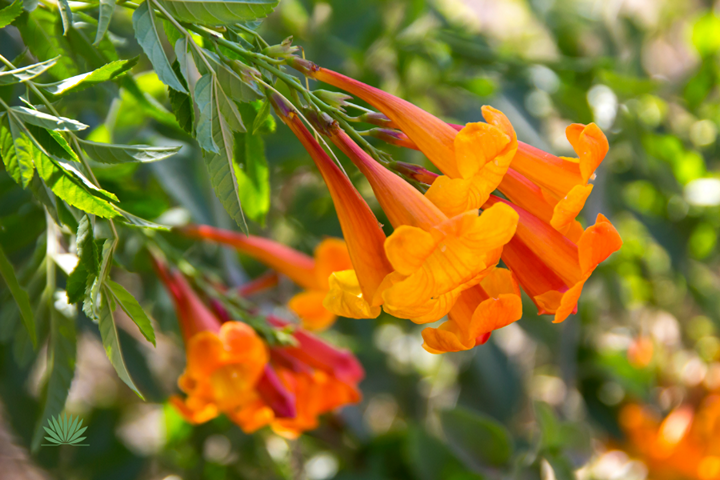
Yellow bells (Tecoma stans) is one of the most popular desert landscape shrubs, for good reason. It’s as tough as it is beautiful. It thrives in full sun and almost any soil, and needs little water once established.
Yellow bells has several hybrids, and at the top of the list is ‘Orange Jubilee’ (Tecoma x ‘Orange Jubilee’). It’s similar in appearance and care requirements, except it has vivid orange trumpet-shaped flowers, rather than yellow.
Bees, hummingbirds, and butterflies are attracted to its nectar-rich flowers. Rabbits, javelinas, and deer generally leave it alone.
Why I Like This Plant
- Bright green leaves
- Vibrant orange flowers
- Loves full sun
- Low maintenance
- No thorns, not toxic
- Supports bees, butterflies, hummingbirds
- Critter resistant
Things to Watch Out For
‘Orange Jubilee’ produces a moderate amount of litter — leaves, flowers, and seed pods — so is not a good choice near a pool.
It is prone to leafroller damage, which is discussed further below. While this pest rarely does serious harm, its damage can look unsightly.
If you normally experience below freezing temperatures, you can expect your ‘Orange Jubilee’ to lose leaves in the winter.
Optimal Growing Conditions
If you’re thinking of adding an ‘Orange Jubilee’ to your garden, you need to find a suitable place that will keep it healthy and looking good… while minimizing maintenance for you.
Here are the key factors to keep in mind.
Temperature
‘Orange Jubilee’ should ideally be grown in USDA Hardiness Zones 8 to 11. It’s a heat-loving shrub that is somewhat sensitive to cold.
It’s semi-deciduous — retains its leaves during mild winters, but experiences leaf damage or loss when temperatures dip into the 20s. It rebounds in the spring, even if it dies back to the ground.
You can minimize winter cold damage by planting it near a sunny, south-facing wall.
It’s somewhat more cold tolerant than its parent plant, yellow bells.

Sun Exposure
‘Orange Jubilee’ needs full sun to perform its best, and doesn’t mind the reflected heat off a garden wall or building. It will get lanky and produce fewer flowers when grown in part shade.
Size and Growth Rate
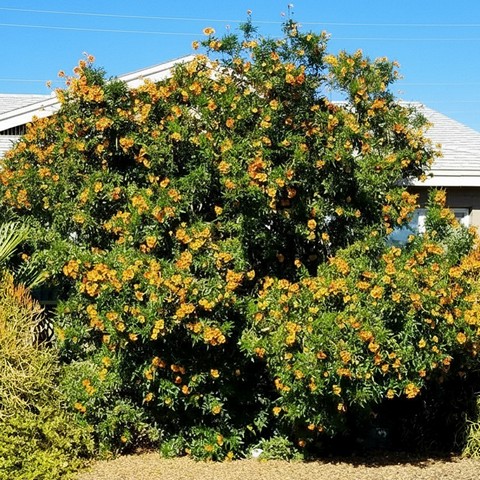
‘Orange Jubilee’ is a fast grower that typically reaches a mature size of 10 to 12 feet tall by 6 to 8 feet wide. Its ultimate size depends largely on whether it freezes back in winter.
Soil
‘Orange Jubilee’ is not particular about soil. It will grow in any type of soil — sandy, clay, loam, or rocky — as long as it’s well-draining. While it’s generally tolerant of alkaline soil, it may develop iron chlorosis in extremely alkaline soil.
‘Orange Jubilee’:
The Essentials
| Common Name | ‘Orange Jubilee’ |
| Scientific Name | Tecoma x ‘Orange Jubilee’ |
| Origin | US/South America (hybrid) |
| Plant Type | Semi-deciduous shrub |
| USDA Zones | Zones 8 – 11 |
| Cold Hardiness | To 15℉ |
| Flower Color | Orange |
| Flower Season | Spring, summer, fall |
| Mature Size | 10-12’ tall x 6-8’ wide |
| Growth Rate | Fast |
| Sun Tolerance | Full, part sun |
| Water Needs | Low to moderate |
| Pests & Diseases | Caterpillar damage |
| Garden Friendly | No thorns, non-toxic |
| Wildlife | Supports pollinators |
How to Plant
The rule of thumb when planting any shrub in the desert is to dig a hole three times as wide as the root ball but no deeper.
Amending the soil is not recommended. Counterintuitively, backfilling with the same native soil you just dug up helps your plant develop a stronger root system.
When to Plant
The best time to plant ‘Orange Jubilee’ is in the fall. This gives it three seasons to grow roots and get established before the following summer.
The second best time is in spring, the earlier the better. This still gives it time to get established before the intense heat of June arrives.
How to Care for ‘Orange Jubilee’
Whether you’ve recently planted a ‘Orange Jubilee’ shrub or have an existing one in your yard, here’s how to take care of it to keep it healthy and looking its best.
How to Water New Plants
Once you’ve got your ‘Orange Jubilee’ in the ground, watering is your most immediate concern. Here is the recommended watering schedule for new shrubs planted in the spring or fall.
| Weeks 1 & 2 | Every 3 – 4 days |
| Weeks 3 & 4 | Every 5 – 7 days |
| Weeks 5 & 6 | Every 7 – 10 days |
| Weeks 7 & 8 | Every 10 – 14 days |
After week 8, gradually extend the time between waterings.
How to Water Established Plants
As your plant gets established, there are two watering factors to consider.
- First is how often to water. This will vary with the seasons.
- Second is how much water to give your shrub with each watering. This depends on its current size.
To determine the ideal watering schedule for ‘Orange Jubilee’, you’ll find everything you need to know, including easy-to-use charts, at How to Water Desert Shrubs: How Often? How Much?
Should You Fertilize?
While fertilizing is not necessary, Arizona State University suggests fertilizing during the summer to encourage flowering.
Pests & Diseases
‘Orange Jubilee’ is susceptible to damage from moths known as leaf-tiers or leafrollers (Antigastra catalaunalis). The caterpillars leave webs and poop, and skeletonize the leaves. An infestation looks like this:

If you have an otherwise healthy plant, the caterpillar damage won’t hurt it, the damage is purely cosmetic. So if the damage is minimal, consider co-existing with the caterpillars. They turn into moths that are important pollinators and a food source for other wildlife.
But if the damage is extensive or becomes an unacceptable eyesore, prune off the worst areas or use the jet spray on your hose to dislodge them.
You can try spraying them with insecticidal soap or Bt (Bacillus thuringiensis), but this is largely ineffective since the caterpillars are so tightly wrapped in leaves and protective webbing.
Leaf-tier caterpillar is a relatively new pest.
It was first noticed in Tucson & Phoenix in 2012.
How to Prune
If your ‘Orange Jubilee’ incurs cold damage, remove any damaged parts in the spring after the danger of frost has passed.
It can be pruned in late winter or early spring, and again in late summer, to control size and shape. Prune away leafroller damage anytime you notice it, spring through summer.
‘Orange Jubilee’ is one of the many desert landscape shrubs that benefit from hard pruning, i.e., cutting it back to one foot in early spring every few years.
Plant Lover Facts
‘Orange Jubilee’ (Tecoma x ‘Orange Jubilee’) goes by several other common names including orange bells, orange trumpet flower, orange trumpet bush, and orange esperanza (which means “hope”).
It’s a hybrid cross of yellow bells (Tecoma stans), a Southwest native, and another lesser-known member of the same genus, Tecoma fulva subsp. guarume, a native of Peru.
So far, this plant’s parentage is pretty straightforward, but if you dive deeper, its nomenclature gets confusing.
You may see ‘Orange Jubilee’ listed by other scientific names including Tecoma x alata or Tecoma stans ‘Orange Jubilee’.
You may read that ‘Orange Jubilee” is crossed with Tecoma alata or Tecoma fulva. But according to my “go to” source for accurate information on scientific names, Tecoma alata is a synonym for Tecoma fulva subsp. guarume. (Tecoma fulva has 6 subspecies — guarume is one of them.)
Fortunately, this naming nightmare isn’t a problem for consumers. When you go plant shopping, the name you’re most likely to see is Tecoma x ‘Orange Jubilee’.
Did you enjoy this article?
Sign up for our weekly newsletter
where you’ll find more great info on creating &
maintaining a beautiful, carefree desert landscape.
Author Bio
Deane Alban is the creator of Southwest Gardener. She studied journalism and received a bachelor’s degree in botany from the University of South Florida. Gardening is her lifelong passion. She’s been gardening in Tucson for over 16 years.
