
Mexican sunflower is a large, shrub-like annual with eye-popping, red-orange flowers that pollinators can’t resist. It’s easy to grow from seed and makes a delightful addition to desert gardens. Here’s everything you need to know about growing this native of Mexico and Central America.
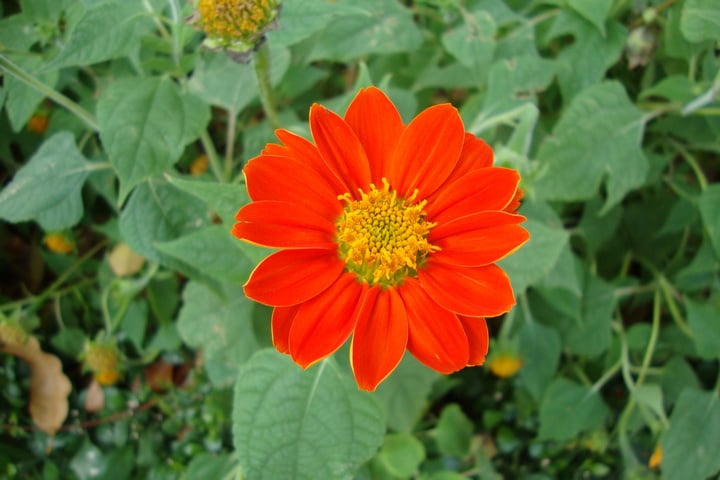
If you’re looking for a large, fast-growing annual to enliven a sunny spot in your garden this summer, Mexican sunflower (Tithonia rotundifolia) should fit the bill. Sow these easy-to-grow seeds in the spring, and you’ll have a large shrub covered with flowers by summer.
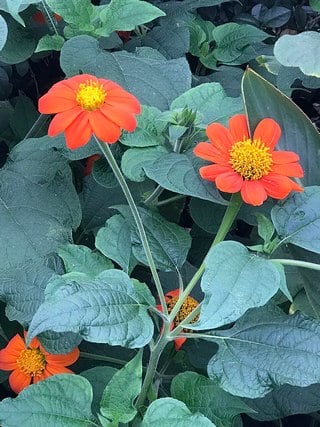
Mexican sunflower has fuzzy, heart-shaped leaves and vivid 3″ flowers that are typically red-orange, but can range from yellow to red. An added feature is that they make beautiful cut flowers.
Depending on your hardiness zone, it may grow as either a frost-tender annual (Zones 2 to 9) or as a perennial (Zones 10 & 11).
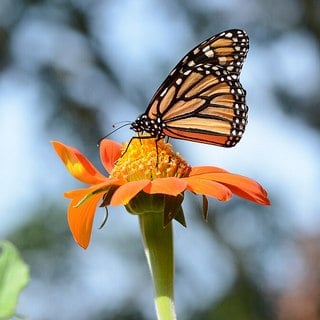
Mexican sunflower is a pollinator magnet. Bees, hummingbirds, and butterflies will frequent its flowers and may be visited by beauties such as monarchs and tiger swallowtails. Songbirds like finches enjoy the seeds.
Its fuzzy leaves and hairy stems generally deter mammals from eating the leaves.
Why I Like This Plant
- Brilliant red-orange flowers
- Fuzzy heart-shaped leaves
- Thrives in summer heat
- Low maintenance
- Supports bees, birds, butterflies
Things to Watch Out For
Mexican sunflower gets tall fast and can get floppy, so you may need to stake yours.
Its stems are prone to wind breakage, so if you live in a particularly windy area, consider growing one of the compact cultivars or a less susceptible plant such as wild sunflower.
Optimal Growing Conditions
If you’re thinking of growing Mexican sunflower in your garden, here are the key factors to keep in mind.
Temperature
Mexican sunflower can be grown as an annual just about anywhere — in USDA Hardiness Zones 2 to 11. It is extremely heat tolerant and can handle the heat of Phoenix, but is not cold-hardy and dies back with the first freeze.
Sun Exposure
Mexican sunflower needs at least 6 hours of full sun to perform best. It should not be grown in shade or part shade.
Size and Growth Rate
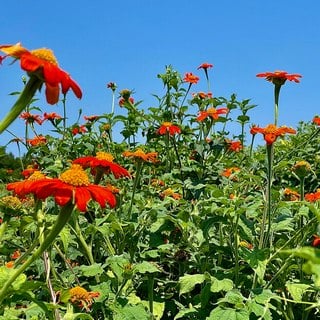
Mexican sunflower is a fast-grower that is not your typical bean pole sunflower. It quickly becomes shrub-like, reaching a size of around 6 feet tall by 4 feet wide. Plants are multi-branched and covered with flowers from June through December.
Soil
Mexican sunflower grows well in most native soil — rocky, sandy, or gravelly — provided it’s well-draining. Planting in rich soil produces weak-stemmed plants with fewer flowers.
Mexican Sunflower:
The Essentials
| Common Name | Mexican sunflower |
| Scientific Name | Tithonia rotundifolia |
| Origin | Mexico, Central America |
| Plant Type | Annual/perennial |
| USDA Zones | Zones 2 – 11 |
| Cold Hardiness | To 32℉ |
| Flower Colors | Red-orange |
| Flower Season | Summer, fall |
| Mature Size | 6′ high x 4’ wide |
| Growth Rate | Fast |
| Sun Tolerance | Full sun |
| Water Needs | Low to moderate |
| Pests & Diseases | Aphids, spider mites |
| Garden Friendly | Non-toxic |
| Wildlife | Attracts butterflies, bees, birds |
How to Plant
While you may find plants for sale, most gardeners grow Mexican sunflower from seed. Seeds can be planted directly in the ground after the danger of frost has passed, or they can be started indoors 6 to 8 weeks before the last frost date.
Seeds should barely be covered with soil, since they need light for germination.
Once seedlings emerge, thin to 2 feet apart.
Where to Buy Seeds
Mexican sunflower seeds aren’t hard to find and most major seed companies carry them. But I like to buy local when possible, so here are some local sources, including one source of free seeds.
Native Seeds/SEARCH is a not-for-profit organization that specializes in seeds of the desert southwest, both edibles and wildflowers. They’ll ship seeds to you, or you can arrange to pick them up if you’re in Tucson.
You can also buy their seeds at Spadefoot Nursery in Tucson.
Tucson’s Pima County library system has a free seed library for cardholders. You can check their seed selection online and place a hold, just like you do for books. Every year, the seed library picks a seed to feature, and this year it’s Mexican sunflower!
Your library system may have a similar program.
How to Care for Mexican Sunflower
Mexican sunflower doesn’t need much care besides regular watering.
Initially, new sprouts need to be kept moist. Plants become somewhat drought tolerant as they mature, but they look their best when consistently watered.
A rule of thumb is to water seeds every 3 days until they sprout, then water every 5 to 7 days.
Plants don’t need pruning but will grow bushier if pinched back once or twice. They flower more if deadheaded, but you may want to leave some dried flowers to feed our feathered friends or to harvest seeds to plant next year.
Mexican sunflower doesn’t need fertilizer, and in fact, fertilizing or amending the soil can lead to weak stems and more leaves at the expense of flowers. But you may want to top dress with organic mulch to keep its roots moist and cool.
Mexican sunflower generally isn’t prone to pests, but it can get aphids or spider mites. If you see these on your plants, spray them off with your hose or use insecticidal soap.
Mexican Sunflower Cultivars
Mexican sunflower has several cultivars. The main differences between them are plant height and/or flower color. Here are some you may encounter.
- ‘Fiesta del Sol’ – 2 – 3′, orange flowers
- ‘Goldfinger’ — 2 – 2.5′, orange-gold flowers
- ‘Red Torch’ – 3 – 4′, red flowers
- ‘Torch’ – 3 – 6′, orange flowers
- ‘Yellow Torch’ – 3 – 4′, yellow flowers
Plant Lover Facts
Mexican sunflower (Tithonia rotundifolia) also goes by the common names red sunflower or tithonia.
It grows as a perennial in its native habitat — the seasonally dry tropical regions of Mexico and Central America. It has naturalized on all inhabited continents. In the US, it has escaped cultivation in Florida and Louisiana.
I find this plant’s scientific name a head-scratcher. 🤔
The genus Tithonia was named after Tithonus, of Greek mythology. This Trojan prince was loved by Eos, goddess of the Dawn. (I don’t get the connection.) The species rotundifolia means “with round leaves”. (I don’t get that either, since the leaves are heart-shaped, not round.)
Mexican sunflower is not in the same genus as typical sunflowers (Helianthus), but it is in the same plant family (Asteraceae).
Did you enjoy this article?
Sign up for our weekly newsletter
where you’ll find more great info on creating &
maintaining a beautiful, carefree desert landscape.
Author Bio
Deane Alban is the creator of Southwest Gardener. She is a science writer with a bachelor’s degree in botany from the University of South Florida. Gardening is her lifelong passion. She’s been gardening in Tucson for over 15 years.

Photo Credits
Prenn, CC BY-SA 3.0, via Wikimedia Commons
F Delventhal, CC BY-SA 2.0, via Wikimedia Commons
Katherine Wagner-Reiss, CC BY-SA 4.0, via Wikimedia Commons
F Delventhal, CC BY-SA 2.0, via Wikimedia Commons