
Mexican flame vine is a beautiful, perennial vine with vivid orange flowers that butterflies can’t resist. Unlike many desert vines, it stays a manageable size. Here’s how to plant and care for this native of Mexico.

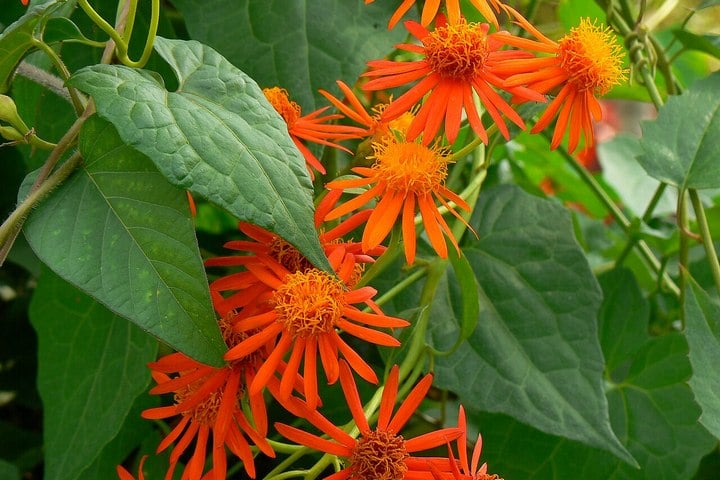
Mexican flame vine (Pseudogynoxys chenopodioides) is a twining vine with deep green, heart-shaped leaves and showy clusters of orange flowers that glow so brightly, they almost look like they’re on fire.
The daisy-like flowers are slightly fragrant and have a long bloom period. While this vine usually blooms from spring through fall, in mild winters, it may bloom all year.
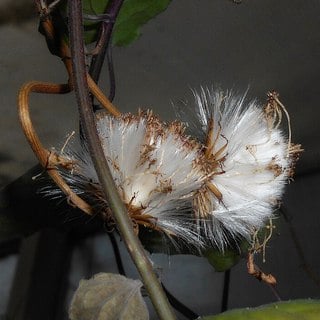
Flowers are followed by inconspicuous, brown fruits that open to release windborne, dandelion-like seeds.
It’s an excellent vine for supporting pollinators. Its nectar attracts bees, hummingbirds, and a wide variety of butterflies including monarchs, queens, swallowtails, fritillaries, skippers, and sulphurs.
Deer, rabbits, and javelinas usually leave it alone.
Why I Like This Plant
- Heart-shaped leaves
- Vivid orange flowers
- Grows fast
- Low maintenance
- Supports butterflies, hummingbirds, bees
Things to Watch Out For
It is mildly toxic if ingested and may cause contact dermatitis in some people. It is toxic to dogs, cats, and horses.
Mexican flame vine may not be easy to find. Tucson’s Spadefoot Nursery sometimes carries it. (You can check their inventory here.) However, I was surprised to discover that you can order Mexican flame vine plants from Amazon, and that plants are easier to find than seeds.
Optimal Growing Conditions
If you’re thinking of adding a Mexican flame vine to your garden, you need to find a suitable place that will keep it healthy and looking good… while minimizing maintenance for you.
Here are the key factors to keep in mind.
Temperature
Grow Mexican flame vine in USDA Hardiness Zones 9 to 11. It is tolerant of desert heat and grows well even in hot spots like Phoenix.
Some sources list it as evergreen, but here in Tucson, it’s semi-deciduous and loses its leaves when the temperature drops below 30℉. But it’s root-hardy down to 20℉ and rebounds quickly in the spring.
Sun Exposure
Mexican flame vine performs best when grown in full sun and should get at least 6 hours per day. When grown in part shade, it will have fewer flowers.
Size and Growth Rate
Mexican flame vine is a fast grower that typically reaches a size of 8 to 12 feet tall and 2 to 6 feet wide in desert gardens. But it can grow taller, depending on how it’s pruned and whether it dies back in the winter.
Soil
Mexican flame vine grows well in any type of desert soil, provided it’s well-draining.
Other Location Considerations
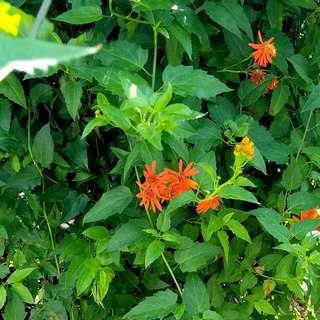
This twining vine readily grows up any nearby support structure, such as a trellis, lattice, or fence. It’s beautiful when rambling over the top of a ramada or pergola. When unsupported, it will grow as a sprawling ground cover.
Mexican Flame Vine:
The Essentials
| Common Name | Mexican flame vine |
| Scientific Name | Pseudogynoxys chenopodioides |
| Origin | Mexico, Central & South America |
| Plant Type | Semi-deciduous vine |
| USDA Zones | Zones 9 – 11 |
| Cold Hardiness | To 20℉ |
| Flower Color | Orange |
| Flower Season | Spring, summer, fall |
| Mature Size | 8-12′ tall x 2-6′ wide |
| Growth Rate | Fast |
| Sun Tolerance | Full, part sun |
| Water Needs | Low to moderate |
| Pests & Diseases | None |
| Cautions! | Toxic |
| Wildlife | Supports butterflies, bees, hummingbirds |
How to Plant
The rule of thumb when planting any vine in the desert is to dig a hole three times as wide as the root ball but no deeper.
Amending the soil is not recommended. Counterintuitively, backfilling with the same native soil you just dug up helps your plant develop a stronger root system.
Topdress with organic mulch rather than gravel, which helps to retain moisture and protects the roots from temperature extremes, but don’t pile mulch right next to the stem.
When to Plant
The best time to plant Mexican flame vine is in the fall. This gives it three seasons to grow roots and get established before the following summer.
The second best time is in spring, the earlier the better. This still gives it time to get established before the intense heat of June arrives.
How to Care for Mexican Flame Vine
Whether you’ve recently planted a Mexican flame vine or have an existing one in your yard, here’s how to take care of it to keep it healthy and looking its best.
How to Water New Vines
Once you’ve got your Mexican flame vine in the ground, watering is your most immediate concern. Here’s a recommended watering schedule for new vines planted in the spring or fall.
| Weeks 1 & 2 | Every 3 – 4 days |
| Weeks 3 & 4 | Every 6 – 7 days |
| Weeks 5 & 6 | Every 7 – 10 days |
| Weeks 7 & 8 | Every 10 – 14 days |
After week 8, gradually revise your watering schedule, depending on the season.
How to Water Established Plants
Mexican flame vine can take anywhere from 1 to 3 years to get established. You’ll know it’s established when it suddenly “takes off”. Here’s a recommended watering schedule for established vines.
| Spring & Fall | Every 10 – 14 days |
| Summer | Every 7 – 10 days |
| Winter | Every 14 – 21 days |
Should You Fertilize?
If you want maximum blooms, don’t fertilize Mexican flame vine. Fertilizing stimulates the production of foliage at the expense of flowers.
Pruning & Propagation
Prune your Mexican flame vine in late winter or early spring to rejuvenate it and remove any cold damage. As it grows, it loses old leaves from the bottom. Cutting it back stimulates new growth to fill in any bare spots.
You can use the cuttings to propagate new plants. It’s super easy since cuttings root in water.
Mexican flame vine has a reputation for being difficult to start from seed, but the problem may be with the seeds, not the gardener’s care. Two Mexican flame vines must cross-pollinate, so if you’re only growing one, don’t expect viable seeds.
Plant Lover Facts
Mexican flame vine (Pseudogynoxys chenopodioides) also goes by the common names orange-flowered groundsel and orange glow vine.
It’s commonly referred to by its former scientific name, Senecio confusus, which, oddly, means “confused old man.” I find this confusing…🤔
Mexican flame vine, unsurprisingly, is native to Mexico. Its native range extends through Central America and into northern and eastern South America.
As an Amazon Associate, Southwest Gardener earns from qualifying purchases, at no cost to you.
See our Terms of Use for details.
Did you enjoy this article?
Sign up for our weekly newsletter
where you’ll find more great info on creating &
maintaining a beautiful, carefree desert landscape.
Author Bio
Deane Alban is the creator of Southwest Gardener. She is a science writer with a bachelor’s degree in botany from the University of South Florida. Gardening is her lifelong passion. She’s been gardening in Tucson for over 16 years.

Photo Credits
Dinesh Valka, CC BY-SA 2.0, via Wikimedia Commons
Yucaluptus, CC0, via Wikimedia Commons
Salicyna, CC0, via Wikimedia Commons