
Maximilian sunflower is a large, shrub-like perennial with golden daisy-like flowers. It’s easy to grow from seed and is a boon for birds and other wildlife. Here’s everything you need to know about growing this sunflower that’s native throughout North America.
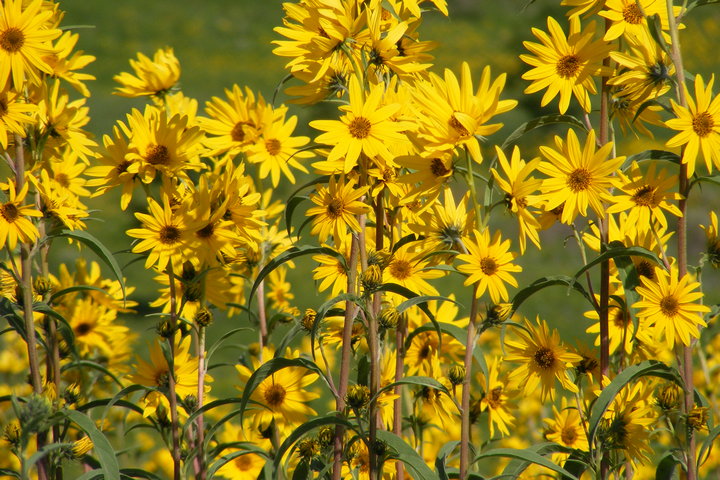
If you love sunflowers, but don’t love having to plant them every year, Maximilian sunflower (Helianthus maximiliani) is a perennial to consider. Unlike annual sunflowers, it comes back every year.
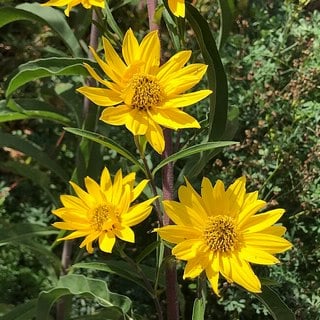
Maximilian sunflower is a large, shrub-like herbaceous perennial with fuzzy, tapered, gray-green leaves that are frequently folded lengthwise. Summer through fall, it’s covered with golden yellow, daisy-like flowers that are small for sunflowers — typically 3 inches across.
Maximilian sunflower produces a heavy crop of seeds, making it a magnet for wildlife — bees, butterflies, small mammals, and birds. According to the Audubon Society, it attracts cardinals, finches, mockingbirds, thrashers, and orioles.
Why I Like This Plant
- Loads of cheerful yellow flowers
- Perennial!
- Low maintenance
- Excellent for supporting birds
And if you have clay soil (like I do), it’s great to find a plant that actually prefers rather than tolerates clay.
Things to Watch Out For
If you are expecting a bean-pole with dinner-plate size flowers, Maximilian sunflower is not that plant. It has more in common with wild sunflower than it does with annual sunflower hybrids.
Another way Maximilian differs is that it’s not as well-behaved. It self-seeds in the garden. It also spreads by underground roots, forming colonies which can be left to expand or dug up and divided. This may be a benefit or a drawback, depending on how much space you have.
This is not a good choice to include in flower or vegetable beds with fertile soil, where it will grow aggressively, crowding out your other plants.
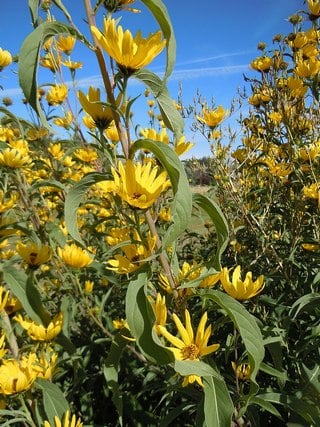
Maximilian sunflower can get floppy and may need staking, particularly when pampered with too much water or shade, or overly fertile soil. This plant doesn’t mind a little neglect.
Rabbits, deer, and livestock will graze on this plant.
Like many members of the Asteraceae family, Maximilian sunflower’s leaves, stems, flowers, and pollen contain compounds that can cause contact dermatitis.
Optimal Growing Conditions
If you’re thinking of adding Maximilian sunflower to your garden, you need to find a suitable place that will keep your plant healthy and looking good… while minimizing maintenance for you.
Here are the key factors to keep in mind.
Temperature
Maximilian sunflower should be grown in USDA Hardiness Zones 4 to 9. It’s tolerant of heat and extreme cold. It will go dormant during the winter, even in mild winters, but will survive temperatures down to -20℉.
Sun Exposure
Maximilian sunflower needs at least 6 hours of full sun to perform best. It can be grown in very light shade, but too much shade will result in a leggy plant with fewer flowers.
Size and Growth Rate
Maximilian sunflower quickly becomes shrub-like, reaching a size of around 6 to 8 feet tall by 2 to 4 feet wide. Plants are multi-branched and covered with flowers from summer through fall.
Soil
Maximilian sunflower is native to prairies and grows best in clay soil. But it will grow well in most native soil — rocky, sandy, or limestone-based — provided it’s well-draining. Planting in overly rich soil produces weak-stemmed plants.
Maximilian Sunflower:
The Essentials
| Common Name | Maximilian sunflower |
| Scientific Name | Helianthus maximiliani |
| Origin | North America |
| Plant Type | Perennial |
| USDA Zones | Zones 4 – 9 |
| Cold Hardiness | To -20℉ |
| Flower Colors | Yellow |
| Flower Season | Summer, fall |
| Mature Size | 6-8′ high x 2-4’ wide |
| Growth Rate | Moderate |
| Sun Tolerance | Full sun |
| Water Needs | Moderate |
| Pests & Diseases | None |
| Garden Friendly | Non-toxic |
| Wildlife | Supports butterflies, bees, birds |
How to Grow
Transplants can be hard to find. Here in Tucson, Spadefoot Nursery sometimes carries them. You can check for availability here. If you live elsewhere, try High Country Gardens, which will ship them to you.
Seeds are not hard to find. Several seed companies carry Maximilian sunflower seeds on Amazon, or you can order them from Terroir Seeds, an Arizona seed company that specializes in heirloom seeds.
Seeds can be planted directly in the ground after the danger of frost has passed. Scatter the seeds directly on top of the soil, then lightly press them into the soil — you don’t want to deeply bury them. Keep the soil moist until they are about 6 inches tall, then water sparingly after that.
If you collect your own seeds, refrigerate them over the winter. This mimics the cold they would experience in nature and can significantly improve germination.
How to Care for Maximilian Sunflower
Maximilian sunflower doesn’t need much care besides watering.
Initially, new sprouts should be kept moist. Plants become somewhat drought tolerant as they mature, but they look their best when consistently watered.
A rule of thumb is to water seeds every 3 days until they sprout, then water every 5 to 7 days for the first growing season. Once established, you can reduce watering to every 2 weeks or so, when actively growing. There’s no need to water during the winter, since they go dormant.
In its native habitat, Maximilian sunflower survives on as little as 9 inches of annual rainfall or as much as 50 inches.
It doesn’t need fertilizer or pruning, other than to cut back dead stems in the early spring.
Plant Lover Facts
Maximilian sunflower (Helianthus maximiliani) also goes by the common name Max sunflower. It’s named in honor of Prince Maximilian of Wied-Neuwied, a German naturalist who explored parts of the American West in the early 1800s.
It’s native to much of North America. Its natural habitat includes over 35 US states, northwest Mexico, and the southern half of Canada. In the US southwest, it naturally grows in California, Utah, and Texas, but not in Arizona, New Mexico, or Nevada.
Historically, Native Americans used parts of this plant as sources of food and vegetable oil, dye, and thread. Recently, it’s been grown along with native grasses to revegetate coal mine spoils.
As an Amazon Associate, Southwest Gardener earns from qualifying purchases, at no cost to you.
See our Terms of Use for details.
Did you enjoy this article?
Sign up for our weekly newsletter
where you’ll find more great info on creating &
maintaining a beautiful, carefree desert landscape.
Author Bio
Deane Alban is the creator of Southwest Gardener. She is a science writer with a bachelor’s degree in botany from the University of South Florida. Gardening is her lifelong passion. She’s been gardening in Tucson for over 16 years.

Photo Credits
USFWS Mountain-Prairie, CC BY-SA 2.0, via Wikimedia Commons
Matt Lavin, CC BY-SA 2.0, via Wikimedia Commons
Francis Groeters, CC BY-SA 4.0, via Wikimedia Commons