
January is the second coldest month, but there are still plenty of things to be done in the desert garden. Here’s a look at what you can plant this month, how to adjust your watering schedule for winter, how to care for holiday plants, and more.

January is one of my favorite months in the desert. I find myself comparing the weather to that of other places I’ve lived (like Chicago, New York, and Baltimore 🥶) and feel grateful that I managed to wind up in my idea of paradise.
The weather in January is nearly indistinguishable from December’s, and consequently, the garden “to do” list is similar to December’s.
January Weather Outlook
There’s not much of a change in the weather since last month. The average highs and lows in Tucson and Phoenix are surprisingly around 1 degree warmer than December’s. But the sun continues to get less intense — the average UV index in January is the lowest of the year.
Here’s a look at January weather averages in both Tucson and Phoenix.
January Weather Averages (Tucson)
| High temperature | 67°F |
| Low temperature | 41°F |
| Precipitation | 1.00″ |
| Relative humidity | 46% |
| UV Index | 2.7 |
| Wind | 13 mph |
January Weather Averages (Phoenix)
| High temperature | 68°F |
| Low temperature | 46°F |
| Precipitation | .88″ |
| Relative humidity | 42% |
| UV Index | 2.3 |
| Wind | 6 mph |
If you live elsewhere, enter your city or town in the search bar at TimeandDate.com to find your weather averages. And you can find your average UV index at UVIndex.io.
January Gardening Tasks
While a lot of tasks are on hold or minimized this month, there are still ways to keep busy in the garden if you choose to.
Here’s a snapshot of the tasks you can expect to do (or not do) this month.
| ✅ | Be prepared for frost |
| ✅ | Water on a reduced schedule |
| ✅ | Plant cold-weather annuals |
| ✅ | Plant living Christmas trees |
| ✅ | Plant bare root plants |
| ✅ | Fertilize citrus |
| ✅ | Prune roses, deciduous trees |
| ❌ | Don’t fertilize most plants |
| ❌ | Don’t prune most plants |
Read on for all the details and exceptions!
What to Plant in January
Surprisingly, there are a handful of things that can be planted in January.
- cold-weather annuals
- live Christmas trees
- bare root roses and deciduous trees
- cold-weather herbs and vegetables
Winter annuals planted now — pansies, snapdragons, alyssum, lobelia, stock, dianthus, geraniums, and petunias — can still be enjoyed for the next four months or so. Then it will be time to replace them with summer annuals.
If you have a live Christmas tree, January is a good time to get it in the ground. Plant it in a hole as deep as the root ball (no deeper) and three times as wide.
Watering New Plants
If you planted any trees or shrubs in November or December, continue to water them according to this University of Arizona recommended schedule for 8 weeks total.
| Weeks 1 & 2 | Every 3 – 4 days |
| Weeks 3 & 4 | Every 5 – 7 days |
| Weeks 5 & 6 | Every 7 – 10 days |
| Weeks 7 & 8 | Every 10 – 14 days |
Water Established Plants on a Reduced Winter Schedule
By now, you should have drastically cut back on watering frequency for all your established plants. Most trees and shrubs only need water about once a month in the winter.
You can stop watering succulents such as cactus, agaves, aloe, hesperaloe, and desert spoon this month. Winter rains normally provide adequate water between fall and spring. But continue to water potted succulents once a month for the next few months.
Continue to give your plants the same amount of water with each watering, but cut back on the frequency, using this chart as a guideline.

Not sure how to adjust your watering schedule for January?
These articles can help:
7 Tips for Watering Landscape Cactus (& Other Succulents)
How to Water Desert Trees: How Often? How Much?
How to Water Desert Shrubs: How Often? How Much?
Watering Before a Freeze
Most plants benefit from watering before a freeze. The exceptions are cactus and other succulents, which are more likely to suffer freeze damage if they’ve been recently watered.
What to Fertilize
Don’t fertilize landscape plants this month. Feeding them now can encourage them to push out new frost-sensitive growth. However, you can still fertilize potted flowering annuals once a month.
Citrus: The Exception
Citrus should be fertilized three times per year, with the first feeding of the year occurring sometime in January or February, regardless of the kind of citrus.
You may be used to fertilizing on certain holidays, such as on Valentine’s Day. This was suggested largely to help gardeners remember when to fertilize, but the latest recommendations are more flexible and now give you a two month range.
There’s more to fertilizing citrus than haphazardly sprinkling fertilizer around a tree. Learn how to fertilize citrus for best results in our article How & When to Fertilize Citrus Trees.
What to Prune
By the second or third week in January, you can start pruning dormant deciduous trees. Once they’ve lost their leaves, you can more readily see their branch structure to determine what needs pruning. Pruning now won’t stimulate new growth, but it will minimize dripping sap.
This is also the time to prune established roses by one-half to two-thirds.
You can prune any dead or broken branches, suckers, or water spouts on shrubs or trees anytime, especially if they pose a hazard.
You can continue to deadhead annuals to encourage flowering.
Don’t prune any cold damaged growth on any of your plants until the danger of frost has passed.
Harvest Your Citrus (Maybe)
Depending on your microclimate and the variety you’re growing, some citrus may be ripe this month.
Color is not the best way to determine if citrus is ripe. When ripe, fruits should have a pleasant citrusy smell and have some heft when you hold them.
If you suspect your fruits are ripe, pick one and give it a try. It’s the only way you’ll know for sure. And remember that citrus, once picked, does not continue to ripen. So don’t be in a hurry to pick oranges and grapefruit since “The longer on the tree, the sweeter it will be.” 😋
How to Care for “Holiday” Plants
Now that the holidays are over, it’s time to decide on the fate of your poinsettias and other holiday plants. Non-gardeners usually treat them like cut flowers — enjoy their temporary beauty and toss them after the holidays.
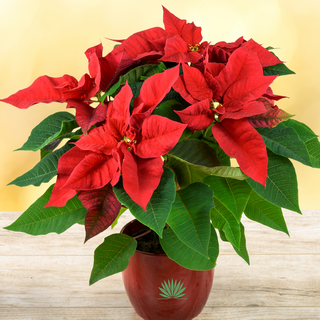
If you want to keep yours growing in the short term, place them in bright indirect light and keep their soil evenly moist.
But if you plan to keep yours permanently, it gets more complicated.
Check out our article The ‘Ins & Outs’ of Growing Poinsettias. It includes precise instructions for taking care of your poinsettia and getting it to bloom next winter. Here in the desert southwest, there are 3 ways to grow this Mexican native — as a house plant, outside as a patio plant, or in the ground as a shrub.
Christmas cactus, cyclamen, kalanchoe, and amaryllis are other traditional holiday plants that can be grown all year here, either indoors or outdoors with some protection. Like poinsettias, they require special care if you want them to bloom again next year. Learn how to care for these plants after the holidays here.
Be Prepared for Frost
By January, there’s a good chance that you’ve experienced frost in your garden. Here are a few things you can do to be prepared for freezing temperatures when they occur.
Figure Out What Plants Need Protecting
Don’t assume that all your plants need protecting. Most desert landscape plants don’t need cold protection, especially if they are native. And it’s rare that a mature plant needs protecting — if it’s made it this far, it should continue to be OK, unless the forecast is for extreme, record-breaking cold.
You can find out which plants are frost-sensitive by referring to our Desert Plant Cold Hardiness Guide, which lists the cold tolerance of over 200 popular landscape plants.
Know Your Precise Temperature Forecast
Second, follow the weather as close to home as possible. Typical weather forecasts will tell you what to expect at the airport — but I doubt you live or garden at the airport! I use Weather Underground, which offers over 60 weather stations in Tucson to pick from.
To find your nearest station, type your city or town in the search box, then click on “Change” and you’ll be presented with a drop-down list of “Nearby Weather Stations.” Review the map and choose the weather station nearest you.
I also suggest putting a thermometer or two in various spots in your yard to track your microclimates. Seeing how consistently cooler or warmer some locations are can be enlightening. Knowing this can make the difference between having to cover certain plants or not.
Recommended Reading:
The Importance (& Limitations) of Knowing Your USDA Hardiness Zone
Get Your Desert Garden Ready for Winter
Be Ready to Cover
Third, have what you need to protect your plants before you need it. It’s not unusual for local hardware stores and nurseries to run out of frost cloth when there’s an impending freeze.
Many gardeners improvise with sheets, towels, blankets, or burlap, but using frost cloth has some advantages. It lets in air and light, can be left up for days, and if there’s rain, it dries fast and doesn’t weigh your plants down. Towels, sheets, and blankets can be too heavy for some plants, especially if they get wet. And many gardeners find that handling burlap makes them itchy.
Frustratingly, cold fronts are often accompanied by wind and sometimes rain. So do a practice run to figure out how you’ll secure your coverings ahead of time. You don’t want to find your frost cloth in your neighbor’s yard the morning after a freeze. (Yes, I’ve had that happen.) 🫣
Covering Cactus
It’s not unusual to see columnar cactus tips covered with red cups or small Santa Claus hats for the holidays. Some people do this for decoration only, but others are trying to protect the tender tips from frost. Not all cactus need protection, but totem poles, fence posts, and young saguaros are among those that benefit from frost protection.

Cloth hats, paper bags, or styrofoam cups are good choices, but do not use plastic cups! Plastic does not insulate — it conducts cold — and can cause more damage than leaving tips bare.
If you put hats on your cactus for Christmas, remove them now.
Ideally, cactus tips should not be covered for more than a few days in a row.
Upcoming Gardening Events in January
After a slight holiday lull, gardening classes and events are picking up again. You’ll find an up-to-date list of gardening-related events in our Tucson Gardening Events Calendar.
Don’t live in Tucson? Look for online classes. You can participate in these no matter where you live.
Did you enjoy this article?
Sign up for our weekly newsletter
where you’ll find more great info on creating &
maintaining a beautiful, carefree desert landscape.
Author Bio
Deane Alban is the creator of Southwest Gardener. She is a science writer with a bachelor’s degree in botany from the University of South Florida. Gardening is her lifelong passion. She’s been gardening in Tucson for over 15 years.
