
With the right care, you can prolong the life of a poinsettia well beyond the holidays. In the desert Southwest, you have options! You can grow it as a houseplant or outside as a patio plant. You can even grow this Mexican native as a landscape shrub.
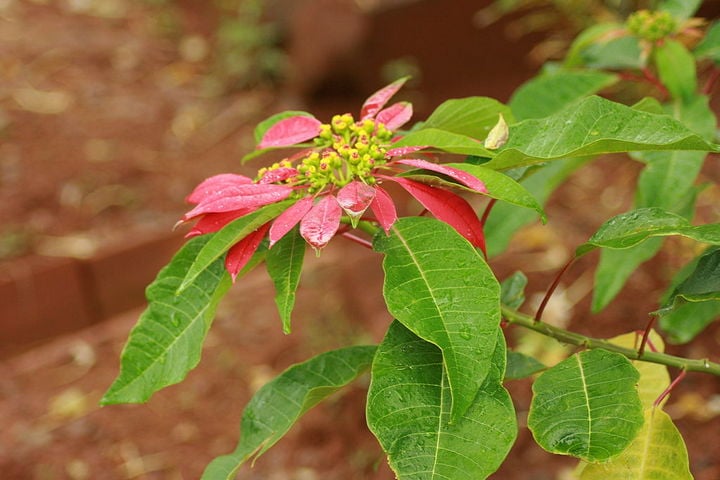
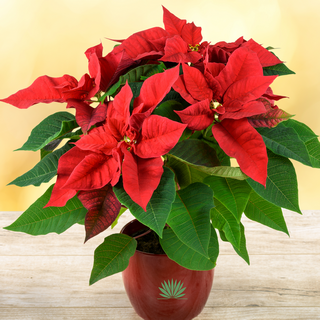
With its deep green leaves and colorful red bracts, poinsettia is the quintessential holiday plant. Most people treat poinsettias like cut flowers — enjoy their temporary beauty and discard them after the holidays. This is understandable, since keeping them alive and getting them to rebloom the following winter is not easy, but it can be done.
And those of us who live in the desert Southwest are fortunate because we can grow poinsettias outside — both in pots and, if your microclimate allows, in the ground as a flowering landscape shrub.
Taking Care of Poinsettia During the Holidays
Whether you plan to grow your poinsettia inside or outside, the initial care instructions during the holidays are pretty straightforward.
Light
Keep your poinsettia in bright, indirect sun for around six hours a day. Too much sun will discolor the bracts — the colorful, modified leaves that are commonly thought of as flowers.
Temperature
Keep your poinsettia at room temperature, around 65℉ to 70℉. Even if you plan to grow it outside eventually, don’t put it outside now. December is too cold at night. Poinsettias don’t like freezing temperatures. Additionally, your poinsettia was grown in a temperature-controlled greenhouse, and our cold nights would be a big shock for it.
Water
Poinsettias like moist, but not wet, soil and should be allowed to dry out between waterings. Water poinsettias when the top few inches of the soil feel dry to the touch. Overwatering can lead to root rot.
Fertilize?
There is no need to fertilize a poinsettia that’s in bloom.
Continue this care until you notice the bracts fading in the spring.
Then follow this next set of instructions.
Taking Care of Poinsettias: Month-by-Month
Keeping a poinsettia alive after the holidays can be challenging, especially if your goal is to have it bloom again next year for the holidays.
There are very specific instructions on how to achieve this if you are growing it as a houseplant. Let’s take a look at what needs to be done month-by-month
April
When you notice the colorful bracts have faded, it’s time to cut back on watering to let your plant go through a rest period.
May
Prune your plant back to around six to eight inches and repot it into a slightly larger pot, adding fresh potting soil. Place it in a sunny spot inside. Once new growth appears, you can begin fertilizing every other week.
June
Now it’s time to move your poinsettia to an appropriate spot outdoors, such as in the dappled shade under a tree.
Monitor your plant carefully during this transition period. June is harsh — it’s the hottest, driest month of the year. So make sure your plant doesn’t dry out or suffer from sunscald.
July
Begin pinching the ends back by about 1 inch to encourage bushiness. More branching now means more flowers later.
Be aware that when you pinch your poinsettia, it will exude milky sap. If you get any on your hands, wash them immediately, since it may cause irritation. Anyone with a known latex allergy should avoid getting the sap on their skin.
Poinsettia belongs to the same genus (Euphorbia)
as many popular succulent landscape plants,
including gopher plant, candelilla, lady slipper,
Moroccan mound, Baja spurge, and firesticks.
August
Continue watering, fertilizing, and pinching back the tips.
September
Now it’s time to bring your poinsettia back inside and place it in a sunny location. Continue watering and fertilizing regularly, but stop pinching the ends.
October
October is when caring for your poinsettia starts getting interesting.
Poinsettia is a photoperiodic plant — it sets buds and produces flowers as the nights get longer. This means your poinsettia must be kept in complete, uninterrupted darkness for 14 hours every night if you want it to bloom! 😮
To accomplish this, you can place it in a large box, dark closet, or unused room every night for the next 8 to 10 weeks. It’s OK if this area is a little cool, since its ideal nighttime temperatures are 55℉ to 65℉.
Then, every morning, take it out of the dark and provide it with 6 hours of sun.
Continue watering and fertilizing regularly.
November
Continue watering, fertilizing, and providing 14 hours of darkness.
December
Once the 8 to 10 weeks of nocturnal darkness are up, you should notice colorful bracts forming. At this point, you can resume the normal holiday care routine at the beginning of this article.
Growing Poinsettia as a Patio Plant
If you grow one outside in a container as a patio plant, follow the same month-to-month care schedule as much as you can, minus the part about moving it in and out. You shouldn’t need to be concerned about providing longer periods of darkness unless your patio is particularly well-lit. But you will need to cover it or move it to a protected area to protect it from occasional freezing temperatures.
My Thoughts
You can see why following this routine is not for everyone. There are many points where things can go wrong. I did it once to prove to myself that it could be done, but I foresee doing it again.
Don’t feel like a bad plant parent if you decide it’s not for you, or if you tried this and it didn’t work out. The nursery industry depends on people like us to buy more poinsettias, anyway. 😉
Now, let’s look at how to grow poinsettias outside in the ground as a landscape plant.
Growing Poinsettias Outside
Poinsettia (Euphorbia pulcherrima) is native to Mexico and Guatemala, where it’s found growing along the Pacific coast and in dry tropical forests. This makes poinsettia a near native to the US Southwest, which is why it can be grown in our region.
If you live in USDA hardiness zones 10 through 11, it should not be too cold to grow poinsettias outside. If you live in zone 9, it’s marginal. They can survive, but should be protected from frost. Light frosts will damage the foliage, while hard freezes can kill the roots.
Growing Poinsettias in the Ground
To successfully grow poinsettias in the ground, you must provide the right conditions. They don’t like extreme temperatures or intense sun, so avoid planting in either the coldest or hottest spot in your yard. Choose a spot with morning sunlight and afternoon shade.
Avoid planting where it could be exposed to artificial light at night, which will prevent it from blooming. And give it plenty of room. They can grow to be 12 feet tall by 8 feet wide.
When planting, amend the soil with compost or soil mix and topdress with organic mulch. Poinsettias prefer moist, fertile, slightly acidic soil.
Fertilize monthly from spring through fall with a balanced fertilizer.
Prune in early spring to remove any cold damage. Then prune regularly during the growing season to encourage bushiness and prevent plants from getting too leggy.
Water as you would any moderate water use landscape shrub.
Poinsettia Problems
When forced to grow outside of their natural habitat, poinsettias are prone to several pests, diseases, and nutritional deficiencies. You’ll find solutions to these problems in this poinsettia presentation created by the Yavapai County Master Gardener Association.
What About Toxicity?
You may have heard that poinsettia is extremely toxic, but is that true?
Reputable sources such as the ASPCA, Poison.org, and the American Journal of Emergency Medicine concur that poinsettia is only mildly toxic and should only cause digestive upset in people and pets.
Considering that almost every plant in the desert is toxic, spiky, or otherwise out to get you, poinsettia is no more dangerous than many other desert landscape plants. However, it’s still prudent to keep it away from kids and pets.
Interesting Poinsettia Facts
Let’s finish up with some fascinating poinsettia facts:
- Every holiday season, over 70 million poinsettias are sold within a 6 week period.
- It’s been called the world’s most economically important potted plant.
- Poinsettias are America’s #1 selling potted plant, contributing $250 million to our nation’s economy.
- The red “flowers” are actually modified leaves called bracts.
- Over 100 varieties have been bred. They come in a rainbow of colors — white, cream, pink, purple, orange, apricot, and yellow. There are also marble and bicolor varieties.
- Poinsettias are named after Joel Poinsett, the United States’ first minister to Mexico, who introduced the plant to the US. (You can learn more about his controversial career here.)
While you can pick up poinsettias just about anywhere, if you live in Tucson, treat yourself to a visit to Green Things Nursery. As Arizona’s largest grower of poinsettias, it’s “the” place to buy poinsettias. They sell them to the public and to other nurseries.

Did you enjoy this article?
Sign up for our weekly newsletter
where you’ll find more great info on creating &
maintaining a beautiful, carefree desert landscape.
Author Bio
Deane Alban is the creator of Southwest Gardener. She studied journalism and received a bachelor’s degree in botany from the University of South Florida. Gardening is her lifelong passion. She’s been gardening in Tucson for over 16 years.
