
Ice plant is a succulent, evergreen ground cover. When in bloom, shimmery, purple daisy-like flowers are so dense they obscure the foliage. Here’s everything you need to know about growing this charming South African native in this complete care guide.

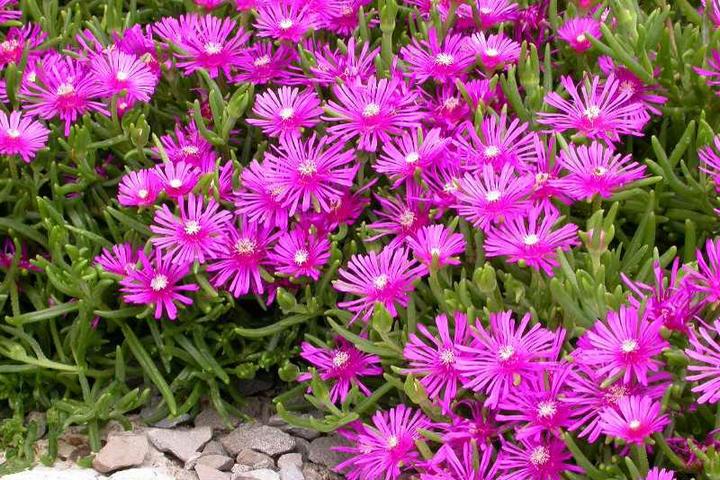
Ice plant (Delosperma cooperi) is a heat-loving ground cover with small, green succulent leaves and starbursts of vivid purple-pink, iridescent flowers that bloom from spring to fall. When in bloom, densely packed flowers form a carpet of color.
Why the name ice plant? If you look closely, the flowers and the leaves appear to glisten. Ice plants have small transparent bladders that reflect and refract light, making them sparkle.
This dainty-looking plant is tougher than it looks. Ice plant tolerates desert temperature extremes and needs relatively little water. In its native habitat of South Africa, it receives the same amount of rain as Tucson — around 12 inches per year.
Flowers attract bees and butterflies. Deer and rabbits generally leave this plant alone.
There are about 180 species called “ice plant”.
This post focuses on Delosperma cooperi,
the most commonly cultivated ice plant.
Why I Like This Plant
- Evergreen, succulent foliage
- Iridescent magenta flowers
- Low maintenance, non-toxic
- Forms a weed-smothering mat
- Supports bees, birds
Things to Watch Out For
Ice plant is easily crushed or broken and does not stand up to foot traffic.
These plants do not tolerate having cold, wet roots. They should not be planted in clay soil, and should not be on irrigation or stay wet for any length of time during the winter.
Optimal Growing Conditions
If you’re thinking of adding an ice plant to your garden, you need to find a suitable place that will keep your plant healthy and looking good… while minimizing maintenance for you.
Here are the key factors to keep in mind.
Temperature
Ice plant should be grown in USDA Hardiness Zones 6 to 10. It’s tolerant of desert heat and is cold-hardy down to 0℉, but only in dry climates. It does not tolerate cold, wet winters. However, it’s normal for it to lose some leaves during extreme cold.
Sun Exposure
Ice plant should be grown in full sun. It tolerates some shade but won’t flower as profusely.
Size and Growth Rate
Ice plant is a fast-growing ground cover. It stays around 6 inches tall and usually spreads 1 to 2 feet across. It blooms from late spring through summer and into fall.
Soil
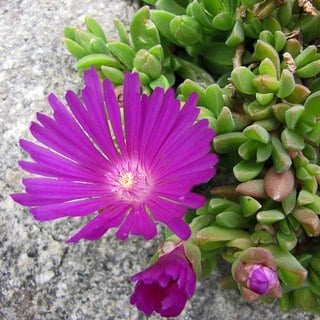
In its native habitat, ice plant grows along rocky outcrops. In desert gardens, it needs well-draining sandy or rocky soil. It will struggle to survive winters in clay soil.
Other Location Considerations
Since ice plant is low litter and non-toxic, and doesn’t have any thorns or irritating hairs, it’s a good choice to plant along pools, patios, walkways, or anywhere else it may come in contact with people or pets, provided it won’t get stepped on.
It makes a beautiful “spiller” in patio planters, raised beds, or hanging baskets. For extra color, pair it with one of the many colorful ice plant cultivars that come in white, yellow, orange, lavender, or red.
It can be planted on slopes for erosion control. Once established, it forms a dense mat that keeps weeds at bay.
If you grow one in a container, be sure it has good drainage and use specifically formulated cactus soil.
Ice Plant:
The Essentials
| Common Name | Ice plant |
| Scientific Name | Delosperma cooperi |
| Origin | South Africa |
| Plant Type | Evergreen ground cover |
| USDA Zones | Zones 6 – 10 |
| Cold Hardiness | To 0℉ |
| Flower Color | Magenta |
| Flower Season | Spring, summer, fall |
| Mature Size | 6″ tall x 2’ wide |
| Growth Rate | Fast |
| Sun Tolerance | Full, part sun |
| Water Needs | Low |
| Pests & Diseases | None |
| Garden Friendly | Unarmed, low litter, non-toxic |
| Wildlife | Supports bees, butterflies |
How to Plant
The rule of thumb when planting any ground cover in the desert is to dig a hole twice as wide as the root ball but no deeper.
Since ice plant prefers sandy or rocky soil that is very well-draining, consider amending with coarse sand or small gravel to improve drainage.
When to Plant
The best time to plant ice plant is in the fall. This gives it three seasons to grow roots and get established before the following summer.
The second best time is in spring, the earlier the better. This still gives it time to get established before the intense heat of June arrives.
How to Care for Ice Plant
Whether you’ve recently planted an ice plant or have an existing plant in your yard, here’s how to take care of it to keep it healthy and looking its best.
How to Water
The University of Arizona recommends watering newly planted, low water use ground covers on this schedule.
| Weeks 1 – 4 | Every 2 – 3 days |
| Weeks 5 & 6 | Every 6 – 7 days |
| Weeks 7 & 8 | Every 10 – 14 days |
Give your ice plant about ½ gallon with each watering. After that, you can water it on this schedule:
| Spring (March – May) | 10 – 14 days |
| Summer (May – Oct.) | 7 – 10 days |
| Fall (Oct. – Dec.) | 10 – 14 days |
| Winter (Dec – March) | 14 – 21 days |
As it grows, it will need more water with each watering. It will need ½ gallon per watering when it’s 1 foot in diameter, but will need 2 gallons when 2 feet across.
If you’re growing one in a container, use this watering schedule as a guide.
| Spring & Fall | Every 7-10 days |
| Summer | Every 5-7 days |
| Winter | Every 10-14 days |
It is imperative that you cut back on watering in the fall to prepare your plant for winter. Well-hydrated plants are often killed by the first hard frost.
Should You Fertilize?
Ice plant evolved to grow in poor, rocky soil and doesn’t need fertilizer. However, most growers recommend feeding once per year with organic fertilizer. Frequent feedings, especially with synthetic fertilizer, encourage growth into the fall, which makes plants susceptible to cold damage.
Pruning & Propagation
Ice plant is an easily managed ground cover that can be trimmed anytime it overgrows its spot. You can use any healthy cuttings to propagate new plants by rooting them in cactus soil. This works best in the spring.
Prune any stems that show signs of cold damage in the spring or heat damage in the fall.
Ice Plant Cultivars
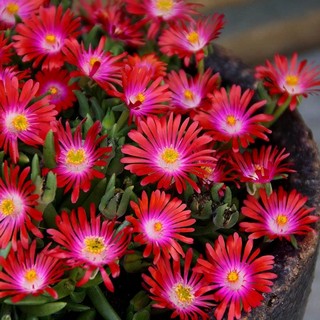
Ice plant Delosperma cooperi cultivars come in a breathtaking assortment of colors such as ‘Alan’s Apricot’, ‘Lavender Ice’, and ‘Orange Ice’. The Jewel of Desert series have fabulous multicolor flowers, like this beauty below.
If you can’t find ice plants locally, you can order them online from High Country Gardens.
Plant Lover Facts
Ice plant (Delosperma cooperi) also goes by the common names purple ice plant, trailing ice plant, and hardy ice plant. It’s native to South Africa. It has naturalized in Italy and Spain, and oddly, in Austria and Great Britain. (Odd because this plant loves heat and dry weather!)
The nomenclature surrounding ice plants can be confusing. Aizoaceae is known as the “ice plant family”. Plants called ice plants can belong to numerous genera within this family besides Delosperma (i.e., Carpobrotus, Drosanthemum, Lampranthus, Malephora, Mesembryanthemum). Rocky Point ice plant, for example, belongs to the Malephora genus.
Delosperma cooperi was first introduced to the gardening community by the Denver Botanic Garden, which was looking for plants to add to their mile-high rock garden. It was found to be suitably cold hardy for the Denver climate.
Did you enjoy this article?
Sign up for our weekly newsletter
where you’ll find more great info on creating &
maintaining a beautiful, carefree desert landscape.
Author Bio
Deane Alban is the creator of Southwest Gardener. She is a science writer with a bachelor’s degree in botany from the University of South Florida. Gardening is her lifelong passion. She’s been gardening in Tucson for over 16 years.

Photo Credits
HQ, CC BY-SA 2.0, via Wikimedia Commons