
Goldenball leadtree is a small deciduous tree with bright green foliage and golden yellow puffball flowers. It may look like it belongs in the tropics, but it’s a tough Chihuahuan Desert native. Learn how to grow it in this complete care guide.
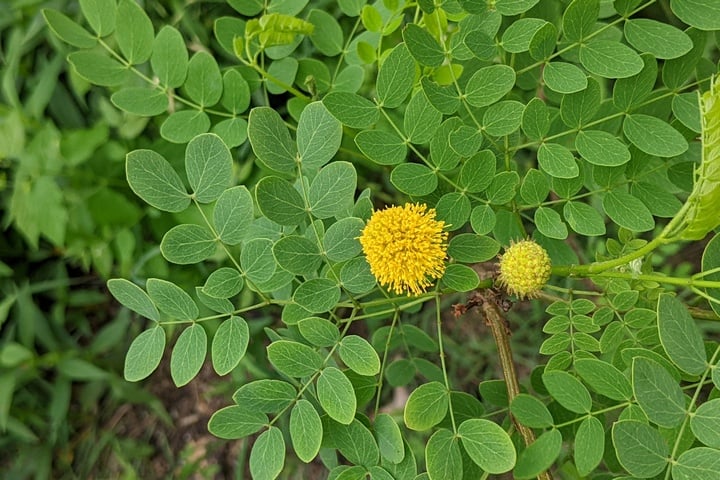
Goldenball leadtree (Leucaena retusa) naturally grows as a large shrub, but when used in the landscape, it’s usually grown as a small ornamental tree.
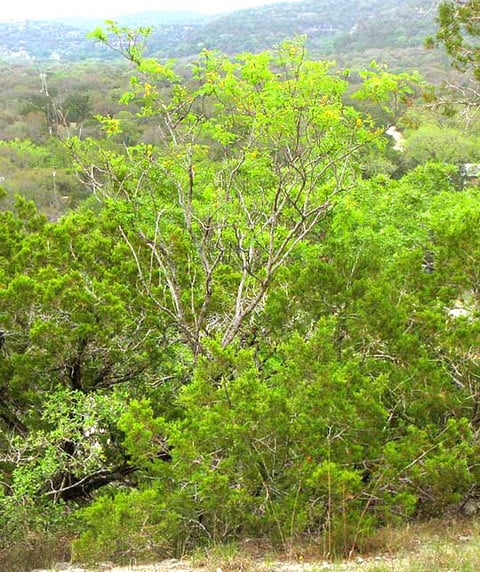
This airy, tropical-looking tree may look delicate, but it’s a tough desert native that is tolerant of desert sun, temperature extremes, and aridity.
Its lacy leaves are bright green, a color not often seen in the desert. You can see how this goldenball leadtree’s foliage pops compared to the surrounding desert plants.
Goldenball is aptly named since, in the spring, plants are covered with yellow, puffball flowers. Flowers also appear intermittently after monsoon rains. Flowers are followed by long skinny pods.
Bees and butterflies frequent the nectar-rich flowers, and some bird species eat the seeds.
Why I Like This Plant
- Small, lacy tree with vivid green foliage
- Fragrant puffball flowers
- Thornless
- Supports birds, bees, butterflies
Things to Watch Out For
Goldenball leadtree has brittle wood that is easily storm damaged, so grow it in a protected spot where it’s shielded from high winds.
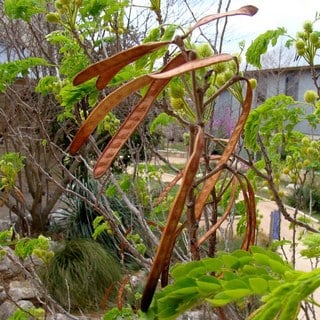
It is not low litter — it has significant 10″ seed pods. If pods are left on the ground, they readily reseed, sometimes to the point of being a nuisance.
Deer will browse on the leaves. If that is a concern where you live, you may want to put a cage or fencing around it while young.
This plant naturally grows as a large shrub. You’ll have to train it to grow as a tree. Unless this is a skill you have mastered, I recommend hiring an arborist to get your tree off to a good start.
Optimal Growing Conditions
If you’re thinking of adding a goldenball leadtree to your garden, you need to find a suitable place that will keep your plant healthy and looking good… while minimizing maintenance for you.
Here are the key factors to keep in mind.
Temperature
Goldenball leadtree should be grown in USDA Hardiness Zones 7 to 11. As a Chihuahuan Desert native, it tolerates the desert’s extreme heat and cold, down to 0℉.
It’s deciduous in all but the mildest climates.
Sun Exposure
Goldenball leadtree thrives in full sun but tolerates partial shade.
Size and Growth Rate
Goldenball leadtree grows slowly, ultimately reaching a mature size of 15 to 20 feet tall and wide. If you grow it as a shrub rather than a tree, you can keep it smaller by pruning.
Its growth rate and size depend somewhat on how much sun and water it receives.
Soil
In its native habitat, goldenball leadtree grows in rocky, limestone canyons. It will grow in any desert soil — from rocky to sandy — provided it’s well-draining.
Other Location Considerations
Goldenball leadtree makes a beautiful patio tree for small spaces.
Goldenball Leadtree:
The Essentials
| Common Name | Goldenball leadtree |
| Scientific Name | Leucaena retusa |
| Origin | Texas, New Mexico, Mexico |
| Plant Type | Deciduous shrub/tree |
| USDA Zones | Zones 7 – 11 |
| Cold Hardy | To 0℉ |
| Flower Color | Yellow |
| Flower Season | Spring |
| Mature Size | 15-20’ tall & wide |
| Growth Rate | Slow |
| Sun Tolerance | Full, part sun |
| Water Needs | Low |
| Pests & Diseases | None |
| Garden Friendly | No thorns, non-toxic |
| Wildlife | Supports birds, bees, butterflies |
How to Plant
The rule of thumb when planting any tree or shrub in the desert is to dig a hole three times as wide as the root ball but no deeper.
Amending the soil is not recommended. Counterintuitively, backfilling with the same native soil you just dug up helps your plant develop a stronger root system.
When to Plant
The best time to plant goldenball leadtree is in the fall. This gives it three seasons to grow roots and get established before the following summer.
The second best time is in spring, the earlier the better. This still gives it time to get established before the intense heat of June arrives.
How to Care for Goldenball Leadtree
Whether you’ve recently planted a new goldenball leadtree or have an existing one in your yard, here’s how to take care of it to keep it healthy and looking its best.
How to Water New Plants
Once you’ve got your tree in the ground, watering is your most immediate concern. Here is the recommended watering schedule for new trees planted in the spring or fall.
| Weeks 1 & 2 | Every 3 – 4 days |
| Weeks 3 & 4 | Every 6 – 7 days |
| Weeks 5 & 6 | Every 7 – 10 days |
| Weeks 7 & 8 | Every 10 – 14 days |
After week 8, gradually revise your watering schedule, depending on the season.
How to Water Established Plants
As your tree becomes established, there are two watering factors to consider.
- First is how often to water. This will vary with the seasons.
- Second is how much water to give your tree with each watering. This depends on its current size.
To determine the ideal watering schedule for any desert tree, you’ll find everything you need to know, including easy-to-use charts, at How to Water Desert Trees: How Often? How Much?
Once established, goldenball leadtree can grow in desert gardens with little to no supplemental water.
Should You Fertilize?
As a desert native, this plant gets all the nutrients it needs from native soil. And since goldenball leadtree is a member of the legume family (Fabaceae), it fixes nitrogen, which naturally improves its surrounding soil.
How to Prune
If you let your goldenball leadtree grow as a shrub, it won’t need much pruning. In the spring, remove any branches that were cold damaged. After it’s done blooming, you can further prune to shape or control size.
But if you want to grow it as a small multi-trunk tree, it will need a few years of training to get the shape you’re looking for. While it can be grown as a single-trunk lollipop tree, this will make it more prone to wind damage, so I don’t recommend it.
Don’t Confuse Goldenball Leadtree With…
Unfortunately, goldenball leadtree is sometimes confused with Leucaena leucocephala, commonly known as lead tree or white lead tree. It, too, is a lacy tree with long pods and puffball flowers. However, it is a fast growing, non-native, aggressive reseeder. It’s becoming invasive in parts of the Southwest — Arizona, California, and Texas.
For Plant Lovers
Goldenball leadtree goes by a confusing array of common names and spellings, including golden-ball lead tree, golden ball lead tree, golden leadball tree, golden leadball, littleleaf leadtree, lemon ball, and wahoo tree.
It’s native to New Mexico, Texas, and Northeastern Mexico.
Did you enjoy this article?
Sign up for our weekly newsletter
where you’ll find more great info on creating &
maintaining a beautiful, carefree desert landscape.
Author Bio
Deane Alban is the creator of Southwest Gardener. She studied journalism and received a bachelor’s degree in botany from the University of South Florida. Gardening is her lifelong passion. She’s been gardening in Tucson for over 16 years.

Photo Credits
Adam Kranz, CC0, iNaturalist.com
Jimmex, CC0, iNaturalist.com
Arizona State University’s Virtual Library of Phoenix Landscape Plants