
How and when should you fertilize desert landscape palms? Do you really need a special palm fertilizer? Discover why fertilizing is recommended, what to look for in a palm fertilizer, and the best times to fertilize your palms.

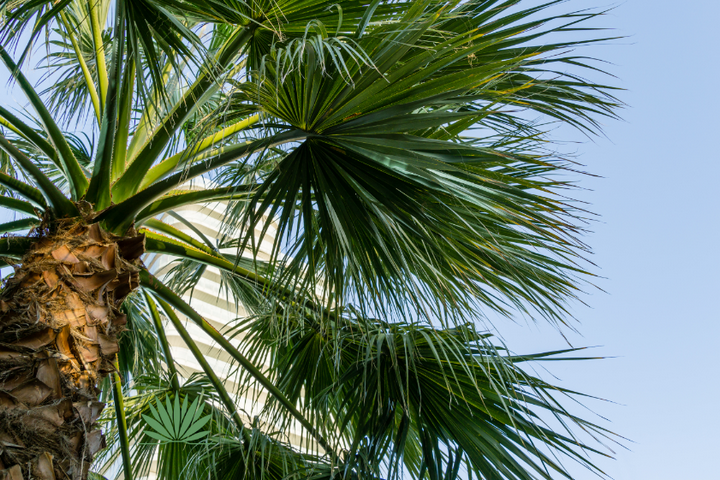
While very few palms are native to the southwest, palms have a beloved place in desert landscaping. They definitely give off a tropical, relaxing vibe and offer some unique benefits. They take up little space, are low litter, and provide habitat for wildlife.
Whether you’ve got one palm or several, you may be unsure of how to feed them. Let’s take a look at why fertilizer is needed, what to look for in a palm fertilizer, and how and when to fertilize.
Why Fertilizer Palms?
Nearly all landscape palms originate outside the desert southwest, and consequently, have not evolved to make the best use of the nutrients in desert soil. (Alkaline desert soil binds up nutrients, making them unavailable to plants.)
Compared to palms growing in the wild, landscape palms face additional stressors and so benefit from extra care.
- They are often planted next to the unnaturally hot reflected heat from walls, patios, and pools.
- We remove their dried fronds, which protect them from the sun and help keep their trunks and roots cool.
- They are often watered improperly — frequent and shallow instead of infrequent and deep.
Fertilizing palms will help them overcome these stressors. The right nutrients can help keep them healthy and less susceptible to diseases and pests.
Fertilizing can prevent deficiencies before they occur. Shockingly, it can take years to completely correct a nutritional deficiency in a palm tree! Affected fronds never recover. Your palm will live with the damage until that frond ultimately dies and is replaced by healthy new foliage which can take years.
And, of course, fertilizing will help your palms look their most beautiful.
Fertilizing palms in containers is particularly important. Potted plants have limited access to nutrients, and frequent watering can flush nutrients away.
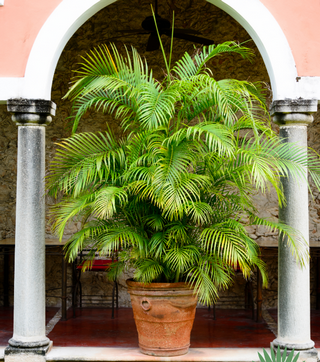
What to Look for in a Palm Fertilizer
I’m not a fan of buying a different fertilizer for every kind of plant. You can find fertilizers sold specifically for roses, citrus, hibiscus, evergreens, houseplants, lawns, orchids, tomatoes, succulents, and even for bamboo (as if it needs help growing)! This is largely a marketing ploy to get you to buy more stuff.
But in the case of palms, their nutritional needs are unique, and a special fertilizer is actually warranted. Here’s what to look for when buying a palm fertilizer.
NPK Macronutrient Ratio for Palms
When shopping for fertilizer, you’ll notice there’s a ratio listed that looks like this: 8:4:8. This indicates the percentage by weight of the macronutrients nitrogen (N), phosphorus (P), and potassium (K).
Palm fertilizers should have a ratio of 2:1:2 or 3:1:3 since palms need approximately three times as much nitrogen and potassium as phosphorus.
Here’s a label of a palm fertilizer. This product’s ratio of 10:4:10 falls within this range.
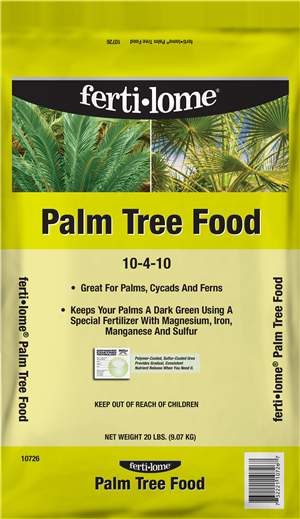
Unfortunately, many fertilizers marketed as palm fertilizers do not have this NPK ratio. Using a fertilizer with the proper balance of macronutrients is important.
Like most non-native plants grown in the desert, they need extra nitrogen but not too much. Too much nitrogen can cause a potassium deficiency, which can be fatal. Palms grown in sandy soils (especially queen and date palms) are particularly susceptible to potassium deficiency.
Skip the DIY palm fertilizer recipes.
They won’t provide the balance of nutrients palms need.
Micronutrients for Palms
Trace amounts of magnesium (Mg), iron (Fe), zinc (Zn), boron (B), sulfur (S), and copper (Cu) are needed for healthy palms, so look for a fertilizer that lists them on the label. These micronutrients are often missing in all-purpose fertilizers.
Manganese (Mn) is the most critical micronutrient. A good palm fertilizer should contain 1- 2% manganese. Manganese deficiency causes a deformity called “frizzle top” which is most common in queen and royal palms.
Organic or Slow Release
Try to find a fertilizer that contains organic ingredients. Organic fertilizers actually improve your soil, and since they don’t break down as fast as synthetic fertilizers, their effects last longer.
Alternatively, the University of Arizona suggests using a controlled release granular fertilizer, which will provide a steady supply of nutrients and minimize leaching and runoff.
Brands to Consider
Note that while there are many palm fertilizers on the market, very few follow these guidelines, and even the best ones are not perfect.
Here are a handful of palm fertilizers that largely meet the recommended criteria.
- Arizona’s Best Palm Tree Food
- Epsoma Organic Palm Tone
- Fertilome Palm Tree Food
- Gardenwise 8-4-8 Palm Tree Professional Fertilizer
- Jobe’s Organics Palm Granular Plant Food
I use Arizona’s Best which has the proper NPK ratio and contains manganese along with magnesium, iron, sulfur, and zinc. I also top dress with compost to add organic matter and fill in any potential nutrient gaps.
When & How to Fertilize Palms
Desert palms should be fertilized twice per year — once in the spring and again in mid-summer when the soil is warm and roots are active. May and August are ideal. There is no point in fertilizing during cooler weather when palms can’t make use of the nutrients.
Follow the instructions on your product’s label regarding how much fertilizer to use. You don’t want to guess and over-fertilize, which can burn your plants.
But ignore the instructions for when to fertilize. These suggested dates are not accurate for palms growing in the southwest. As I occasionally mention — gardening is different here. 😉
Spread the fertilizer under a palm’s canopy, but keep it directly away from the trunk. Then immediately water it in to a depth of 12 inches.
As an Amazon Associate, Southwest Gardener earns from qualifying purchases, at no cost to you.
See our Terms of Use for details.
Did you enjoy this article?
Sign up for our weekly newsletter
where you’ll find more great info on creating &
maintaining a beautiful, carefree desert landscape.
Author Bio
Deane Alban is the creator of Southwest Gardener. She is a science writer with a bachelor’s degree in botany from the University of South Florida. Gardening is her lifelong passion. She’s been gardening in Tucson for over 16 years.
