
Coral honeysuckle is a good choice for attracting and supporting bees, butterflies, and numerous bird species. And, unlike some vines, it’s well-behaved in desert gardens. Here’s how to plant and care for this resilient native of the central and eastern US.
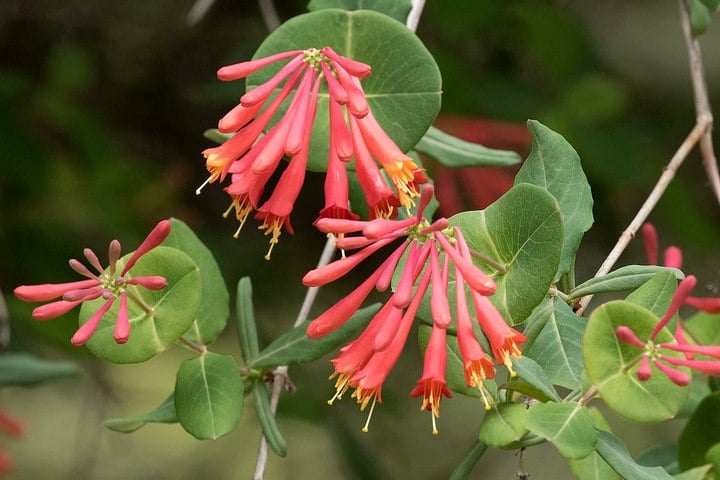
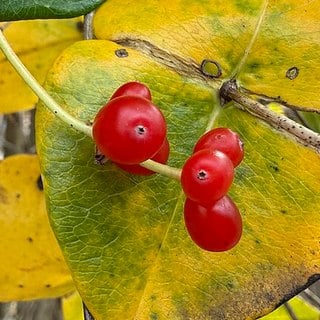
We’re all familiar with honeysuckles, and coral honeysuckle (Lonicera sempervirens) is one of the best for desert gardens. It has evergreen leaves and showy clusters of tubular coral-red flowers with yellow stamens. Flowers are followed by shiny, red berries that are inedible to humans, but not to wildlife.
Unlike many desert landscape vines, it’s well-behaved and doesn’t grow aggressively in desert gardens. It has no thorns and is non-toxic.
It’s a great vine for attracting birds. Hummingbirds flock to the flowers, while other birds, including finches and quail, come for the berries.
It supports insect pollinators of all kinds — bees, moths, and butterflies — and a few species use it as a larval host.
Deer, rabbits, and javelinas usually leave it alone.
Why I Like This Plant
- Attractive evergreen vine
- Coral-red flowers spring through fall
- Bright red berries
- Stays a manageable size
- No thorns, non-toxic
- Supports birds, butterflies, insect pollinators
Things to Watch Out For
If you’re looking for a vine that has that wonderful honeysuckle fragrance, coral honeysuckle is not it. Its flowers are not fragrant.
Coral honeysuckle is native to the eastern US, from Florida to Maine. It has naturalized as far north as Canada. It tolerates extreme cold better than extreme heat, so don’t try to grow this in the hottest or sunniest spot in your garden and expect it to be happy.
Optimal Growing Conditions
If you’re thinking of adding a coral honeysuckle to your garden, you need to find a suitable place that will keep it healthy and looking good… while minimizing maintenance for you.
Here are the key factors to keep in mind.
Temperature
Coral honeysuckle should be grown in USDA Hardiness Zones 4 to 9. It tolerates desert heat in the summer and is cold hardy down to -20℉. It’s normally evergreen in Tucson, where the winter lows are usually in the mid-twenties. It generally retains all or some of its leaves in zones 8 and 9.
Sun Exposure
Coral honeysuckle does best in part shade. It tolerates full sun as long as its roots are kept shaded or it gets some relief from afternoon sun.
Size and Growth Rate
Coral honeysuckle is a large, fast-growing vine that generally reaches a size of 20 feet high by 10 feet wide. A plant’s mature size depends on how it’s watered and pruned.
Soil
Coral honeysuckle prefers fertile soil but will grow in a wide variety of soil types — sandy, loam, clay, and even limestone and caliche — provided it’s well-draining.
Other Location Considerations
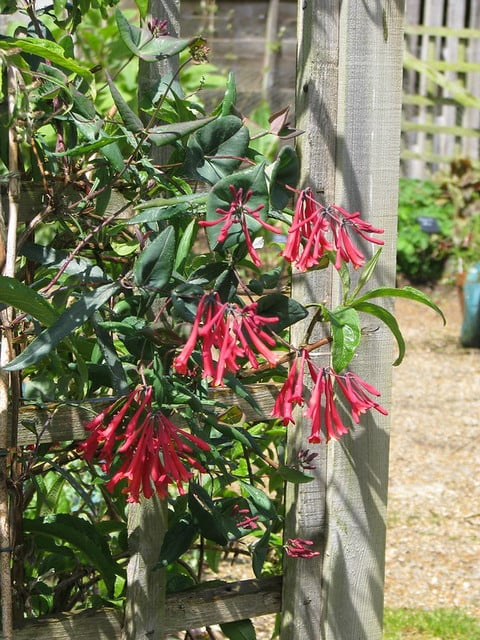
Coral honeysuckle is a twining vine that needs a support structure to climb, such as a trellis, pergola, or fence.
If left unsupported, it will sprawl as a vigorous ground cover. You can use this trait to cover banks or slopes or for erosion control.
Coral Honeysuckle:
The Essentials
| Common Name | Coral honeysuckle |
| Scientific Name | Lonicera sempervirens |
| Origin | Central, eastern US |
| Plant Type | Semi-deciduous vine |
| USDA Zones | Zones 4 – 9 |
| Cold Hardiness | To -20℉ |
| Flower Color | Coral-red |
| Flower Season | Spring, summer, fall |
| Mature Size | 20′ tall x 10′ wide |
| Growth Rate | Fast |
| Sun Tolerance | Full, part sun |
| Water Needs | Moderate |
| Pests & Diseases | None |
| Garden Friendliness | No thorns, non-toxic |
| Wildlife | Supports birds, pollinators |
How to Plant
The rule of thumb when planting any vine in the desert is to dig a hole three times as wide as the root ball but no deeper.
Since coral honeysuckle prefers fertile soil, consider amending your hole with compost or a commercial soil mix. Top with organic mulch rather than gravel, which helps to retain moisture, increase soil fertility, and keep roots cool.
When to Plant
The best time to plant coral honeysuckle is in the fall. This gives it three seasons to grow roots and get established before the following summer.
The second best time is in spring, the earlier the better. This still gives it time to get established before the intense heat of June arrives.
How to Care for Coral Honeysuckle
Whether you’ve recently planted a coral honeysuckle or have an existing plant in your yard, here’s how to take care of it to keep it healthy and looking its best.
How to Water New Plants
Once you’ve got your vine in the ground, watering is your most immediate concern. Here is a recommended watering schedule for new vines planted in the spring or fall.
| Weeks 1 & 2 | Every 3 – 4 days |
| Weeks 3 & 4 | Every 6 – 7 days |
| Weeks 5 & 6 | Every 7 – 10 days |
| Weeks 7 & 8 | Every 10 – 14 days |
After week 8, gradually revise your watering schedule, depending on the season.
How to Water Established Plants
Here’s a recommended watering schedule for subsequent years.
| Spring & Fall | Every 10 – 14 days |
| Summer | Every 7 – 10 days |
| Winter | Every 14 – 21 days |
Coral honeysuckle is moderately drought tolerant once established, but looks its best with regular irrigation.
Should You Fertilize?
Since coral honeysuckle is a prolific bloomer that’s not native to the desert, it benefits from applications of fertilizer in the spring and mid-summer.
How to Prune
Prune your coral honeysuckle in late winter or early spring before new growth appears to remove any cold damage or to control its shape and size.
Don’t Confuse Coral Honeysuckle With…
Coral honeysuckle is sometimes confused with other members of the honeysuckle genus, especially Japanese honeysuckle (Lonicera japonica) and its cultivars. You can usually tell the species apart when in bloom since Japanese honeysuckle has white and yellow flowers. (However, some cultivars defy this rule of thumb — ‘John Clayton’ and ‘Sulfurea’ are coral honeysuckles with yellow flowers.)
Japanese honeysuckle is native to China, Japan, and Korea, and is very invasive in the eastern half of the US. While it’s generally safe to grow in arid regions, there are reports of it escaping cultivation in isolated pockets of the southwest — in California, Nevada, Utah, Arizona, New Mexico, and Texas.
Plant Lover Facts
Coral honeysuckle (Lonicera sempervirens) also goes by the common names trumpet honeysuckle and woodbine.
The genus Lonicera honors the German botanist Adam Lonitzer. The species name sempervirens means “evergreen”.
Coral honeysuckle has a large native range that covers about half of the US. It’s native to almost every state east of the Mississippi from Maine to Florida. Its western boundary extends as far west as Texas, Oklahoma, and Nebraska.
This vine is so appealing that Thomas Jefferson mentioned it in his notes as a vine he wanted to include in his gardens at Monticello, along with Carolina jessamine and trumpet creeper.
Did you enjoy this article?
Sign up for our weekly newsletter
where you’ll find more great info on creating &
maintaining a beautiful, carefree desert landscape.
Author Bio
Deane Alban is the creator of Southwest Gardener. She is a science writer with a bachelor’s degree in botany from the University of South Florida. Gardening is her lifelong passion. She’s been gardening in Tucson for over 16 years.

Photo Credits
Zeynel Cebeci, CC BY-SA 4.0, Wikimedia Commons
Famartin, CC BY-SA 4.0, Wikimedia Commons
“Lonicera sempervirens Cedar Lane” by peganum is licensed under CC BY-SA 2.0