
‘Color Guard’ is a medium size yucca cultivar that makes an exceptionally attractive accent plant. It’s showy striped leaves brighten any spot in desert gardens. Here’s everything you need to know about planting and caring for this native of the southeastern US.
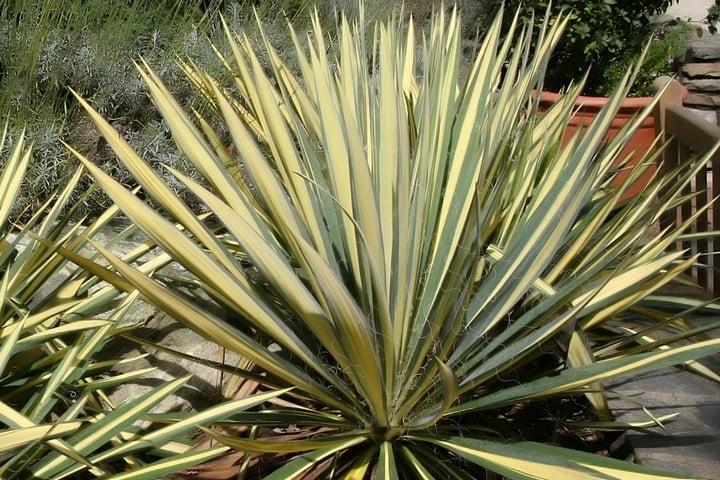
One defining feature of Yuccas is their green, sword-like leaves. But ‘Color Guard’ (Yucca filamentosa ‘Color Guard’) is not your typical yucca. Its leaves have a wide, creamy gold center stripe that really makes this plant pop. The margins are lined with curly white threads.
While not a desert native, it thrives in desert heat, sun, and aridity. In its native habitat, it often grows on sandy dunes and is at home in sandy desert soil as well.
It reproduces by offsets, forming small colonies of plants. If you’re looking for a succulent to naturalize in your yard to fill in bare spots, this is one to consider.
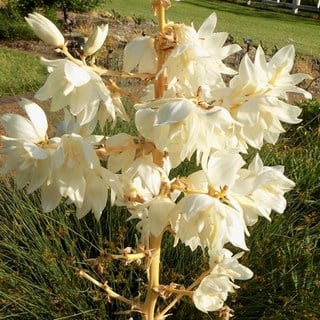
When it blooms in late spring or early summer, it sends up a flower stalk of creamy white, bell-shaped flowers that attract hummingbirds, butterflies, and other insects, but only moths can pollinate yuccas.
It is generally resistant to rabbits, javelina, and deer.
Why I Like This Plant
- Colorful leaves
- Creamy white flowers
- Looks good all year long
- Withstands extreme heat and cold
- Reproduces by offsets
- Virtually maintenance-free
Things to Watch Out For
Handling ‘Color Guard’ yucca leaves can cause an allergic reaction in some people.
While this plant isn’t as pokey as many landscape succulents, the ends are tipped with spines.
All yuccas contain saponins that are toxic to dogs, cats, and horses.
Optimal Growing Conditions
If you’re thinking of adding a ‘Color Guard’ yucca to your garden, you need to find a suitable place that will keep your plant healthy and looking good… while minimizing maintenance for you.
Here are the key factors to keep in mind.
Temperature
‘Color Guard’ yucca should be grown in USDA Hardiness Zones 4 to 10. It tolerates desert heat and is extremely cold-hardy down to -30℉.
Sun Exposure
‘Color Guard’ yucca does best in full sun but will tolerate light or part shade.
Size and Growth Rate
‘Color Guard’ yucca is a fast-growing plant that is slightly wider than tall. A single plant will ultimately reach a size of around 3 to 4 feet tall by 4 feet wide. But plants reproduce by basal offsets, forming small colonies, so give this plant room to spread unless you plan on removing the offsets as they appear.
When plants bloom, they send up a flower stalk that’s 3 to 4 feet tall.
Soil
‘Color Guard’ yucca prefers dry, sandy, or rocky soil that is well-draining.
Other Location Considerations
‘Color Guard’ can be grown on slopes for erosion control. This medium size yucca makes an excellent container plant.
‘Color Guard’ Yucca:
The Essentials
| Common Name | ‘Color Guard’ yucca |
| Scientific Name | Yucca filamentosa ‘Color Guard’ |
| Origin | Southeastern US (cultivar) |
| Plant Type | Succulent |
| USDA Zones | Zones 4 – 10 |
| Cold Hardiness | To -30℉ |
| Flower Color | Creamy white |
| Flower Season | Spring, summer |
| Mature Size | 3-4′ tall x 3’ wide |
| Growth Rate | Fast |
| Sun Tolerance | Full, part sun |
| Water Needs | Low |
| Pests & Diseases | None |
| Caution | Toxic to pets |
| Wildlife | Attracts hummingbirds, moths, butterflies |
How to Plant
To plant a ‘Color Guard’ yucca, dig a hole the same depth as the root system and twice as wide.
It’s generally recommended that you not add any soft fill, gravel, or fertilizer, just native soil. However, good drainage is critical. If you know your soil is slow-draining, amend with coarse sand or small gravel until you have a loose, well-drained mix.
Carefully remove the plant from the container, place it in the hole, and press the soil to remove any air pockets.
When to Plant
The best time to plant a yucca is in the fall (October), when warm soil temperatures encourage root development. The second best time is in spring (April or May).
How to Care for ‘Color Guard’ Yucca
Whether you’ve recently planted a ‘Color Guard’ yucca or have an existing plant in your yard, here’s how to take care of it to keep it healthy and looking its best.
How to Water
You’re probably used to giving a plant a good soaking immediately after transplanting, but that isn’t the best practice with yuccas. Counterintuitively, it’s better to wait a week or two after planting to water.
Then, water once per month from spring through fall. No supplemental water is necessary during the winter.
Should You Fertilize?
There is no need to fertilize ‘Color Guard’, it will get all the nutrients it needs from desert soil.
Pruning & Propagation
‘Color Guard’ yucca should not be pruned other than removing lower leaves as they die. You can do this any time of year. The only other pruning task you’ll want to do is to remove any spent flower stalks.
‘Color Guard’ yucca will produce offsets. You can let them grow where they appear, or you can separate them from the parent and use them to start new plants elsewhere.
Plant Lover Facts
‘Color Guard’ yucca (Yucca filamentosa ‘Color Guard’) is a cultivar of Yucca filamentosa, which goes by the common name Adam’s needle.
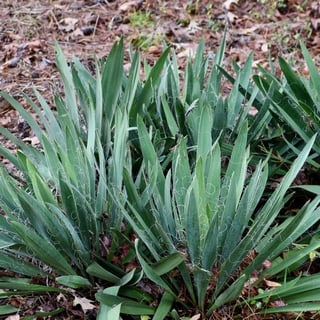
With its long, thread-like filaments, this Yucca is appropriately named filamentosa, which means filament or thread.
Adam’s needle is native to the Southeastern and Mid-Atlantic US. It can be found growing from Florida and Alabama, north to Maryland and West Virginia. The closest it gets to the southwest is Louisiana. Due to its extreme cold hardiness, it has naturalized north into New York and Massachusetts.
Adam’s needle was an important plant to Native Americans, who used it for food, medicine, cordage, and soap. Its leaves are believed to have the strongest fibers of any North American plant.
There are 54 accepted species of Yucca. Biologists have only recently discovered that almost every Yucca species is pollinated by a single species of moth (a few are pollinated by two). The female moths pollinate the flowers, and moth larvae feed on the developing fruit, forming a symbiotic relationship. Pretty amazing!
Did you enjoy this article?
Sign up for our weekly newsletter
where you’ll find more great info on creating &
maintaining a beautiful, carefree desert landscape.
Author Bio
Deane Alban is the creator of Southwest Gardener. She is a science writer with a bachelor’s degree in botany from the University of South Florida. Gardening is her lifelong passion. She’s been gardening in Tucson for over 16 years.

Photo Credits
David J. Stang, CC BY-SA 4.0, via Wikimedia Commons
Cathy Dewitt, CC BY 4.0, North Carolina State Extension