
Bush morning glory is a silvery ground cover that always looks cool and fresh, even in desert heat. Here’s how to plant and care for this Mediterranean native.

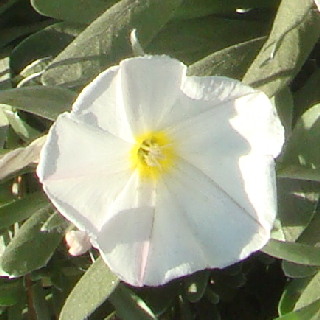
Silver-gray leaves and snow-white flowers make bush morning glory (Convolvulus cneorum) a standout in desert gardens. This ground cover looks cool even when the temperatures soar, and it makes a nice contrast to hot-colored flowers and spiky plants.
Even when not in bloom, its symmetrical, mounding form makes it a perfect addition to rock gardens or berms, or alongside boulders.
It’s a well-behaved addition to desert gardens. It stays fresh-looking all year round and nicely shaped without pruning. It rarely, if ever, reseeds.
It’s native to the rocky coast and islands of the Mediterranean, where it’s often found growing among rocks.
Why I Like This Plant
- Evergreen, looks attractive year round
- Silver leaves and white flowers look cool
- Low-water, minimal pruning
- Litter-free, non-toxic, no thorns
- Flowers attract hummingbirds, bees, butterflies
Things to Watch Out For
Bush morning glory can live several years in the right location, but it’s not very long-lived in most gardens. This is often due to overwatering. Plants cannot tolerate wet roots and easily succumb to root rot.
Optimal Growing Conditions
If you’re thinking of adding a bush morning glory to your garden, you need to find a suitable place that will keep your plant healthy and looking good… while minimizing maintenance for you.
Here are the key factors to keep in mind.
Temperature
Bush morning glory should be grown in USDA Hardiness Zones 8 to 11. This plant withstands temperature extremes. It loves summer heat and is cold-hardy down to 15℉.
Sun Exposure
Bush morning glory does well in full sun to part shade. It tolerates the reflected sun off building or hot garden walls.
Size and Growth Rate
Bush morning glory is a fast growing ground cover that spreads to a size of 2 feet tall by 4 feet wide.
Soil
Bush morning glory prefers sandy or gravelly soils that are slightly alkaline. But it will grow in any desert soil, as long as it’s well-draining.
Other Location Considerations
Because it has no thorns, is non-toxic, and nearly litter-free, you can feel comfortable placing bush morning glory near a pool, sidewalk, or anywhere it might come in contact with pets and people.
Striking silver leaves and white flowers come to the forefront at dusk, making it an excellent addition to a moon garden.
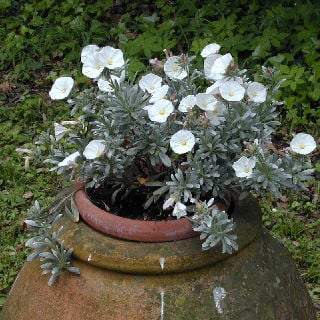
Bush morning glory does well in containers. Make sure your pot has drainage holes and use specifically formulated cactus soil.
Bush Morning Glory:
The Essentials
| Common Name | Bush morning glory |
| Scientific Name | Convolvulus cneorum |
| Origin | Mediterranean |
| Plant Type | Evergreen ground cover |
| USDA Zones | Zones 8 – 11 |
| Cold Hardiness | To 15℉ |
| Flower Color | White |
| Flower Season | Spring, summer |
| Mature Size | 2′ high x 4’ wide |
| Growth Rate | Fast |
| Sun Tolerance | Full, part, reflected sun |
| Water Needs | Low |
| Pests & Diseases | Root rot if overwatered |
| Garden Friendly | No thorns, non-toxic, low litter |
| Wildlife | Attracts butterflies, hummingbirds, bees Deer resistant |
How to Plant
Dig a hole as deep as and twice as wide as the nursery container. Carefully remove the plant from the container, put it in the hole, and press the soil to remove any air pockets.
It’s generally recommended that you backfill with only native soil and not add any amendments. However, good drainage is critical. So if you know your soil is slow draining, amend with coarse sand or small gravel until you have a loose, well-drained mix.
When to Plant
The best time to plant bush morning glory is in the fall. This gives it three seasons to grow roots and get established before the following summer.
The second best time is in spring, the earlier the better. This still gives it time to get established before the intense heat of June arrives.
How to Care for Bush Morning Glory
Whether you’ve recently planted a new bush morning glory or have an existing one in your yard, here’s how to take care of it to keep it healthy and looking its best.
How to Water
The University of Arizona recommends watering newly planted, low water use ground covers on this schedule.
| Weeks 1 – 4 | Every 2 – 3 days |
| Weeks 5 & 6 | Every 6 – 7 days |
| Weeks 7 & 8 | Every 10 – 14 days |
Give your bush morning glory about ½ gallon with each watering.
After that, you can water it on this schedule:
| Spring (March – May) | 10 – 14 days |
| Summer (May – Oct.) | 7 – 10 days |
| Fall (Oct. – Dec.) | 10 – 14 days |
| Winter (Dec – March) | 14 – 21 days |
As it grows, it will need more water with each watering, depending on its diameter. Use this chart as a guide.
| 1′ diameter | .5 gallons |
| 2′ diameter | 2 gallons |
| 3′ diameter | 3.5 gallons |
| 4′ diameter | 5 gallons |
Should You Fertilize?
There’s no need to fertilize bush morning glory, it gets all the nutrients it needs from the desert soil. But if you keep one in a pot, fertilize it lightly a few times a year when it’s actively growing.
How to Prune
Bush morning glory rarely needs pruning. If you want to give it a light trim, do so in late spring after it’s done flowering. If it gets leggy during the summer, you can trim it in the fall.
Prune your plant back to half its size every two to three years to rejuvenate it and manage its size.
Don’t Confuse Bush Morning Glory With…
Bush morning glory (Convolvulus cneorum) is not the only plant called “bush morning glory.” Ipomoea leptophylla, Ipomoea carnea, and Convolvulus tricolor also go by the common name bush morning glory.
Is Bush Morning Glory Invasive?
You may be concerned about growing bush morning glory, having heard that “morning glories” are invasive or illegal to grow in Arizona. This does not refer to all morning glories. Astoundingly, there are over 1,000 plants with the common name morning glory!
In reality, only a few species in a different genus (Ipomoea) are considered Prohibited Noxious Weeds in Arizona. Note that not all members of this genus are pests — Arizona has a dozen native morning glories in this genus.
For more on this topic, check out the University of Arizona’s document The Curious Case of Arizona’s Morning Glories (Ipomoea spp.).
Did you enjoy this article?
Sign up for our weekly newsletter
where you’ll find more great info on creating &
maintaining a beautiful, carefree desert landscape.
Author Bio
Deane Alban is the creator of Southwest Gardener. She is a science writer with a bachelor’s degree in botany from the University of South Florida. Gardening is her lifelong passion. She’s been gardening in Tucson for over 16 years.

Photo Credits
Miwasatoshi, CC BY-SA 4.0, via Wikimedia Commons
Laurentius, CC BY-SA 2.5, via Wikimedia Commons