
When covered with brilliant flowers, bougainvilleas are a sight to behold! So when they fail to bloom, it can be disappointing. Learn why bougainvilleas stop flowering, when it’s a problem (and when it’s normal), and how to encourage yours to produce more flowers.

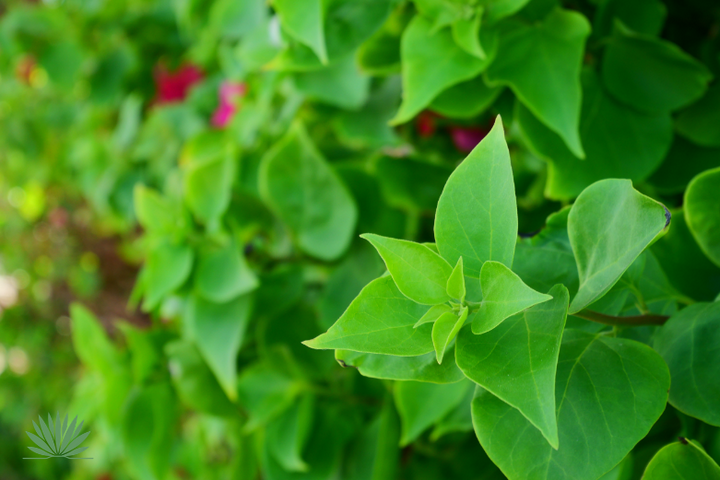
Bougainvilleas are shrubby vines that bloom so prolifically that they’re often called “flower machines”. These plants need little care and, when happy, bloom profusely from spring through the first frost. You can grow bougainvillea in the hottest, sunniest spot in your garden.
So if yours doesn’t bloom, you may wonder what’s wrong and what you can do.
You may have heard that you should ignore your bougainvilleas or that they thrive on neglect. Have you ever wondered why that works? There’s actually a logical explanation for this :
Bougainvilleas have two growing cycles — the vegetative growth cycle and the flowering cycle. Bougainvilleas alternate between growing and flowering in 3 to 5 week cycles. They don’t do both at the same time.
And understanding these cycles is fundamental to understanding bougainvillea care and how to encourage flowering.
When bougainvilleas don’t bloom, it’s usually one of the following issues:
Too Little Sun
Bougainvilleas like full sun — and I mean full, Arizona “death star” sun. They need at least 6 hours of full sun, but 8 or more is even better.
When a bougainvillea does not get sufficient sunlight, it stays in its growth cycle, producing stems and leaves, not flowers.
There may or may not be anything you can do if an existing plant doesn’t get adequate sun. But if you’re thinking of planting a new one, plant it in the hottest, sunniest spot in your yard. Go ahead and plant it near a hot garden wall — it won’t mind, and the warmth of the wall will help keep it flowering longer into the winter.
Too Much Water
Bougainvilleas are low water use plants. Ask anyone who has spectacular specimens, and they’ll almost certainly tell you that they water theirs rarely, or not at all.
Cutting back on water may seem counterintuitive, but this works because too much water (like too little sun) keeps bougainvillea in the growth cycle, producing leaves rather than flowers.
If you’re going to water your bougainvillea, give it a deep soaking every 3 to 4 weeks. Letting your bougainvillea completely dry out between waterings will help jumpstart the flowering cycle.
Pamper your bougainvillea with too much water, shade,
or fertilizer, and it will grow leaves at the expense of flowers.
Too Much Fertilizer
Another factor that can keep bougainvilleas in growth mode is too much fertilizer, specifically too much nitrogen. Nitrogen stimulates the growth of leaves instead of flowers.
If you feel you need to fertilize, use a low nitrogen fertilizer formulated for bougainvilleas. Or you can topdress with organic mulch or compost for a light nutritional boost.
Got a lawn?
Lawn fertilizer is very high in nitrogen,
which can affect bougainvilleas.
Improper Pruning
Landscapers love to prune or shear shrubs on a regular schedule, but frequent pruning removes bougainvillea’s potential flowers, since it blooms on new wood.
Here’s how to properly prune bougainvillea.
If it dies back in the winter, give it a hard prune in the spring. If you’re satisfied with its shape and size, you don’t need to prune it at all since bougainvilleas look gorgeous when allowed to grow unfettered. Or you can lightly prune a few times during the growing season as needed — always after a flower cycle.
But for maximum flowers, pinch the soft stem tips. This makes for a bushier plant with more branches, which bear more flowers.
It’s Taking a Break
A happy, healthy bougainvillea will alternate between the growth cycle and the flowering cycle. So if your plant isn’t flowering, it may simply be in the growth stage. This is normal and to be expected, so there’s nothing for you to do.
It’s Getting Established
Is your bougainvillea new?
Transplant shock may keep it from flowering. For such a vigorous, tough plant, it’s surprisingly temperamental when it comes to being transplanted — it does not like having its roots disturbed.
So if your bougainvillea is new, it might just need time. It may take a year or two for it to get fully established and really take off.
Plant a Desert-Friendly Bougainvillea
Bougainvilleas come in a wide variety of cultivars that vary in size, form, and flower color. If you are new to growing bougainvilleas or are unsure which of the many cultivars to grow, you won’t go wrong with ‘Barbara Karst’.
It’s widely considered the best bougainvillea for the desert Southwest. It tolerates our temperature extremes better than other cultivars. It’s vigorous and one of the most abundant bloomers, covered with brilliant magenta flowers most of the year.
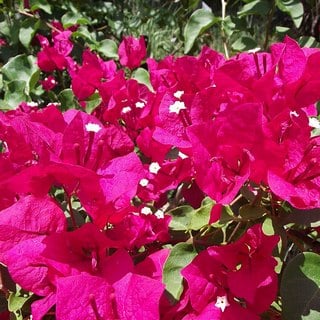
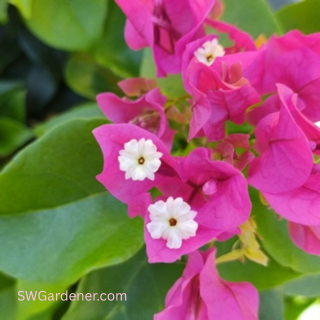
Fun Fact!
Bougainvillea “flowers” are
actually modified leaves called bracts.
The “true” tiny, white flowers can be
found nestled within the bracts.
A Blooming Recap
If your bougainvillea isn’t flowering, you may be giving it too much care rather than too little. To produce maximum flowers, follow these simple steps:
- Plant it where it gets 6 to 8 hours of full sun
- Don’t overwater
- Don’t overfertilize, especially with nitrogen
- Prune minimally & pinch new growth
If you’re thinking of adding a new bougainvillea to your garden, plant it in a hot, sunny location. If you don’t get this right, you’ll never get the flowers you hope for.
As an Amazon Associate, Southwest Gardener earns from qualifying purchases, at no cost to you.
See our Terms of Use for details.
Did you enjoy this article?
Sign up for our weekly newsletter
where you’ll find more great info on creating &
maintaining a beautiful, carefree desert landscape.
Author Bio
Deane Alban is the creator of Southwest Gardener. She is a science writer with a bachelor’s degree in botany from the University of South Florida. Gardening is her lifelong passion. She’s been gardening in Tucson for over 16 years.

Photo Credit
Stickpen, Public domain, via Wikimedia Commons