
Boojum tree is every bit as weird as its name implies. Here’s what you need to know to decide whether this desert native would be a good choice for your yard and how to care for an existing one. And discover the Tucson connection of how it got its quirky name.
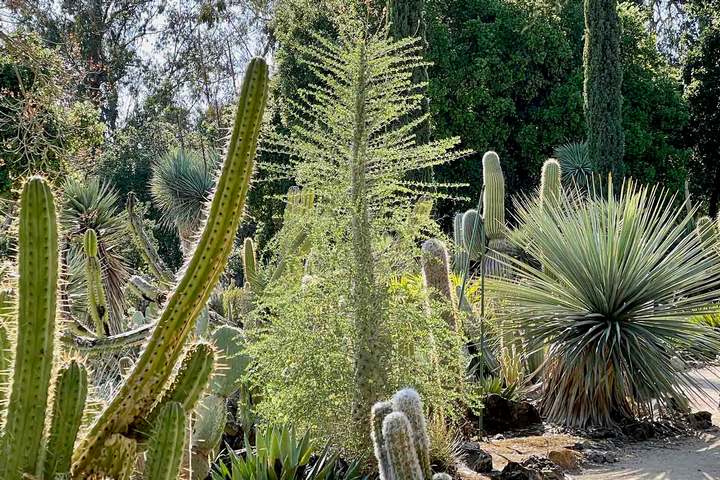
The desert southwest has a lot of unusual plants, and the boojum tree (Fouquieria columnaris) may be the weirdest of them all. It’s technically a succulent, not a tree, and is closely related to another unusual desert plant — the ocotillo.
Some obvious things about this unique plant are different from the norm. It’s often described as looking like an upside down carrot or something out of a Dr. Seuss book. It grows in the winter and is leafless and dormant in the summer. Consequently, it needs more water in the winter and less in the summer.
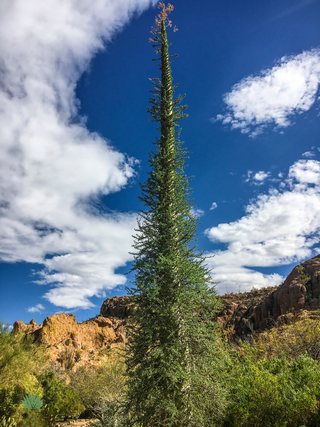
This tree-like succulent has a single, water-storing trunk that’s thick at the base and narrow at the top. Short, thin branches that stick straight out from the trunk are covered with small leaves from fall through spring.
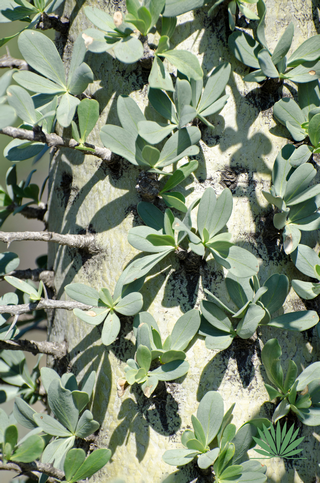
Young plants are bushy — the trunk becomes columnar and tapers with age. At around 5 years, plants start to flower, usually in September. Small, cream-colored flowers appear in spike-like clusters.
This plant is definitely not for everyone, but in the right location, it can be a dramatic showpiece of a desert garden.
Why I Like This Plant
- Unique, otherworldly specimen plant
- Adds architectural interest all year
- Virtually no maintenance
Things to Watch Out For
Boojum branches are covered with 1 inch spines.
They go dormant in the summer, so you can expect yours to be leafless from April to September.
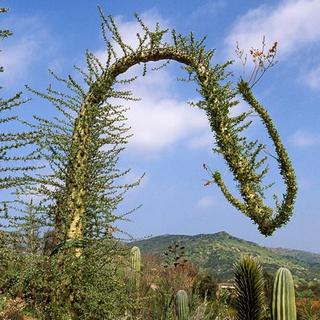
Mature plants can easily overwhelm a small urban or suburban yard. Some plants bend and arch over time. Not every yard has room for a boojum that grows like this!
Since wild harvesting is forbidden and young seedlings grow slowly, plants are hard to find and expensive. I’ve seen one gallon plants for under $100, but larger boojums can go for $1,000 per linear foot. (This site sells them for $20,000! 😮)
Optimal Growing Conditions
If you’re thinking of adding a boojum tree to your yard, you need to find a suitable place that will keep your plant healthy and looking good… while minimizing maintenance for you.
Here are the key factors to keep in mind.
Temperature
Boojum tree should be grown in arid regions of USDA Hardiness Zones 9 to 11. It tolerates intense desert heat. Its cold-hardiness depends on its age. Mature specimens can tolerate cold down to 20℉, but young plants should be protected from freezes.
Sun Exposure
Boojum tree needs plenty of sunlight to thrive and doesn’t mind the reflected heat off a hot garden wall or building. It needs plenty of sunlight to maintain strong, upright growth. Since they grow in the winter, they must be in full sun from September through May. They can tolerate some shade during the summer when they’re dormant.
But young boojums should be given partial shade during the hottest part of the day to protect delicate new growth.
Size and Growth Rate
Young boojums grow agonizingly slowly. It can take 10 to 20 years to reach one foot in height, and another 15 to 20 years to reach ten feet tall.
But after that, it picks up the pace and will ultimately be huge. In its native habitat, it can grow 50 feet tall by 10 to 15 feet wide, but it typically reaches a mature height of 20 feet in cultivation.
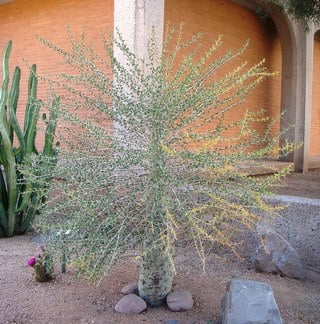
Here’s a young, bushy boojum at Arizona State University.
And here’s a mature one in the wild.
Soil
In its native habitat, boojum grows in granite soil. In desert gardens, it does best in fast-draining sandy or rocky soil. It is not a good choice if you have clay since it is very sensitive to overwatering and root rot.
Other Location Considerations
Boojum tree should not be planted near foot traffic or anywhere people or pets might bump into its thorns.
Don’t plant boojum tree near other landscape plants that are frequently irrigated. Don’t plant one in a swale or low spot in your yard, but do grow one on a slope or berm to ensure excellent drainage. Boojum roots will rot with too much water, especially during monsoon rains.
Boojum Tree:
The Essentials
| Common Names | Boojum, boojum tree |
| Scientific Name | Fouquieria columnaris |
| Origin | Sonoran Desert |
| Plant Type | Deciduous succulent |
| USDA Zones | Zones 9 – 11 |
| Cold Hardiness | To 25℉ |
| Flower Color | Light yellow |
| Flower Season | Late summer |
| Mature Size | 50′ high x 15’ wide |
| Growth Rate | Very slow |
| Sun Tolerance | Full, reflected sun |
| Water Needs | Very low |
| Pests & Diseases | Root rot |
| Cautions | Thorns |
| Wildlife | Attracts bees, hummingbirds Critter resistant |
How to Plant
When you’re ready to plant your boojum tree, dig a hole as deep and as wide as the root system. Carefully remove the plant from the container, place it in the hole, and press the soil to remove any air pockets.
Fast draining soil is critical. If you have any doubt as to whether your soil drains fast enough, consider amending it with sand, gravel, or decomposed granite. (In its native habitat, it does best when grown in granite soil.)
When to Plant
The best time to plant boojum is in the spring or early summer when warm soil temperatures encourage root development.
Where to Find a Boojum?
Spadefoot Nursery, Four Arrows Garden, and Plants for the Southwest periodically have them for sale. You can find addresses and contact info for all in our Tucson Nursery Directory.
Growing Boojum in a Container
If your new plant is still small, you may want to grow it in a container until it gets larger. (Since they grow so slowly, this might take a while.) This will make it easier to protect from too much sun, cold winter temperatures, critter damage, and human folly. You don’t want anyone stepping on it!
Make sure your container has adequate drainage holes and use specifically formulated cactus soil. Consider adding some decomposed granite.
The Arizona-Sonora Desert Museum recommends watering boojums in containers once per week and fertilizing between November and February.
How to Care for Boojum Tree
Whether you’ve recently planted a boojum tree or have an existing one in your yard, here’s how to take care of it to keep it healthy and looking its best.
How to Water
Like many other things about this plant, its watering schedule is backwards. When in leaf (fall through spring), water it once per week. But when it goes dormant in the summer, water every 3 weeks (or not at all if you’ve had monsoon rains).
Always allow the soil to completely dry between waterings. When in doubt, don’t water, since plants are more likely to suffer from too much water than too little.
The average rainfall in its native habitat is between 3 and 6 inches per year. When established, your boojum should survive on rainwater alone, but plants look better and grow faster with more water.
Should You Fertilize?
There is no need to fertilize a boojum tree, unless you’re growing one in a container. This plant has evolved to get all the nutrients it needs from native desert soil.
How to Prune
Boojum trees do not need pruning. You should never trim one like a shrub or top it off. You’ll destroy its natural shape forever. However, you can prune dead or damaged branches close to the trunk.
Boojum Lover Facts
How did the boojum tree get its name? Godfrey Sykes, who helped supervise the construction of Tucson’s Desert Laboratory, named it after a mythical creature from Lewis Carroll’s narrative nonsense poem “The Hunting of the Snark”.
Boojum (Fouquieria columnaris) is in the same genus as ocotillo (Fouquieria splendens), another desert oddity. The Fouquieria genus has only 11 members and is the only genus in its family, Fouquieriaceae. Both genus and family are named after the French physician Pierre Fouquier.
Boojum also goes by the Spanish name cirio, which means “fat candle”.
This Sonoran Desert native has a small native range. It naturally occurs in the middle third of the Baja California peninsula, where it grows along the coasts. Coastal fog is thought to help boojums meet their water needs.
Boojums can live for more than 300 years, and some are believed to be more than 700 years old.
Did you enjoy this article?
Sign up for our weekly newsletter
where you’ll find more great info on creating &
maintaining a beautiful, carefree desert landscape.
Author Bio
Deane Alban is the creator of Southwest Gardener. She studied journalism and received a bachelor’s degree in botany from the University of South Florida. Gardening is her lifelong passion. She’s been gardening in Tucson for over 16 years.
