
Blue mistflower is a large perennial with bright green foliage and fuzzy blue flowers that butterflies are wildly attracted to. Here’s everything you need to know about growing this native of Texas (and beyond), including the amazing reason butterflies flock to its flowers.
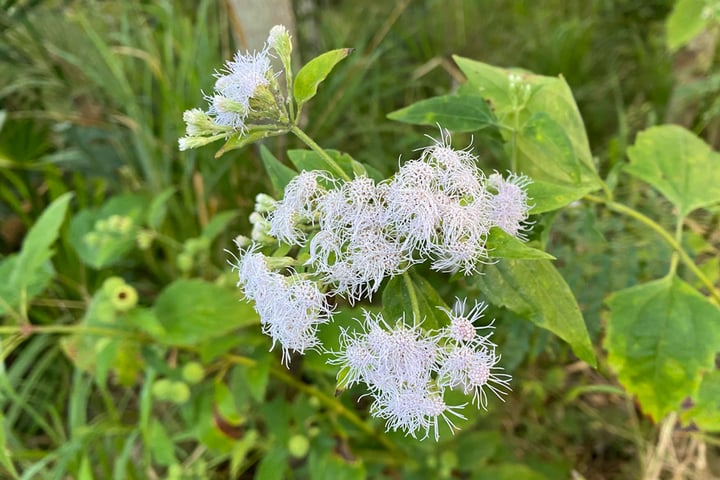
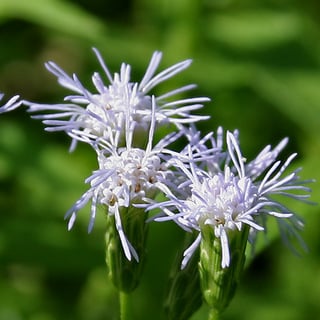
If you’re thinking of starting or expanding a butterfly garden, blue mistflower (Chromolaena odorata) is a top plant to consider. Its bright green leaves and clusters of fuzzy, lavender-blue flowers may remind you of another popular butterfly plant — Gregg’s mist (Conoclinium dissectum).
Blue mistflower is less commonly grown as a landscape plant, but is equally attractive to butterflies. It’s a much larger plant that can develop a woody base — like Gregg’s mist on steroids! It blooms from fall through the first frost and really picks up when Gregg’s mist is winding down, making them excellent companions. Planting them together will greatly extend your fall butterfly season.
Even though blue mistflower is not a desert plant — its closest native habitat is along the Gulf Coast of Texas — it thrives in Southwest gardens.
Like milkweeds, blue mistflower reliably attracts butterflies. But unlike milkweeds, it’s not toxic to humans and pets, and doesn’t attract insects you may not welcome, such as aphids or tarantula hawk wasps.
Birds may eat the seeds and use the fuzzy flowers to build their nests.
Why I Like This Plant
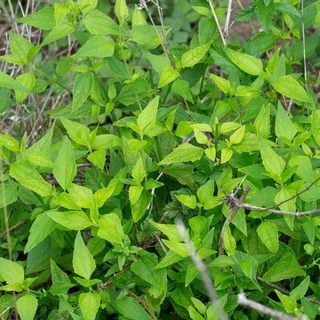
- Bright green foliage
- Fuzzy lavender-blue flowers
- Extends butterfly season through late fall
- Low-maintenance, low litter
- Attracts swarms of butterflies
Things to Watch Out For
Like many members of the Asteraceae family, blue mistflower’s leaves, stems, flowers, and pollen contain compounds that can cause contact dermatitis.
Fun Fact!
A group of butterflies can be called a swarm,
flutter, flight, rabble, wing, or kaleidoscope.
Optimal Growing Conditions
If you’re thinking of adding blue mistflower to your garden, you need to find a suitable place that will keep your plant healthy and looking good… while minimizing maintenance for you. Here are the key factors to keep in mind.
Temperature
Blue mistflower should be grown in USDA Hardiness Zones 9 to 11. It tolerates desert heat and cold. It’s considered semi-deciduous and may or may not lose its leaves depending on how cold your winter is. It dies back when the temperature dips into the mid-twenties, but rebounds in the spring.
Sun Exposure
Blue mistflower grows in every sun exposure from full sun to bright shade. It will not withstand reflected heat and appreciates some relief from afternoon sun during the summer.
Size and Growth Rate
Blue mistflower grows moderately fast and grows faster with more water. It typically reaches a size of 4 feet tall and wide in desert gardens, but it can grow much larger. In its native habitat, it can grow to be 8 feet tall.
Soil
Blue mistflower is not fussy about soil. It will grow in rocky, clay, sandy, limestone, or caliche soil.
Other Location Considerations
Since blue mistflower attracts butterflies like crazy, plant it where you can watch the butterfly activity up close.
Blue Mistflower:
The Essentials
| Common Name | Blue mistflower |
| Scientific Name | Chromolaena odorata |
| Origin | Texas, Mexico, Central & South America |
| Plant Type | Semi-evergreen perennial |
| USDA Zones | Zones 9 – 11 |
| Cold Hardy | To 25℉ |
| Flower Color | Lavender-blue |
| Flower Season | Late summer, fall |
| Mature Size | 4′ tall & wide |
| Growth Rate | Fast |
| Sun Tolerance | Full, part sun, bright shade |
| Water Needs | Moderate |
| Pests & Diseases | None |
| Cautions | Contact dermatitis, toxic to livestock |
| Wildlife | Supports butterflies |
How to Plant
The rule of thumb when planting any perennial in the desert is to dig a hole twice as wide as the root ball but no deeper. Plant slightly higher than ground level, allowing room for some settling and mulch.
Amending the soil is not recommended. Counterintuitively, backfilling with the same native soil you just dug up helps your plant develop a stronger root system.
When to Plant
The best time to plant blue mistflower is in the fall. This gives it three seasons to grow roots and get established before the following summer. The second best time is in spring, the earlier the better. This still gives it time to get established before the intense heat of June arrives.
How to Care for Blue Mistflower
Whether you’ve recently planted a blue mistflower or have an existing one in your yard, here’s how to take care of it to keep it healthy and looking its best.
How to Water
During the first growing season, give your blue mistflower about ½ gallon of water every 2 to 3 days for the first 4 weeks. After that, the University of Arizona recommends watering perennials that are not desert natives on this schedule:
| Spring (March – May) | 5 – 7 days |
| Summer (May – Oct.) | 3 – 5 days |
| Fall (Oct. – Dec.) | 5 – 7 days |
| Winter (Dec – March) | 7 – 14 days |
If you grow blue mistflower near Gregg’s mist, a fairly thirsty plant, the extra water won’t do your blue mistflower any harm, but it will make it grow faster and larger.
How to Prune
If your blue mistflower dies back in the winter, prune it in the spring to encourage new growth and bushiness. If you’re satisfied with its shape and size, there’s no need to regularly prune it.
Should You Fertilize?
Blue mistflower is a robust plant that doesn’t need fertilizer to bloom prolifically.
Why Butterflies Flock to Blue Mistflower
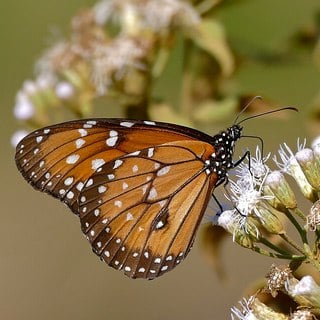
Blue mistflower produces compounds called pyrrolizidine alkaloids (PA) that are a natural defense mechanism against insect predators. PA is also the reason butterflies, especially males, flock to it. Visiting males ingest PA, which acts as a pheromone that attracts the females. Males pass PA to the females when mating. The females then pass it onto their eggs, making them less palatable to predators. Isn’t that amazing!?
In its native habitat of southeast Texas, blue mistflower is a favorite of monarchs. But in the Southwest, blue mistflower is just as likely to attract queen butterflies (Danaus gilippus) as monarchs (Danaus plexippus). As you can see below, they look a lot alike, and the differences can be subtle.

Plant Lover Facts
Blue mistflower’s scientific name is Chromolaena odorata. Its species name odorata refers to the leaves, which are aromatic when crushed. This plant goes by a long list of common names including shrubby blue mistflower, fragrant mistflower, blue boneset, fragrant boneset, Jack in the bush, Siam weed, common flossflower, Christmas bush, and devilweed.
There’s a good reason it’s sometimes called devilweed in other parts of the world.
While blue mistflower is native to our neighbors in Texas and Mexico and stays manageable in desert gardens, in tropical parts of Africa and Australia, it’s a reviled invasive species. It upsets native ecosystems, competes with agriculture, and is toxic to cattle. I was surprised to learn it’s considered one of the top 100 invasive species in the world.
Blue mistflower contains compounds with antimicrobial, anti-inflammatory, and antioxidant activity and has been used to treat malaria, wounds, digestive disorders, coughs, and colds.
Since this plant has negative economic impact in some parts of the world and has potential medicinal properties, it’s been well-studied. There’s evidence that it has allelopathic properties, but I’ve not heard of this being a problem when grown as a desert landscape plant.
Did you enjoy this article?
Sign up for our weekly newsletter
where you’ll find more great info on creating &
maintaining a beautiful, carefree desert landscape.
Author Bio
Deane Alban is the creator of Southwest Gardener. She studied journalism and received a bachelor’s degree in botany from the University of South Florida. Gardening is her lifelong passion. She’s been gardening in Tucson for over 16 years.

Photo Credits
smathichong, CC BY, iNaturalist.com
Bernard Dupont, CC BY-SA 2.0, Wikimedia Commons
J.M. Garg, CC BY-SA 3.0, Wikimedia Commons
Jane Weeden, CC BY, iNaturalist.com