
Bee brush is a lacy shrub with aromatic flowers that smell like vanilla and attract bees and butterflies like crazy. Here’s everything you need to know about growing this Chihuahuan Desert native.
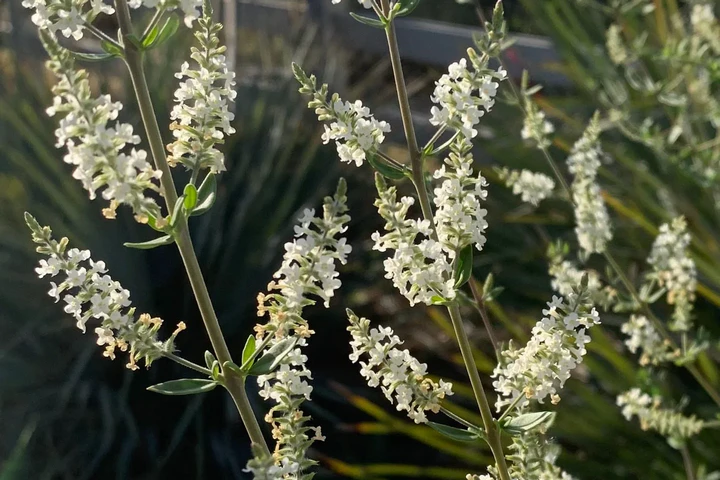
Bee brush (Aloysia gratissima) is a beautiful, upright shrub with wispy green foliage and spires of fragrant flowers that are usually pure white, but may also be pale lavender.
As its name implies, bees are highly attracted to this plant’s nectar-rich flowers when in bloom, which is much of the year. The most intense bloom is in the spring, but it flowers on and off from spring through fall, especially after rain or an increase in humidity.
Flowers also attract many species of butterflies. Birds such as finches and verdins enjoy the seeds.
As a Chihuahuan Desert native, it takes intense sun, heat, and aridity in its stride.
Why I Like This Plant
- Fragrant white flowers
- Long bloom period
- Low maintenance
- No thorns
- Chihuahuan Desert native
- Pollinator magnet
Things to Watch Out For
It’s suspected that it may be toxic to pets and livestock (horses, mules, and burros). However, there’s more information available on the toxicity of lemon verbena (Aloysia triphylla), a closely related plant, than on bee brush.
Optimal Growing Conditions
If you’re thinking of adding a bee brush to your garden, you need to find a suitable place that will keep your plant healthy and looking good… while minimizing maintenance for you.
Here are the key factors to keep in mind.
Temperature
Bee brush should be grown in USDA Hardiness Zones 7 to 10. It thrives in extreme heat and is cold hardy down 15℉ and possibly even colder. It’s usually evergreen but may lose leaves when the temperature dips.
Sun Exposure
Grow bee brush in either full sun or part shade. It will get leggy and flower less when it doesn’t get enough sun.
Size and Growth Rate
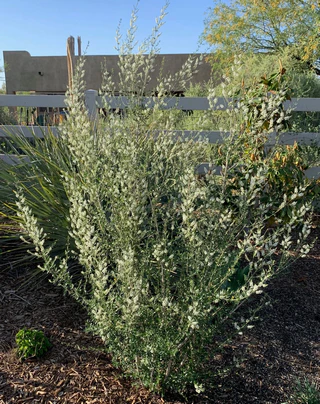
Bee brush grows moderately fast and has an upright form that’s taller than it is wide. It typically reaches a size of 6 to 10 feet tall by 4 to 6 feet wide.
Soil
In its native habitat, bee brush grows on rocky outcrops, sandy arroyos, and desert grasslands, and is not particular about soil. It can grow well in any native soil — rocky, sandy, limestone, or clay — provided it’s well-draining.
Bee Brush:
The Essentials
| Common Name | Bee brush |
| Scientific Name | Aloysia gratissima |
| Origin | Chihuahuan Desert, South America |
| Plant Type | Evergreen shrub |
| USDA Zones | Zones 7 – 10 |
| Cold Hardy | To 15℉ |
| Flower Color | White |
| Flower Season | Spring, summer, fall |
| Mature Size | 6-10′ high x 4-6’ wide |
| Growth Rate | Moderate to fast |
| Sun Tolerance | Full, part sun |
| Water Needs | Low |
| Cautions | May be toxic |
| Pests & Diseases | None |
| Wildlife | Attracts bees, moths, butterflies, birds |
How to Plant
The rule of thumb when planting any shrub or tree in the desert is to dig a hole three times as wide as the root ball but no deeper.
Amending the soil is not recommended. Counterintuitively, backfilling with the same native soil you just dug up helps your bee brush develop a stronger root system.
When to Plant
The best time to plant bee brush is in the fall. This gives it three seasons to grow roots and get established before the following summer.
The second best time is in spring, as soon as the risk of frost is over. This still gives it time to get established before the intense heat of June arrives.
How to Care for Bee Brush
Whether you’ve recently planted a bee brush or have an existing one in your yard, here’s how to take care of it to keep it healthy and looking its best.
How to Water New Plants
Once you’ve got your bee brush in the ground, watering is your most immediate concern. Here is the recommended watering schedule for new shrubs planted in the spring or fall.
| Weeks 1 & 2 | Every 3 – 4 days |
| Weeks 3 & 4 | Every 5 – 7 days |
| Weeks 5 & 6 | Every 7 – 10 days |
| Weeks 7 & 8 | Every 10 – 14 days |
After week 8, gradually revise your watering schedule, depending on the season.
How to Water Established Plants
As your bee brush gets established, there are two watering factors to consider.
- First is how often to water. This will vary with the seasons.
- Second is how much water to give your shrub with each watering. This depends on its current size.
To determine the ideal watering schedule for your bee brush, you’ll find everything you need to know, including easy-to-use charts, at How to Water Desert Shrubs: How Often? How Much?
While bee brush can survive on minimal water, it will grow faster and produce more leaves and flowers with occasional deep watering.
Should You Fertilize?
Bee brush does not need fertilizer. It sometimes gets leggy and has fewer flowers when fertilized.
How to Prune
Bee brush doesn’t need pruning unless you want to shape it, control its size, or attempt to make it bushier. Prune in late winter or in spring after its peak bloom has passed. Unlike most native shrubs, it tolerates being grown as an informal hedge.
Plant Lover Facts
Bee brush (Aloysia gratissima) also goes by the common names beebrush, whitebrush, fragrant bee brush, and common bee brush.
It has a large native range that encompasses Arizona, New Mexico, Texas, and Mexico, and several South American countries — Argentina, Bolivia, Brazil, Chile, Paraguay, and Uruguay.
Bee brush was traditionally used to treat bronchial infections, lung disorders, depression, anxiety, and inflammation. Research confirms that it contains anti-inflammatory, analgesic, antimicrobial, and antidepressant compounds.
A note to beekeepers — bees that feed on the nectar of bee brush make delicious honey!
Did you enjoy this article?
Sign up for our weekly newsletter
where you’ll find more great info on creating &
maintaining a beautiful, carefree desert landscape.
Author Bio
Deane Alban is the creator of Southwest Gardener. She is a science writer with a bachelor’s degree in botany from the University of South Florida. Gardening is her lifelong passion. She’s been gardening in Tucson for over 16 years.
