
Yellow oleander is a large evergreen shrub that blooms in late summer through fall when the flowers of many desert shrubs are fading after a long, hot summer. Here’s how to plant and care for this low-maintenance native of the western hemisphere tropics.
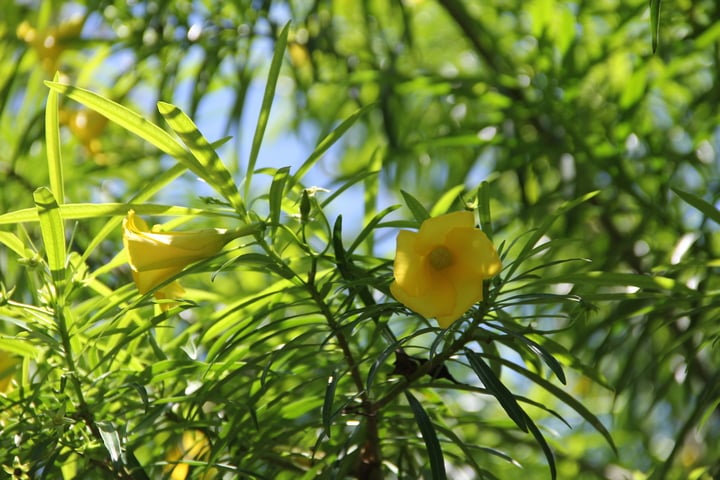
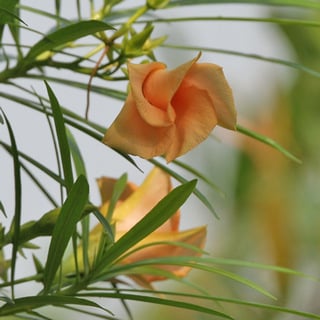
Yellow oleander (Cascabela thevetia) is a large, evergreen shrub with long, glossy, willow-like leaves. When in bloom, it’s covered with clusters of fragrant, trumpet-shaped flowers that are usually yellow but also come in cream, apricot, or orange.
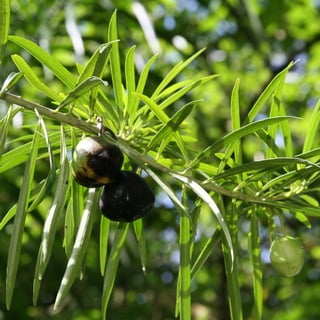
Flowers are followed by olive-like pods that ripen from lime green to nearly black.
It’s native to the seasonally dry tropical regions of Mexico, Central, and South America, but it tolerates most desert conditions, especially intense heat and sun.
Yellow oleander is not a true oleander (Nerium oleander), but they both belong to the same plant family (Apocynaceae), one known for containing many poisonous plants.
The flowers attract bees and butterflies.
Why I Like This Plant
- Glossy evergreen foliage
- Yellow flowers summer through fall
- Grows fast
- Low maintenance
- No thorns
What to Watch Out For
Yellow oleander naturally grows as a large shrub. If you want a plant that looks like a small tree, you’ll need to train it to grow that way.
Important warning! ⚠️ All parts of yellow oleander are toxic and can be lethal to people, pets, and horses. There are many reported fatalities from consuming the seeds, which contain numerous cardiac glycosides.
Some people experience dermatitis from handling the leaves. The milky sap can be an eye and skin irritant. The smoke from burning leaves is toxic.
Optimal Growing Conditions
If you’re thinking of adding a yellow oleander to your garden, you need to find a suitable place that will keep your plant healthy and looking good… while minimizing maintenance for you.
Here are the key factors to keep in mind.
Temperature
Yellow oleander should be grown in USDA Hardiness Zones 9 to 11. It tolerates the most extreme desert heat but is not particularly cold hardy. It experiences leaf damage at 28℉ but will survive temperatures in the mid twenties.
Sun Exposure
Yellow oleander is not particular about sun exposure and will grow in full or part sun. It doesn’t mind the reflected sun off walls or buildings.
Size and Growth Rate
Yellow oleander has a moderate growth rate. Its mature size can vary greatly depending on how it’s pruned and how cold your winters are.
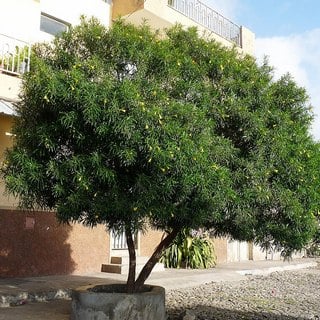
In southwest desert gardens, it typically reaches a size of 10 to 20 feet tall by 5 to 12 feet wide, but it can grow much larger. In its native tropical habitat, it can be 30 feet tall and wide.
Here’s a picture of one that has been trained to grow as a small multi-trunk tree.
Soil
Yellow oleander prefers sandy loam that stays somewhat moist, but is well-draining. This type of soil is rare in the desert, so amending your soil may be in order.
Yellow Oleander:
The Essentials
| Common Name | Yellow oleander |
| Scientific Name | Cascabela thevetia |
| Origin | Mexico, Central & South America |
| Plant Type | Evergreen tree/shrub |
| USDA Zones | Zones 9 – 11 |
| Cold Hardy | To 25℉ |
| Flower Color | Yellow |
| Flower Season | Summer, fall |
| Mature Size | 10-20’ tall x 6-12’ wide |
| Growth Rate | Moderate |
| Sun Tolerance | Full, reflected, part sun |
| Water Needs | Moderate |
| Pests/Diseases | None |
| Caution! | All parts toxic |
| Wildlife | Attracts bees, butterflies |
How to Plant
The rule of thumb when planting any tree or shrub in the desert is to dig a hole three times as wide as the root ball but no deeper.
Since yellow oleander prefers fertile soil, consider amending your hole with compost or a commercial soil mix. Top with organic mulch rather than gravel, which helps to retain moisture and increase soil fertility, and reduce alkalinity.
When to Plant
The best time to plant yellow oleander is in the fall. This gives it three seasons to grow roots and get established before the following summer.
The second best time is in spring, the earlier the better. This still gives it time to get established before the intense heat of June arrives.
How to Care for Yellow Oleander
Whether you’ve recently planted a yellow oleander or have an existing one in your yard, here’s how to take care of it to keep it healthy and looking its best.
How to Water New Plants
Once you’ve got your yellow oleander in the ground, watering is your most immediate concern. Here is the recommended watering schedule for new shrubs planted in the spring or fall.
| Weeks 1 & 2 | Every 3 – 4 days |
| Weeks 3 & 4 | Every 5 – 7 days |
| Weeks 5 & 6 | Every 7 – 10 days |
| Weeks 7 & 8 | Every 10 – 14 days |
How to Water Established Plants
As your shrub gets established, there are two watering factors to consider.
- First is how often to water. This will vary with the seasons.
- Second is how much water to give your shrub with each watering. This depends on the current size of your plant.
To determine the ideal watering schedule for yellow oleander, you’ll find everything you need to know, including easy-to-use charts, at How to Water Desert Shrubs: How Often? How Much? Since it is not a low water use plant, use the “High Water Use” schedule.
Yellow oleander is fairly drought tolerant once established.
Should You Fertilize?
There is no need to fertilize yellow oleander, but it would benefit from an occasional top dressing of organic mulch or compost.
How to Prune
Unlike most desert shrubs, which should be pruned in the spring, yellow oleander should ideally be pruned in the fall, after it’s done blooming.
If you want it to grow as a tree, you’ll need to train it when it’s young. Unless you are experienced in pruning desert trees, I suggest you have an arborist train your young tree to get it off to the best possible start.
You can deadhead spent flowers if you wish to prevent the formation of seed pods, which are the most toxic part of this plant.
Non-Toxic Alternative
If you are wary about yellow oleander due to its toxicity, consider yellow bells (Tecoma stans). It has many of the same growing requirements and features, but is not toxic and is safe to grow around children and pets.

Plant Lover Facts
Yellow oleander (Cascabela thevetia) is also referred to as lucky nut. I’ve not found a good explanation for why this nut is lucky, and find it an odd common name for a plant that’s so toxic. 🤔
It’s native to Mexico, Central America, and the northern half of South America. It has naturalized in India and southeastern Asia. Closer to home, it has escaped cultivation in Florida and throughout the Caribbean.
Did you enjoy this article?
Sign up for our weekly newsletter
where you’ll find more great info on creating &
maintaining a beautiful, carefree desert landscape.
Author Bio
Deane Alban is the creator of Southwest Gardener. She is a science writer with a bachelor’s degree in botany from the University of South Florida. Gardening is her lifelong passion. She’s been gardening in Tucson for over 15 years.

Photo Credits
Treeworld Wholesale, CC BY 2.0, Wikimedia Commons
David J. Stang, CC BY 4.0, Wikimedia Commons
Ji-Elle, CC BY 3.0, Wikimedia Commons
J.M. Garg, CC BY 3.0, Wikimedia Commons
Arizona State University’s Virtual Library of Phoenix Landscape Plants