
‘Winter blaze’ is a bit of a misnomer for this lovely emu bush, since it blooms much of the year, not just in winter. Here’s how to plant and care for this low-maintenance, evergreen cultivar of an Australian native.
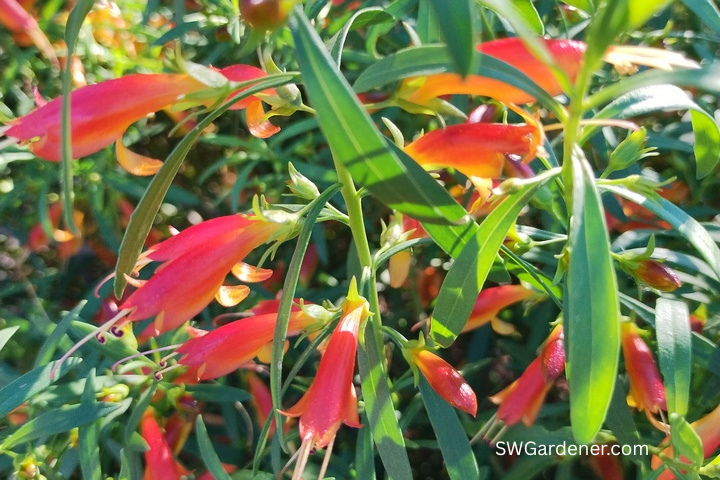
‘Winter Blaze’ emu bush (Eremophila glabra ssp. carnosa ‘Winter Blaze’) is a medium size shrub with small, glossy evergreen leaves. Its vivid, tubular flowers are shades of red, orange, and gold, and are highly attractive to hummingbirds.
With the name ‘Winter Blaze’, you might assume that it only blooms in the winter, but that’s not the case. While it blooms most profusely in late winter to early spring, it blooms intermittently throughout the year.
Winter blaze’s genus name Eremophila means “desert-loving” and it lives up to its name. It’s unfazed by blazing sun, poor soil, temperature extremes, and drought.
Other than needing occasional supplemental water, this plant is undemanding and virtually takes care of itself, and yet it is a standout all year long.
Why I Like This Plant
- Evergreen
- Vivid flowers with a long bloom season
- Low maintenance
- No thorns, non-toxic, low litter
- Attracts hummingbirds
Winter Blaze Emu: Valentine Emu Alternative
Winter blaze makes an excellent alternative to its botanical cousin, Valentine emu bush (Eremophila maculata ‘Valentine’). Both are medium size evergreen shrubs with tubular flowers. But there’s a difference that might matter to you.
Valentine emu has undeniably gorgeous fuchsia flowers, but it has a very short bloom period — only a week or two. Winter blaze, on the other hand, blooms much of the year.
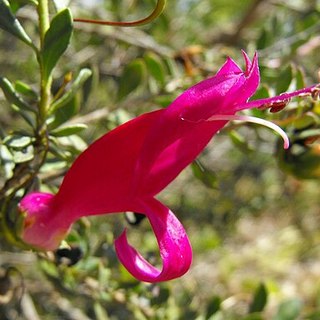
If I only had room for one of these, I’d choose the shrub with year-round flowers — and I’m sure my resident hummingbirds would, too!
Optimal Growing Conditions
If you’re thinking of adding a winter blaze emu bush to your garden, you need to find a suitable place that will keep your plant healthy and looking good… while minimizing maintenance for you.
Here are the key factors to keep in mind.
Temperature
Winter blaze emu bush should be grown in USDA Hardiness Zones 8 – 11. It thrives in desert heat and happily grows in the hottest places, such as Phoenix. It’s cold-hardy down to 20℉ and stays green all winter.
Sun Exposure
Winter blaze emu bush thrives in full sun, even the reflected sun off of buildings or garden walls. But it will also grow in part shade, such as the dappled shade under a tree.
Size and Growth Rate
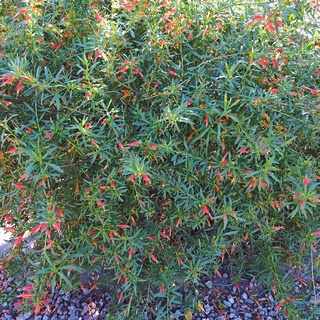
Winter blaze emu is moderately fast growing shrub that reaches a mature size of 3 to 4 feet tall and 4 to 5 feet wide.
Soil
Winter blaze emu bush is not particular about soil and will grow in any desert soil provided it’s well-draining. It is a cultivar of Eremophila glabra ssp. carnosa, which naturally grows in sand along the Western Australia coast.
Winter Blaze Emu Bush:
The Essentials
| Common Name | Winter blaze emu bush |
| Scientific Name | Eremophila glabra ssp. carnosa ‘Winter Blaze’ |
| Origin | Australia (cultivar) |
| Plant Type | Evergreen shrub |
| USDA Zones | Zones 8 – 11 |
| Cold Hardy | To 20℉ |
| Flower Color | Orange-red |
| Flower Season | All year |
| Mature Size | 3-4’ high x 4-5’ wide |
| Growth Rate | Moderate to fast |
| Sun Tolerance | Full, reflected, part sun |
| Water Needs | Low |
| Pests/Diseases | Root rot if overwatered |
| Garden friendly | No thorns, low litter, not toxic |
| Wildlife | Attracts hummingbirds Rabbit resistant |
How to Plant
The rule of thumb when planting any emu bush in the desert is to dig a hole three times as wide as the root ball but no deeper.
Amending the soil is not recommended. Counterintuitively, backfilling with the same native soil you just dug up helps your plant develop a stronger root system.
When to Plant
The best time to plant winter blaze is in the fall. This gives it three seasons to grow roots and get established before the following summer.
The second best time is in spring, the earlier the better. This still gives your plant time to get established before the intense heat of June arrives.
How to Care for Winter Blaze Emu Bush
Whether you’ve recently planted a winter blaze emu or have an existing one in your yard, here’s how to take care of it to keep it healthy and looking its best.
How to Water New Plants
Once you’ve got your shrub in the ground, watering is your most immediate concern. Here is the recommended watering schedule for new shrubs planted in the spring or fall.
| Weeks 1 & 2 | Every 3 – 4 days |
| Weeks 3 & 4 | Every 5 – 7 days |
| Weeks 5 & 6 | Every 7 – 10 days |
| Weeks 7 & 8 | Every 10 – 14 days |
How to Water Established Plants
As your shrub gets established, there are two watering factors to consider.
- First is how often to water. This will vary with the seasons.
- Second is how much water to give your shrub with each watering. This depends on the current size of your plant.
To determine the ideal watering schedule for winter blaze emu, you’ll find everything you need to know, including easy-to-use charts, at How to Water Desert Shrubs: How Often? How Much? Since it is a low water use plant, use the “Low Water Use” schedule.
In its native habitat, it will go dormant during severe drought, springing back to life when moisture appears.
Should You Fertilize?
There is no need to fertilize emu bushes. These are tough desert survivors that normally grow in poor, sandy soil.
How to Prune
This shrub generally doesn’t need pruning, but if you wish to shape it or control its size, you can cut it back by half in the spring. Pruning should not be a routine maintenance task — it should only be done every 3 years or so.
You can minimize the need to prune by watering less. More water means faster growth and more pruning.
Plant Lover Facts
Winter blaze emu (Eremophila glabra ssp. carnosa ‘Winter Blaze’ ) is a cultivar of a subspecies. Here’s how that happened.
Eremophila glabra is a widespread species found in the dry areas of all mainland states of Australia. It goes by the common name “common emu bush”. Yes, really.
Eremophila glabra has eight recognized subspecies. ‘Winter Blaze’ is a cultivar of the carnosa subspecies, a recent discovery that was first described in 2007.
Multiple Eremophila species have been used as traditional medicines by the indigenous people of Australia. E. glabra has been found to have antibacterial, antifungal, antiviral, antioxidant, anti-diabetic, anti-cancer, and/or anti-inflammatory properties.
Did you enjoy this article?
Sign up for our weekly newsletter
where you’ll find more great info on creating &
maintaining a beautiful, carefree desert landscape.
Author Bio
Deane Alban is the creator of Southwest Gardener. She is a science writer with a bachelor’s degree in botany from the University of South Florida. Gardening is her lifelong passion. She’s been gardening in Tucson for over 15 years.

Photo Credit
Stickpen, Public Domain, Wikimedia Commons