
Willow acacia is a tall, pendulous tree that is not a true willow, but has many willow-like attributes. But be aware that this is a high maintenance tree that many homeowners regret planting. Here’s everything you need to know to decide whether this Australian native is a good fit for your yard.
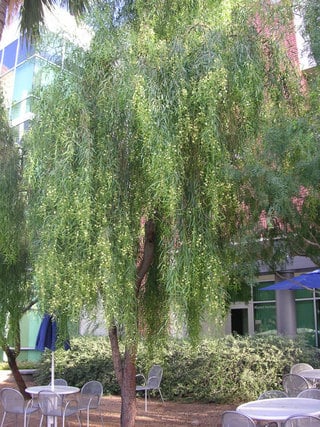
Willow acacia (Acacia salicina) is a large, thornless, evergreen tree that, unlike many desert trees, usually grows as a single trunk.
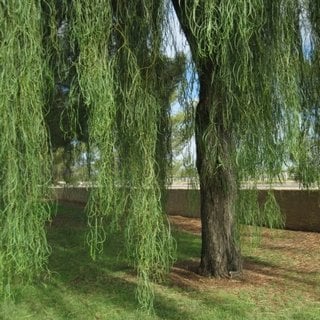
As the name implies, it has many willow-like features. It is graceful and pendulous with slender, blue-green, willow-like foliage. But unlike true willows, this Australian native does not need a lot of water and is at home in the hot, arid desert southwest.
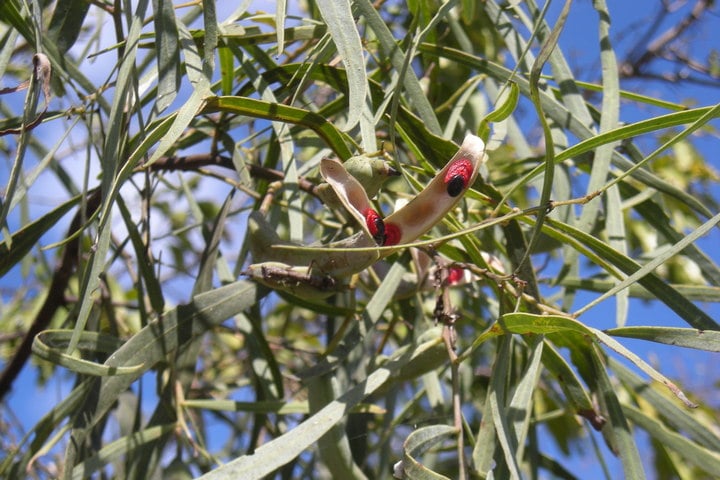
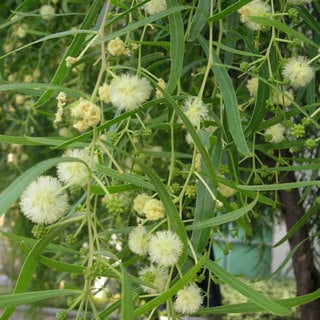
When in bloom, this tree is covered with small, fragrant, creamy white puffball flowers. Flowers are followed by 3 to 4 inch seed pods that split open to reveal dark, shiny seeds with a red outer coating.
It grows twice as tall as wide, making it a tree to consider for narrow spaces.
Things I Like About This Plant
- Evergreen foliage
- Fuzzy, fragrant cream flowers
- Provides shade fast
- Low water use
- No thorns
Why I Do Not Recommend This Tree
Willow acacia is a high maintenance tree with some significant problems.
Willow acacia is known for aggressively reseeding. It also sends up numerous vigorous suckers along the roots that quickly grow into young trees. If you don’t stay on top of weeding and removing sprouts, your yard will be overrun with willow acacia saplings.
I can’t stress how common it is for these trees to suffer from storm damage, even when professionally trained and staked. This tree requires regular pruning to raise and thin the canopy to reduce wind resistance. These trees frequently suffer from broken branches and leaning trunks. It’s not unusual for them to be uprooted during storms.
If you aren’t willing to invest in the services of an arborist to train and maintain your tree, you’ll undoubtedly pay later when your damaged or fallen tree has to be removed.
Willow acacia needs deep, infrequent irrigation to develop a strong anchoring root system. (The landscaper’s default irrigation setting of 20 minutes every 3 days will leave you with a shallow root system that will not sufficiently anchor your tree.)
For these reasons, I do not recommend planting this tree. There are too many other beautiful, resilient desert trees that do not have these inherent problems or require this much maintenance.
Other Things to Watch Out For
If you have kids or pets, keep in mind that the leaves and bark are mildly toxic.
Optimal Growing Conditions
If you’re thinking of adding a willow acacia to your yard, you need to find a suitable place that will keep your tree healthy and looking good… while minimizing maintenance for you.
Here are the key factors to keep in mind.
Temperature
Willow acacia should be grown in USDA Hardiness Zones 9 to 11. It thrives in extreme heat and survives temperatures down to 20℉, or even a few degrees lower for short periods of time.
Sun Exposure
Willow acacias thrive in full sun.
Size and Growth Rate
Willow acacia is a fast grower that can reach a mature size of 40 to 50 feet tall by 20 feet wide.
Soil
Willow acacia will grow in any type of soil — sandy, clay, loam, or rocky — provided it’s well-draining. It’s prone to root rot and storm damage in poor-draining soil.
Willow Acacia:
The Essentials
| Common Name | Willow acacia |
| Scientific Name | Acacia salicina |
| Origin | Australia |
| Plant Type | Evergreen tree |
| USDA Zones | Zones 9 – 11 |
| Cold Hardiness | To 20℉ |
| Flower Color | Creamy white |
| Flower Season | Spring |
| Mature Size | 50’ high x 20′ wide |
| Growth Rate | Fast |
| Sun Tolerance | Full sun |
| Water Needs | Low |
| Pests & Diseases | Root rot |
| Garden Friendly | No thorns |
How to Plant
The rule of thumb when planting any tree in the desert is to dig a hole three times as wide as the root ball but no deeper.
Amending the soil is not recommended. Counterintuitively, backfilling with only native soil helps your acacia develop a stronger root system.
When to Plant
The best time to plant willow acacia is in the fall. This gives it three seasons to grow roots and get established before the following summer.
The second best time is in spring, the earlier the better. This still gives your tree time to get established before the intense heat of June arrives.
How to Care for Willow Acacia
Whether you’ve recently planted a new willow acacia or have an existing one in your yard, here’s how to take care of it to keep it healthy and looking its best.
How to Water
Once you’ve got your willow acacia in the ground, watering is your most immediate concern.
Here is the recommended watering schedule for new trees planted in the spring or fall.
| Weeks 1 & 2 | Every 3 – 4 days |
| Weeks 3 & 4 | Every 6 – 7 days |
| Weeks 5 & 6 | Every 7 – 10 days |
| Weeks 7 & 8 | Every 10 – 14 days |
After week 8, gradually extend the time between waterings.
After the first year, you can take your tree off drip irrigation. Too much water promotes overly rapid growth, resulting in weak wood.
However, if you experience extreme drought, you can water it every month during the summer. Water deeply along the tree’s drip line to the depth of 3 feet. This will ensure that your tree develops a strong root system that will keep it firmly anchored during storms.
You can learn more about watering desert trees here.
Should You Fertilize?
Willow acacia doesn’t need fertilizer. As a member of the legume family (Fabaceae), it fixes nitrogen, which naturally improves the surrounding soil.
How to Prune
Young willow acacias need proper pruning and staking to get them off to a good start. I urge you to hire a certified arborist (not a guy with a truck and a chainsaw) to manage the acute branch angle attachments and bark inclusions these trees exhibit. (If you don’t know what that means, it’s a sign that you should not be pruning your own tree.)
When improperly pruned, this tree will develop structural defects that imperil its appearance, health, and longevity.
Willow acacia needs regular trimming so that you can walk under it since its pendulous branches will eventually touch the ground. This is one pruning task homeowners can do themselves.
Don’t Confuse Willow Acacia With…
Don’t confuse willow acacia with shoestring acacia (Acacia stenophylla). Both are large Australian natives with weeping silhouettes.
However, it’s easy to tell them apart by looking at their leaves. Willow acacia’s leaves are typically 4 to 6 inches long, while shoestring acacia’s leaves are much longer, around 16 inches.
Plant Lover Facts
Willow acacia (Acacia salicina) is also called weeping acacia or weeping wattle. Acacias are commonly called wattles in Australia. The word wattle comes from a quick house construction method used by the early English settlers that involved using acacia wood.
It’s native throughout hot, dry areas of central and eastern Australia. It has escaped cultivation in California and southwestern Mexico.
Willow acacia is not related to true willows, which belong to the willow family (Salicaceae).
Willow acacias don’t have leaves — they have phyllodes, which are flattened leaf stalks that look and function like leaves. Phyllodes are common in acacias, especially the Australian species.
The Indigenous people of Australia used toxins from willow acacia’s bark for fishing. They smoked the leaves, which are thought to be psychoactive.
Did you enjoy this article?
Sign up for our weekly newsletter
where you’ll find more great info on creating &
maintaining a beautiful, carefree desert landscape.
Author Bio
Deane Alban is the creator of Southwest Gardener. She is a science writer with a bachelor’s degree in botany from the University of South Florida. Gardening is her lifelong passion. She’s been gardening in Tucson for over 15 years.

Photo Credits
Ethyl Aardvark, CC BY-SA 3.0, Wikimedia Commons