
Weber’s agave makes a bold and beautiful accent plant, but it’s definitely not right for every garden due to its massive size and propensity for forming colonies. Here’s everything you need to know about growing this Chihuahuan Desert native in this complete care guide.
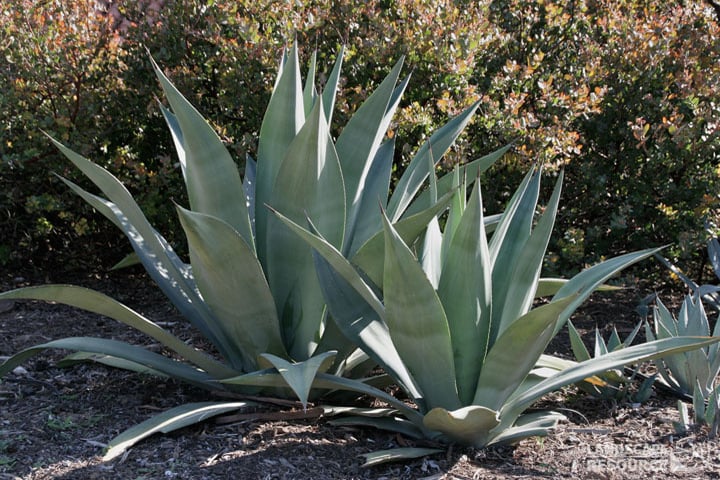
Weber’s agave (Agave weberi) is one of the largest agaves, and its commanding presence makes it a popular desert landscape plant. (It’s believed to be more common as a landscape plant than it is in the wild.)
Its large, fleshy, gray-green leaves have relatively smooth edges but end in a sharp tip.
This Chihuahuan Desert native is extremely low-maintenance and needs virtually no care other than digging up pups if they take over your space. You’ll often see plants of various sizes growing in clusters since it produces a prodigious number of offsets or “pups”. You can leave these where they pop up or move them for an endless supply of free plants.
When in bloom, the large flower stalk attracts pollinators of all kinds — hummingbirds, bats, moths, bees, and other insects.
Why I Like This Plant
- Arresting accent plant that provides architectural interest
- Extremely low maintenance
- Produces many pups
- Amazing flower stalk at the end of its life
- Supports a wide range of pollinators
Things to Watch Out For
Like all agaves, Weber’s agave blooms once and then dies.
This plant is a giant that you may regret planting, especially if you have a small yard. It’s not just the plant itself that is huge, the 20 foot flower stalk can get into power lines or push against the eaves of your house.
It’s essential that you keep its mature size in mind before planting. If you can’t visualize how big it may get or what an ordeal it can be to remove one that’s outgrown its space or died, check out this quick video of a 20 year old agave being removed. 😮 (Note that this is a video of a century plant, not a Weber’s, but they reach they same size when mature.)
While it has smooth edges and so is less dangerous than some agaves, its sharp tips can pose a hazard to people and pets.
Agaves contain compounds that can cause a rash called agave dermatitis in some people.
Weber’s agave, along with century plant, are the two species most susceptible to agave weevil infestations.
Optimal Growing Conditions
If you’re thinking of adding a Weber’s agave to your garden, you need to find a suitable place that will keep your plant healthy and looking good… while minimizing maintenance for you.
Here are the key factors to keep in mind.
Temperature
Weber’s agave should be grown in USDA Hardiness Zones 8 – 12. It tolerates desert heat and survives cold down to 12℉.
Sun Exposure
Weber’s agave thrives in either full sun or light shade. In the hottest, sunniest locations, it appreciates some afternoon shade, which prevents it from turning yellow.
Size & Growth Rate
Weber’s agave grows moderately fast and ultimately reaches an impressive size of 8 to 10 feet tall by 6 feet wide.
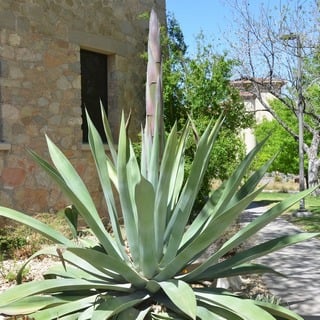
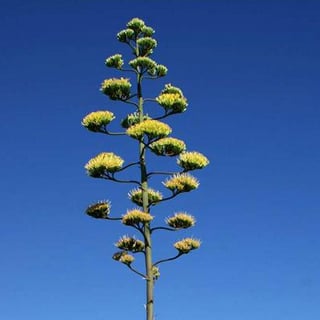
Sometime after 10 to 15 years, it will send up a large, fast-growing reproductive stalk that signals the end of its life. While this stalk is usually a candelabra of yellow flowers, some stalks produce small replicas of the plant called bulbils instead of flowers. You can harvest the bulbils to plant or give away.
It’s truly a fascinating marvel of nature to watch the flower stalk’s progress unfold!
Here’s a picture of the asparagus-like stalk emerging.
And here’s the final result.
Soil
Weber’s agave will grow in any well-draining desert soil, but it prefers alkaline soil that’s sandy or rocky.
Pests & Diseases
Agave weevils infest agave crops and desert landscape plants and are a global problem. There is no cure, and infestations are always fatal. Unfortunately, Weber’s agave is one of the most susceptible agave species.
The best defense is to keep your plant healthy. Agave weevils are more likely to attack plants that are over- or under-watered or otherwise stressed or damaged.
Learn more:
Agave Weevil: Little Bug, Big Problem
Other Location Considerations
Keep its mature size in mind when deciding where to plant one. When planted where they don’t have enough room to grow, there’s no way to make this plant smaller without butchering it.
Weber’s agave is huge with sharp tips, so don’t plant it near foot traffic. If the sharp ends become a hazard, you can clip them. Other creative solutions I’ve seen include putting wine corks or small balls on the tips to keep people or pets from getting poked.
Weber’s Agave:
The Essentials
| Common Name | Weber’s agave |
| Scientific Name | Agave weberi |
| Origin | Mexico |
| USDA Zones | Zones 8 – 11 |
| Cold Hardiness | To 12℉ |
| Mature Size | 6’ high x 8-10’ wide |
| Growth Rate | Moderate |
| Sun Tolerance | Full, part sun |
| Water Needs | Low |
| Pests & Diseases | Agave weevils, root rot |
| Cautions! | Agave dermatitis, spines |
| Wildlife | Attracts birds, bats, insect pollinators |
How to Plant
To plant a Weber’s agave, dig a hole the same depth as the root system and twice as wide.
Carefully remove the plant from the container, place it in the hole, and fill with the same native soil you just removed. Press the soil to remove any air pockets.
It’s generally recommended that you not add amendments to the soil. However, good drainage is critical, so if your soil drains slowly, amend with coarse sand or small gravel until you have a loose, well-drained mix.
If you are planting an offset, let the end dry in the shade for a few days, and then either plant it directly in the ground or temporarily place it in a well-draining pot with cactus soil.
When to Plant
The best time to plant agaves is in spring between April and May, when warm temperatures encourage root development.
How to Care for Weber’s Agave
Whether you’ve recently planted a Weber’s agave or have an existing one in your yard, here’s how to take care of it to keep it healthy and looking its best.
How to Water
You’re probably used to giving a plant a good soaking immediately after transplanting, but that isn’t the best practice with agaves.
Counterintuitively, it’s best to not water agaves for one to two weeks after planting. Then use the following schedule as a guide.
| Spring & Fall | Every 3-5 weeks |
| Summer | Every 2-4 weeks |
| Winter | Only if no winter rains |
Supplemental water encourages faster growth, which may or may not be desirable, depending on your situation.
If your plant’s leaves start to yellow during the heat of the summer, give it some extra supplemental water.
Should You Fertilize?
Weber’s agave does not need fertilizing. It gets all the nutrients it needs from the surrounding desert soil.
How to Prune
Weber’s agave should not be pruned except to remove dead lower leaves.
Eventually, you’ll need to remove the flower stalk, but try to wait until it’s spent. While in bloom, the flowers are an important source of food for many pollinators.
And if your stalk has bulbils, wait as long as you can so they get a chance to mature on the stalk. Then you can harvest them to plant for yourself or give away.
Weber’s Agave Cultivar
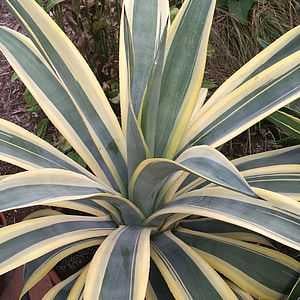
Weber’s agave is available as an attractive variegated cultivar, Agave weberi ‘Arizona Star’. Variegated Weber agave is a smaller version (4′ tall by 7′ wide) that has gray-green leaves lined with creamy yellow stripes.
This selection was picked from a crop of Agave weberi growing at Mountain States Nursery in Arizona.
For Plant Lovers
Weber’s agave also goes by the common names Weber agave, Weber’s century plant, and smooth edge agave.
It’s native to northeast Mexico, but has naturalized in southern Texas and in Florida. It’s becoming invasive in parts of South Africa.
It’s named after the French botanist Frédéric Albert Constantin Weber, who specialized in studying members of the cactus family and is also credited with naming a few agave species. (But not Weber’s agave.)
Weber’s agave is one of the many agaves used traditionally to make mezcal and other alcoholic beverages. Its roots were used as a food source and to make soap.
Did you enjoy this article?
Sign up for our weekly newsletter
where you’ll find more great info on creating &
maintaining a beautiful, carefree desert landscape.
Author Bio
Deane Alban is the creator of Southwest Gardener. She is a science writer with a bachelor’s degree in botany from the University of South Florida. Gardening is her lifelong passion. She’s been gardening in Tucson for over 15 years.
