
Velvet mesquite is a Sonoran Desert native with lots of character. It’s one of the best trees for attracting and supporting wildlife, but it’s messy and has some other issues that gardeners should be aware of. Here’s everything you need to know about this tree, so you can decide whether it’s a good fit for your garden, plus how to take care of any new or existing plants.
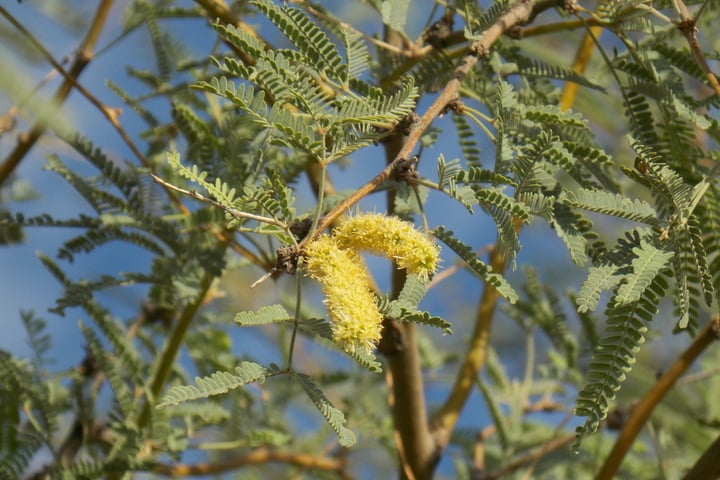
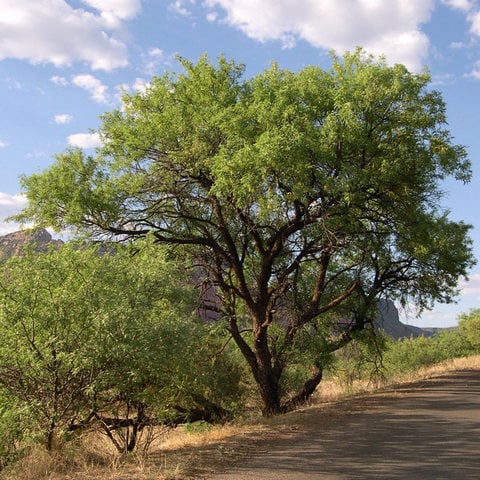
Velvet mesquite (Neltuma velutina) is a large, deciduous tree with fern-like leaves that are covered with soft hairs. It has a wild, informal look. The branches are pendulous or grow horizontally, and the trunk often contorts into interesting shapes.
In the spring, it’s covered with pale yellow flowers called catkins. Flowers are followed by an abundance of 4 inch, edible seed pods.
This native mesquite offers many advantages over South American species. It has stronger wood, a more robust root system, and is less likely to split or blow over. It’s extremely long-lived and can survive several hundred years.
It’s extremely low water use and needs no supplemental water after the first year.
And there is no better tree for supporting a wide variety of wildlife. This Sonoran Desert keystone species creates its own ecosystem, providing food and shelter for many species of birds, mammals, bees, butterflies, and other pollinating insects.
This tree is not appropriate for a small yard, but it can be a fantastic addition if you have a decent amount of outdoor space.
Why I Like This Plant
- Attractive shade tree
- Extremely low water use
- Sonoran Desert native
- Excels at supporting wildlife
Things to Watch Out For
Velvet mesquite is truly a wonderful tree that has many great features when grown in the right situation. But it has several issues that gardeners should consider before planting one in their yard.
It Needs Space
It is not a good choice for small urban or suburban yards. This tree is best grown away from houses, sidewalks, driveways, patios, pools, garden walls, and other structures.
It drips dark, sticky sap that stains patios, sidewalks, and pavers. Its roots can be invasive when grown too close to structures and outdoor living areas. They have been known to damage walls, pavement, and foundations.
It’s Messy
Velvet mesquite usually loses its leaves in the winter, but the leaves are fine and largely inconspicuous on gravel or mulch. However, mature trees drop thousands of seed pods. Keeping on top of them can be an onerous task.
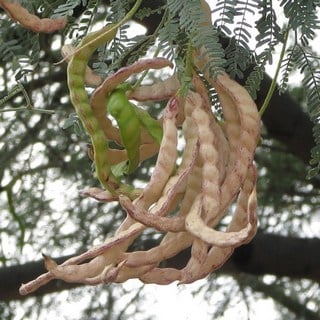
On the bright side, velvet mesquite pods taste slightly sweet and are considered one of the best for eating. You can learn how to harvest and prepare mesquite pods here.
It’s Not All That People Friendly
Velvet mesquite produces copious amounts of allergenic pollen.
Some people find that touching the leaves can cause irritation.
Trees have sharp, 2 to 3 inch thorns.
Pruning is a Challenge
Each velvet mesquite is unique, and fans say they have a lot of character. But don’t plant this if you want a normal-looking, “lollipop” tree.
When left to their own thing, velvet mesquites can grow to be asymmetrical, sprawling, and oddly shaped. If you want a more manicured looking tree, your velvet mesquite will need considerable pruning.
After pruning, velvet mesquite can sucker profusely at its base and grow water sprouts at pruning cuts. So unless you have expertise in pruning challenging desert trees, you’ll either have to learn how to do it yourself or hire a certified arborist. (I urge you not to rely on a guy with a truck who calls himself a “landscaper”.)
Pests
Like all mesquites, it can be a potential host to desert mistletoe. While this hemiparasite is rarely a serious problem in healthy trees, having a tree with mistletoe may not be the look you’re going for if you want it to be the showpiece of a small yard.
Optimal Growing Conditions
If you’re thinking of adding a velvet mesquite to your garden, you need to find a suitable place that will keep your plant healthy and looking good… while minimizing maintenance for you.
Here are the key factors to keep in mind.
Temperature
Velvet mesquite should be grown in USDA Hardiness Zones 7 to 11. It is tolerant of extreme heat and cold and can withstand temperatures down to 10℉.
It is usually deciduous in Tucson, but in mild winters, it may keep its leaves until new foliage emerges in spring.
Sun Exposure
It thrives in full sun and doesn’t mind the reflected heat off garden walls or buildings.
Size and Growth Rate
This tree is a moderately fast grower. It typically reaches a size of 25 to 30 feet tall and wide in desert gardens. However, it can grow much bigger — up to 50 feet tall and wide.
Soil
Velvet mesquite is not particular about soil and does well in sandy, rocky, or clay soil, provided it’s well-draining.
Velvet Mesquite:
The Essentials
| Common Name | Velvet mesquite |
| Scientific Name | Neltuma velutina |
| Origin | Sonoran Desert |
| Plant Type | Deciduous tree |
| USDA Zones | Zones 7 – 11 |
| Cold Hardiness | To 10℉ |
| Flower Color | Yellow |
| Flower Season | Spring |
| Mature Size | 30’ high x 30’ wide |
| Growth Rate | Moderate to fast |
| Sun Tolerance | Full, reflected sun |
| Water Needs | Low |
| Pests & Diseases | Desert mistletoe |
| Cautions | Thorns, allergenic |
| Wildlife | Supports many kinds of wildlife |
How to Plant
The rule of thumb when planting a velvet mesquite in the desert is to dig a hole three times as wide as the root ball but no deeper.
Amending the soil is not recommended. Counterintuitively, backfilling with the same native soil you just dug up helps your plant develop a stronger root system.
When to Plant
The best time to plant a velvet mesquite is in the fall. This gives your tree three seasons to grow roots and get established before the following summer.
The second best time is in spring, the earlier the better. This still gives it time to get established before the intense heat of June arrives.
How to Care for Velvet Mesquite
Whether you’ve recently planted a new velvet mesquite or have an existing one in your yard, here’s how to take care of it to keep it healthy and looking its best.
How to Water
Once you’ve got your velvet mesquite in the ground, watering is your most immediate concern.
Here is the recommended watering schedule for new trees planted in the spring or fall.
| Weeks 1 & 2 | Every 3 – 4 days |
| Weeks 3 & 4 | Every 6 – 7 days |
| Weeks 5 & 6 | Every 7 – 10 days |
| Weeks 7 & 8 | Every 10 – 14 days |
After week 8, gradually extend the time between waterings.
After the first year, you can take your tree off drip irrigation. Too much water promotes overly rapid growth, resulting in weak wood.
However, if you experience extreme drought, you can water it every month or two during the summer. Water deeply along the tree’s drip line. This will ensure that your tree develops a strong root system that will keep it firmly anchored during storms.
Should You Fertilize?
Velvet mesquite does not need fertilizer. And since mesquites are members of the legume family (Fabaceae), they fix nitrogen, which naturally improves the surrounding soil.
Pruning: Professional Care Highly Recommended
Unless you’ve got plenty of room to let your velvet mesquite grow unfettered, it will need pruning. Unless you have experience pruning this kind of desert tree, I strongly urge you to hire a professional.
Hiring a certified arborist to get your tree off to the right start is an excellent investment that will result in a beautiful, healthy, sturdy tree that will provide shade and beauty to your yard for decades to come. A poorly pruned tree can become an eyesore that is prone to storm damage.
Plant Lover Facts
Velvet mesquite (Neltuma velutina) also goes by the common names Arizona mesquite and tree of life.
You may also see it referred to as Prosopis velutina, the previous scientific name that is still widely used.
The species name velutina refers to the velvet-like hairs on the leaves.
It’s native to Arizona, New Mexico, and northern Mexico, and has naturalized in parts of California.
Native Americans put this plant to good use. The flour they made from the high-protein pods was a staple of their diet. They used it medicinally to treat various ailments and used its wood for fuel and lumber.
It still has culinary uses today — for mesquite honey, mesquite flour, and mesquite wood for grilling.
Did you enjoy this article?
Sign up for our weekly newsletter
where you’ll find more great info on creating &
maintaining a beautiful, carefree desert landscape.
Author Bio
Deane Alban is the creator of Southwest Gardener. She is a science writer with a bachelor’s degree in botany from the University of South Florida. Gardening is her lifelong passion. She’s been gardening in Tucson for over 15 years.

Photo Credits
Eliseo D Moreno, CC BY-SA, iNaturalist.com
The University of Arizona Campus Arboretum
Max Licher, CC BY-SA, SWBiodiversity.org