
When you read plant labels, you’ll notice that many plant names are more complicated than just genus and species. This indicates that they may be a variety, hybrid, or cultivar. What’s the difference? And why does it matter?

All plants have a scientific name consisting of a genus and a species. But many plant names include additional information that tells you whether a plant is a variety, hybrid, or cultivar. Sometimes it indicates that a plant is patented. Learn how to have a better understanding of plant labels and what this information means about the plants you grow.
What is a Plant Variety?
All plants are given a scientific name that includes a genus and species, i.e., Agave americana. But a few will have a name that looks like this — Agave americana var. ‘marginata’. This means that this plant is a variety. Variety is a taxonomic rank below species.
A variety is a version of a plant that has unique characteristics different from the typical form, but it’s still the same species. Varieties naturally occur in nature, usually as adaptations to their environment, with no human intervention.
Variety names look like this:
Agave americana var. ‘marginata’
Note that if you grow a variety from seed, the offspring will grow true to type and retain that plant’s unique characteristics.
Variety Examples
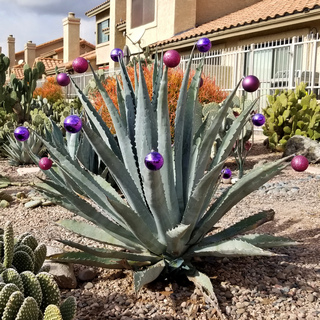
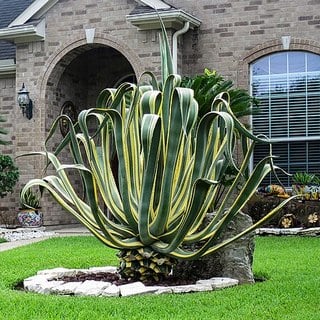
Here’s a picture of two century plants. The first is the species, Agave americana, and the second is a naturally occurring variety, Agave americana var. ‘marginata’.
I find it fascinating that these two very different-looking plants are members of the same species.
Other popular desert landscape plants that are varieties include:
- Mexican redbud (Cercis canadensis var. ‘mexicana’) — variety of Eastern redbud (Cercis canadensis)
- Artichoke agave (Agave parryi var. ‘truncata’) — variety of Parry’s agave (Agave parryi)
What is a Hybrid?
A hybrid is a cross between two different, but usually closely related, species. Most plant hybrids are created by growers seeking to form a new plant that has specific attributes of the parent plants, but some hybrids occur naturally.
An “x” in a plant name denotes that it is a hybrid.
Hybrid names look like this:
Pistacia x ‘Red Push’
Hybrids can be created in both low and high-tech ways. On one hand, home gardeners can try their hand at hybridizing by manually moving pollen from one plant to another using a cotton swab. On the other hand, genetic engineering can also be used to create hybrids.
Note that if you try growing a hybrid from seed, you should not expect the offspring to have the same characteristics as your original plant. Hybrid seeds do not grow true to type and are usually less vigorous.
Hybrid Examples
Red push pistache (Pistacia x ‘Red Push’) is a large, deciduous shade tree that’s a hybrid of Chinese pistache (Pistacia chinesis) and Mt. Atlas pistache (Pistacia atlantica).
A major benefit of this hybrid is its resistance to Verticillium wilt, a serious and often fatal fungal disease. Most commercial pistachio trees (Pistache vera) are now grown on red push pistache rootstock, to take advantage of this benefit.
The infamous ‘Desert Museum’ palo verde (Parkinsonia X ‘Desert Museum’) is unusual in that it’s a naturally occurring hybrid of a hybrid. It was discovered growing in Tucson and was determined to be a cross between blue palo verde (Parkinsonia florida) and a hybrid tree that was a cross between foothills palo verde (Parkinsonia microphylla) and Mexican palo verde (Parkinsonia aculeata).
This is a case where a hybrid had an undesirable trait that wasn’t discovered until it had been extensively planted. It grows super-fast, resulting in weak wood and a top-heavy canopy. Consequently, it’s extremely prone to storm damage. If you’ve ever seen palo verdes down after a storm, it’s often this hybrid.

What is a Cultivar?
A cultivar is a “cultivated variety” that has been selectively bred for desired traits. Cultivars usually exist due to human intervention or manipulation, but some occur naturally.
While cultivars can be found growing in the wild, they are usually “discovered” by growers who are always looking for new and improved plants to bring to the market.
Cultivar names look like this:
Chilopsis linearis ‘Bubba’
Since cultivar seeds do not grow true, cultivars are generally propagated by asexual methods such as cuttings, divisions, offsets, or grafting.
Cultivar Examples
Desert willow ‘Bubba’ (Chilopsis linearis ‘Bubba’) is a cultivar of desert willow that offers several improvements over an already lovely native tree. It has thicker, glossier leaves, lusher foliage, and produces fewer seed pods.
Purple hop bush (Dodonaea viscosa ‘Purpurea’) is a cultivar that has more colorful leaves than the parent plant hop bush (Dodonaea viscosa), which has emerald green leaves. The purple version was found growing as a sport — a part of a plant that has a natural variation in coloring. A gardener found it growing wild in New Zealand, and eventually, it was grown commercially.

(Dodonaea viscosa ‘Purpurea’)
Patented Cultivars
Some cultivars are patented or trademarked. For example, Tucson’s Civano Growers patented a cultivar of fairy duster and called it ‘Mexicali Rose‘. Patented cultivars have PP (Plant Patent) followed by the patent number in the name.
A patented cultivar label looks like this:
Calliandra californica ‘Mexicali Rose’ PP36387
Sometimes you’ll see PPAF on a label instead of PP. This means “Plant Patent Applied For” — the grower has applied for a patent, but it has not yet been granted.
Why Plant Types Matter
You may or may not find learning about these differences in plant nomenclature and labeling interesting. (Plant nerds like me love this stuff, but I realize it’s not everyone’s jam.) However, there are some practical reasons for understanding the nomenclature information on a plant label.
It will help you make more appropriate choices when buying plants. Sometimes the differences between the parent plant and a variety or cultivar of that plant can be significant in appearance or in the care it requires.
It also matters if you want to propagate your plant. Don’t count on the seeds from cultivars or hybrids, which do not grow true and may even be sterile.
And weird but true — propagating a patented plant is technically against the law. This is rarely (as in never) an issue if you propagate it for home use. But it could become a problem if you propagate a patented plant and then try to sell it.
Did you enjoy this article?
Sign up for our weekly newsletter
where you’ll find more great info on creating &
maintaining a beautiful, carefree desert landscape.
Author Bio
Deane Alban is the creator of Southwest Gardener. She is a science writer with a bachelor’s degree in botany from the University of South Florida. Gardening is her lifelong passion. She’s been gardening in Tucson for over 15 years.

Photo Credits
Arizona State University’s Virtual Library of Phoenix Landscape Plants
David Stang, CC BY-SA 4.0, via Wikimedia Commons