
Valentine emu bush is an evergreen shrub that puts on an eye-catching display of brilliant fuchsia flowers in the winter. Here’s how to plant and care for this low-maintenance Australian native.
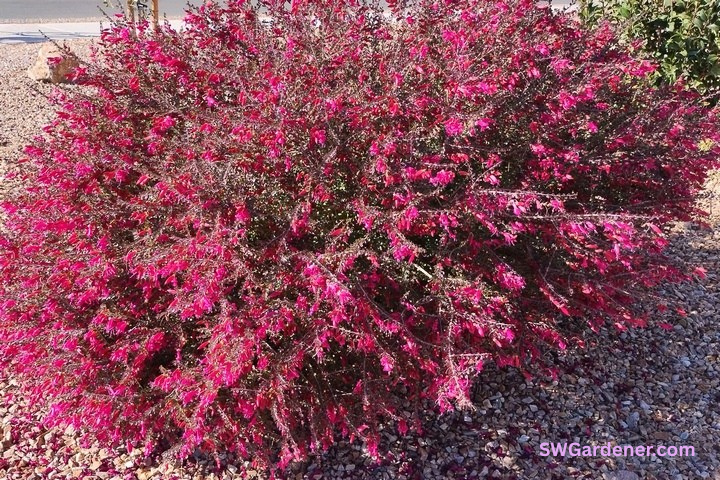
Valentine emu bush (Eremophila maculata ‘Valentine’) is an evergreen shrub with small, grey-green leaves that turn purple-grey in the winter. What makes this shrub a stand-out is its display of brilliant fuchsia flowers.
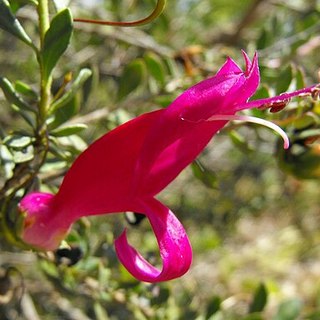
The one inch tubular flowers appear in the winter, often around Valentine’s Day, when little else is blooming. The blanket of flowers is so dense that it temporarily obscures the foliage. When it’s finished blooming, it suddenly drops its petals nearly all at once, leaving behind a carpet of pink.
It’s a perfect shrub for snowbirds or anyone who enjoys spending time in their garden during our delightful winter weather.
Why I Like This Plant
- Brilliant fuchsia flowers provide winter color
- Low maintenance
- Drought tolerant
- No thorns, non-toxic, low litter (except for flower petals)
- Attracts hummingbirds
What to Watch Out For
If you’re considering planting Valentine emu bush for its stunning flowers, be aware that the bloom period is disappointingly short — they peak after only a week or two. So don’t count on it being a show-stopper for most of the year.
This shrub naturally grows wider than tall and is prone to splitting if left to grow too wide.
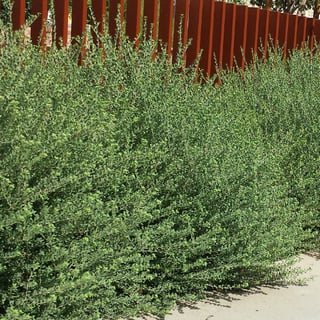
When not in bloom, it’s not a stand-out but is still a perfectly serviceable shrub. Here’s what it looks like when not in bloom.
If you would prefer a shrub with a longer bloom period, consider ‘Winter Blaze’, an emu bush that has red flowers much of the year.
Optimal Growing Conditions
If you’re thinking of adding a Valentine emu bush to your garden, you need to find a suitable place that will keep your plant healthy and looking good… while minimizing maintenance for you.
Here are the key factors to keep in mind.
Temperature
Valentine emu bush should be grown in USDA Hardiness Zones 8 – 11. It survives cold down to 15℉.
It tolerates desert heat… up to a point. Plants struggle when the temperature is above 115℉ for days in a row, as can happen during heat waves in Phoenix.
Sun Exposure
Valentine emu bush isn’t fussy about sun. It grows in full sun or part shade, and, with adequate water, will tolerate the reflected sun off garden walls and buildings.
Size and Growth Rate
Valentine emu bush grows slowly at first, and then the pace picks up as it matures. It can ultimately reach a size of 4 to 5 feet tall by 6 to 8 feet wide.
Soil
Valentine emu bush will grow in most types of desert soil — loam, sand, or rocky — provided it’s well-draining.
However, this plant can struggle when grown in clay. If you have clay soil, plant it on a berm or slope, or amend your soil to prevent root rot.
Valentine Emu Bush:
The Essentials
| Common Name | Valentine emu bush |
| Scientific Name | Eremophila maculata ‘Valentine’ |
| Origin | Australia |
| Plant Type | Evergreen shrub |
| USDA Zones | Zones 8 – 11 |
| Cold Hardy | To 15℉ |
| Flower Color | Fuchsia |
| Flower Season | Winter, early spring |
| Mature Size | 4-5’ high x 6-8’ wide |
| Growth Rate | Slow to moderate |
| Sun Tolerance | Full, part, reflected sun |
| Water Needs | Low |
| Pests/Diseases | Root rot |
| Garden friendly | No thorns, non-toxic, low litter |
| Wildlife | Attracts hummingbirds |
How to Plant
The rule of thumb when planting an emu bush in the desert is to dig a hole three times as wide as the root ball but no deeper.
Amending the soil is generally not recommended. Counterintuitively, backfilling with the same native soil you just dug up helps your plant develop a stronger root system. However, if you have clay soil, mix some small gravel in with the backfill to improve drainage and then top dress with organic mulch.
When to Plant
The best time to plant Valentine emu bush is in the fall. This gives it three seasons to grow roots and get established before the following summer.
The second best time is in spring, the earlier the better. This still gives your shrub time to get established before the intense heat of June arrives.
How to Care for Valentine Emu Bush
Whether you’ve recently planted a Valentine emu bush or have an existing one in your yard, here’s how to take care of it to keep it healthy and looking its best.
How to Water New Plants
Once you’ve got your emu bush in the ground, watering is your most immediate concern. Here is the recommended watering schedule for new shrubs planted in the spring or fall.
| Weeks 1 & 2 | Every 3 – 4 days |
| Weeks 3 & 4 | Every 5 – 7 days |
| Weeks 5 & 6 | Every 7 – 10 days |
| Weeks 7 & 8 | Every 10 – 14 days |
How to Water Established Plants
As your Valentine emu gets established, there are two watering factors to consider.
- First is how often to water. This will vary with the seasons.
- Second is how much water to give your shrub with each watering. This depends on the current size of your plant.
To determine the ideal watering schedule for Valentine emu, you’ll find everything you need to know, including easy-to-use charts, at How to Water Desert Shrubs: How Often? How Much? Since it is a low water use plant, use the “Low Water Use” schedule.
According to Civano Nursery, they can survive on rainwater alone. This surprised me. They won’t look their best, of course, but it’s interesting to know that they are this drought resistant.
Should You Fertilize
You can fertilize Valentine emu bush, but it’s not necessary. These are resilient plants that naturally grow in rocky or poor desert soil.
How to Prune
Valentine emu generally doesn’t need much pruning, but if you wish to prune to shape or control size, cut it back to half its size in the spring after the flowers have faded. This will result in a bushier plant with more flowers the following year, since the flowers are born on new wood.
Plants left unpruned often grow horizontally, which can result in splits at the base, as in this picture.
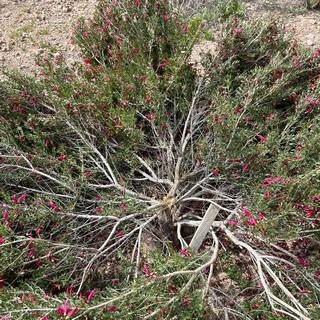
The best remedy for this is prevention. Once it happens, your only recourse is to prune any affected branches. When pruned this severely, sadly, it may or may not bounce back.
You can minimize the need to prune by controlling the amount of supplemental water your plant receives. More water equals faster growth and more pruning.
Plant Lover Facts
Valentine emu bush (Eremophila maculata ‘Valentine’) is sometimes called Valentine bush, red emu bush, or outback cupid.
It’s a cultivar of spotted emu bush (Eremophila maculata), a native of Australia’s deserts and shrublands. This species naturally occurs with a variety of flower colors and is frequently cultivated. You can find hybrids or selections in a wide array of colors — red, purple, white, yellow, orange, and various shades of pink.
The genus Eremophila is derived from the Greek words eremos (desert) and philos (loving), and means “desert loving.”
The Eremophila genus consists of approximately 250 species widely distributed in the arid regions of Australia.
Multiple Eremophila species have been used as traditional medicine by the indigenous Australians. Some species, including E. maculata, have been found to have antibacterial, antifungal, antiviral, antioxidant, anti-diabetic, anti-cancer, and/or anti-inflammatory properties.
Did you enjoy this article?
Sign up for our weekly newsletter
where you’ll find more great info on creating &
maintaining a beautiful, carefree desert landscape.
Author Bio
Deane Alban is the creator of Southwest Gardener. She is a science writer with a bachelor’s degree in botany from the University of South Florida. Gardening is her lifelong passion. She’s been gardening in Tucson for over 15 years.

Photo Credits
Arizona State University’s Virtual Library of Phoenix Landscape Plants
Stickpen, Public Domain, Wikimedia Commons