
Turpentine bush is a small flowering shrub that’s native to the southwest’s three deserts. If you have an intensely hot, sunny spot where little will grow, turpentine bush may be the answer. Here’s how to grow and care for this tough evergreen shrub.
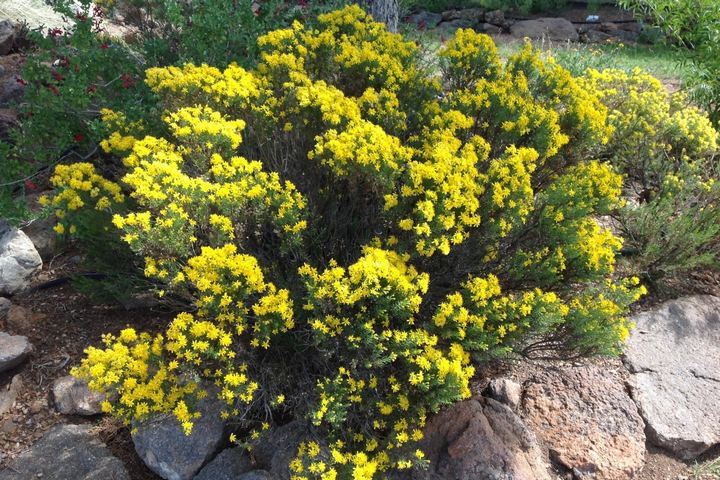
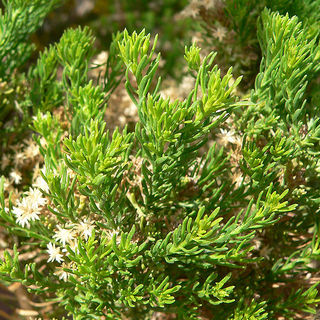
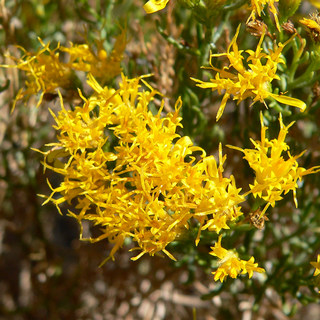
Turpentine bush (Ericameria laricifolia) is a small shrub with densely packed, needle-like leaves. It’s rather unremarkable when not in bloom, but every fall it puts on a show when masses of golden-yellow flowers blanket it. From a distance, it could almost pass for a chrysanthemum, another fall bloomer.
This native shrub can survive the desert’s harshest conditions — extreme heat, cold, drought, and sun. In its native habitat, it can survive on as little as 4 inches of annual rainfall.
Leaves are coated with a sticky resin that smells like turpentine. Browsing mammals generally leave it alone. However, it provides nectar for native bees, moths, and butterflies and food for seed-eating birds.
Why I Like This Plant
- Evergreen
- Golden-yellow flowers
- Very low maintenance
- No thorns, low-litter, non-toxic
- Supports bees, birds, moths, butterflies
Things to Watch Out For
It’s important that turpentine bush not be overwatered, so don’t plant it where it will get irrigation runoff from nearby plants.
The appearance of this plant has been described as informal, casual, or natural, so this is not a good choice if you want a more manicured look.
Optimal Growing Conditions
If you’re thinking of adding a turpentine bush to your garden, you need to find a suitable place that will keep your plant healthy and looking good.
Here are the key factors to keep in mind.
Temperature
Turpentine bush should ideally be grown in USDA Hardiness Zones 7 – 10. It tolerates the desert’s extreme heat and cold down to 0℉.
Sun Exposure
Turpentine bush is a true sun-lover that grows best in full sun or reflected sun. It gets leggy and has fewer flowers when grown in part shade.
Size and Growth Rate
Turpentine bush is a slow grower that typically reaches a mature size of 2 to 4 feet tall and wide.
The main bloom period is August through December, but flowers can appear almost any time of year.
Soil
Turpentine bush will grow in any desert soil, as long as it’s well-draining, but it prefers dry, rocky, sandy, or limestone soil low in organic matter.
In its native habitat, it can often be found growing in rocky slopes and canyons.
Other Location Considerations
Turpentine bush has no thorns, stickers, or irritating hairs. Because plants are “unarmed,” non-toxic, and low-litter, they are a good choice near a pool, sidewalk, patio, or anywhere they might come in contact with pets or people.
While any plant can be flammable, turpentine bush’s resin coating adds to its flammability, so don’t plant it near a fire pit or outdoor cooking area, and avoid planting it next to your house.
Turpentine Bush:
The Essentials
| Common Name | Turpentine bush |
| Scientific Name | Ericameria laricifolia |
| Origin | Mojave, Chihuahuan Sonoran Deserts |
| Plant Type | Evergreen shrub |
| USDA Zones | Zones 7 – 10 |
| Cold Hardiness | To 0℉ |
| Flower Color | Yellow |
| Flower Season | Late summer, fall |
| Mature Size | 2-4′ high x 2-4’ wide |
| Growth Rate | Slow |
| Sun Tolerance | Full, reflected sun |
| Water Needs | Low |
| Pests & Diseases | Root rot if overwatered |
| Garden Friendly | No thorns, no litter, non-toxic |
| Cautions | Flammable |
| Wildlife | Attracts bees, birds, butterflies, moths Deer, rabbit resistant |
How to Plant
The rule of thumb when planting any shrub in the desert is to dig a hole twice as wide as the root ball but no deeper.
Amending the soil is not recommended. Counterintuitively, backfilling with the same native soil you just dug up helps your shrub develop a stronger root system.
When to Plant
The best time to plant turpentine bush is in the fall. This gives it three seasons to grow roots and get established before the following summer.
The second best time is in spring, the earlier the better. This still gives your plant time to get established before the intense heat of June arrives.
How to Care for Turpentine Bush
Whether you’ve recently planted a turpentine bush or have an existing one in your yard, here’s how to take care of it to keep it healthy and looking its best.
How to Water New Plants
Once you’ve got your shrub in the ground, watering is your most immediate concern. Here is the recommended watering schedule for new shrubs planted in the spring or fall.
| Weeks 1 & 2 | Every 3 – 4 days |
| Weeks 3 & 4 | Every 5 – 7 days |
| Weeks 5 & 6 | Every 7 – 10 days |
| Weeks 7 & 8 | Every 10 – 14 days |
After week 8, gradually extend the time between waterings.
How to Water Established Plants
Once your turpentine bush is established, you can take it off irrigation. Watering once a month in the summer and every other month in the winter is sufficient.
When overwatered, it loses its natural form, getting spindly and floppy. It may also develop root rot.
Should You Fertilize?
Turpentine bush naturally thrives in poor soil and does not need to be fertilized.
How to Prune
Turpentine bush is a slow grower that does not need regular pruning.
You can trim away the dried seed heads after it’s done blooming, but you don’t have to. They’ll eventually fall off on their own.
Every few years, you can give it a hard prune in the spring to rejuvenate it and get rid of old, woody growth.
Don’t Confuse Turpentine Bush With…
Turpentine bush can easily be confused with damianita (Chrysactinia Mexicana). Both plants are small, native shrubs that have needle-like evergreen leaves and yellow flowers. However, damianita is an all-around smaller plant (6-12″ high by 1-2’ wide) that blooms profusely nearly all year.

Turpentine Bush Cultivars
If you find turpentine bush to be a little too wild-looking, consider planting one of its cultivars. All have a somewhat more refined look than the straight species. Here are some you may come across:
- ‘Aguirre‘ — discovered growing in New Mexico
- ‘Butterbloom‘ — a patented Civano Growers exclusive
- ‘Desert Mountain‘ — discovered growing in Scottsdale
Plant Lover Facts
Turpentine bush also goes by the common names larchleaf goldenweed and turpentine brush.
Its native range includes parts of the Sonoran, Mojave, and Chihuahuan Deserts. It can be found growing wild in Arizona, California, Nevada, New Mexico, Texas, Utah, and Mexico.
Did you enjoy this article?
Sign up for our weekly newsletter
where you’ll find more great info on creating &
maintaining a beautiful, carefree desert landscape.
Author Bio
Deane Alban is the creator of Southwest Gardener. She is a science writer with a bachelor’s degree in botany from the University of South Florida. Gardening is her lifelong passion. She’s been gardening in Tucson for over 15 years.

Photo Credits
Mountain States Wholesale Nursery
Stan Shebs, CC BY-SA 3.0, Wikimedia Commons
California Native Plant Society flower
KC Kelly, CC BY-SA 4.0, Wikimedia Commons