
Tufted evening primrose is a perennial ground cover that bursts forth with large, fragrant white-to-pink flowers when in bloom. It’s unusually pretty for a plant so tough. Here’s how to grow and care for this native of the Sonoran and Chihuahuan Deserts (and beyond).
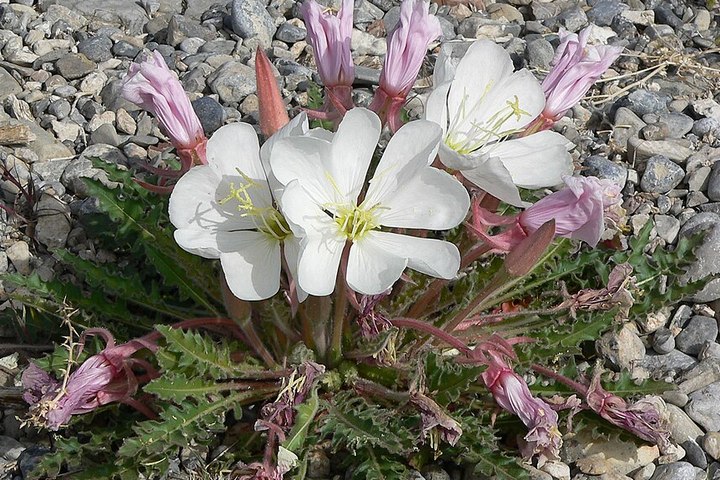
Tufted evening primrose (Oenothera cespitosa) is a “pretty as a picture” native wildflower with jagged, dark green leaves that form low-growing rosettes. Spring through fall, large fragrant flowers with heart-shaped petals steal the show. Flowers start out white, turning pastel pink as they fade.
Since it’s fragrant and blooms in the evening, plant it where it can be viewed and admired up close, such as near a patio or seating area. It makes an ideal addition to a moon garden.
Tufted evening primrose has a huge and varied natural range, which is a testament to its adaptability and resilience. Its native habitats include desert scrub, grasslands, chaparral, rocky slopes, and woodlands of the western US, northern Mexico, and central Canada. It can survive on as little as 6″ of annual rainfall.
It’s an important plant for wildlife. Nocturnal pollinators, mainly hawk moths and sphinx moths, feed on its nectar and use it as a host plant. Seed-eating birds eat the seeds.
Why I Like This Plant
- Evergreen ground cover
- Large, fragrant, white-to-pink flowers
- Low maintenance
- No thorns, low-litter, non-toxic
- Support wildlife
Another reason I like tufted evening primrose is that it reseeds and sends out lateral roots to form small colonies, but generally behaves in desert gardens. This makes it an excellent alternative to its botanical cousin Mexican evening primrose, a deceptively aggressive plant that many gardeners (myself included) have regretted planting.
Things to Watch Out For
Tufted evening primrose is a larval host for several species of moths. This means you can expect to see caterpillars (and possible leaf damage) on your plants. (If you do, I hope you’ll choose to leave them alone since they turn into important pollinators.)
Optimal Growing Conditions
If you’re thinking of adding a tufted evening primrose to your garden, you need to find a suitable place that will keep your plant healthy and looking good.
Here are the key factors to keep in mind.
Temperature
Tufted evening primrose can be grown in almost any USDA Hardiness Zone. It tolerates desert heat and extreme cold. Plants can survive extremely frigid temperatures. I’ve seen this plant’s cold hardiness listed as -20℉, -30℉ and even -40℉! 🥶
Plants are evergreen and can flower all year during mild winters. During cold winters, the leaves may be tinged with red.
In the heat of the summer, flowering tapers off and plants may go dormant if they don’t receive enough water.
Sun Exposure
Tufted evening primrose tolerates full sun, but looks better in the summer when growing in part shade.
Size and Growth Rate
Tufted evening primrose grows moderately fast. When fully grown, it forms an attractive mound, typically 1 foot tall by 3 feet across. Plants are short-lived but readily reseed, forming small colonies.
Soil
Tufted evening primrose grows in any desert soil — clay, loam, sand, or rocky — provided it’s well-draining.
Other Location Considerations
Tufted evening primrose has no thorns, stickers, or irritating hairs. Because plants are “unarmed,” non-toxic, and low-litter, you can feel comfortable placing them near a pool, sidewalk, or anywhere they might come in contact with pets or people.
Tufted Evening Primrose:
The Essentials
| Common Name | Tufted evening primrose |
| Scientific Name | Oenothera cespitosa |
| Origin | Western US, Mexico, Canada |
| Plant Type | Evergreen perennial |
| USDA Zones | All zones |
| Cold Hardiness | To -30℉ |
| Flower Color | White, pink |
| Flower Season | Spring, summer, fall |
| Mature Size | 1′ high x 3’ wide |
| Growth Rate | Moderate to fast |
| Sun Tolerance | Full, part sun |
| Water Needs | Low |
| Pests & Diseases | None |
| Garden Friendly | No thorns, low litter, non-toxic |
| Wildlife | Attracts birds, moths |
How to Plant
The rule of thumb when planting any perennial in the desert is to dig a hole twice as wide as the root ball but no deeper.
Amending the soil is not recommended. Counterintuitively, backfilling with the same native soil you just dug up helps your primrose develop a stronger root system.
When to Plant
The best time to plant tufted evening primrose is in the fall. This gives it three seasons to get established before the following summer.
The second best time is in spring, the earlier the better. This still gives your primrose time to get established before the intense heat of June arrives.
How to Care for Tufted Evening Primrose
Whether you’ve recently planted a tufted evening primrose or have existing plants in your yard, here’s how to take care of it to keep it healthy and looking its best.
How to Water
During the first growing season, give your plant about ½ gallon of water once a week while it’s establishing its root system.
After that, use this recommended watering schedule:
| Spring (March – May) | 10 – 14 days |
| Summer (May – Oct.) | 7 – 10 days |
| Fall (Oct. – Dec.) | 10 – 14 days |
| Winter (Dec – March) | 14 – 21 days |
Should You Fertilize?
Tufted evening primrose does not need to be fertilized. As a native plant, it has evolved to get all the nutrients it needs from local soil.
How to Prune
Tufted evening primrose does not need regular trimming, but you can trim any dead or damaged growth as it appears. It is self-cleaning and does not need to be deadheaded.
Plant Lover Facts
Tufted evening primrose also goes by the common names fragrant evening primrose, white evening primrose, gumbo evening primrose, and gumbo lily.
While Oenothera cespitosa is the correct scientific name, the species name is often spelled as caespitosa instead, but I’ve never found any explanation for this. 🤔
This plant has many traditional uses. It was used medicinally to treat sores, swellings, and toothaches. It was also used ceremonially and as a tobacco substitute.
Did you enjoy this article?
Sign up for our weekly newsletter
where you’ll find more great info on creating &
maintaining a beautiful, carefree desert landscape.
Author Bio
Deane Alban is the creator of Southwest Gardener. She is a science writer with a bachelor’s degree in botany from the University of South Florida. Gardening is her lifelong passion. She’s been gardening in Tucson for over 15 years.

Photo Credits
Stan Shebs, CC BY-SA 3.0, Wikimedia Commons
Siris603, CC BY-SA 4.0, Wikimedia Commons
Stan Shebs, CC BY-SA 3.0, Wikimedia Commons