
Trailing rosemary is an aromatic, evergreen ground cover with delicate blue flowers from winter through spring. It’s a prostrate form of the “usual” rosemary, a culinary and healing herb native to the Mediterranean region. Here’s how to grow the trailing cultivar as a desert landscape plant.
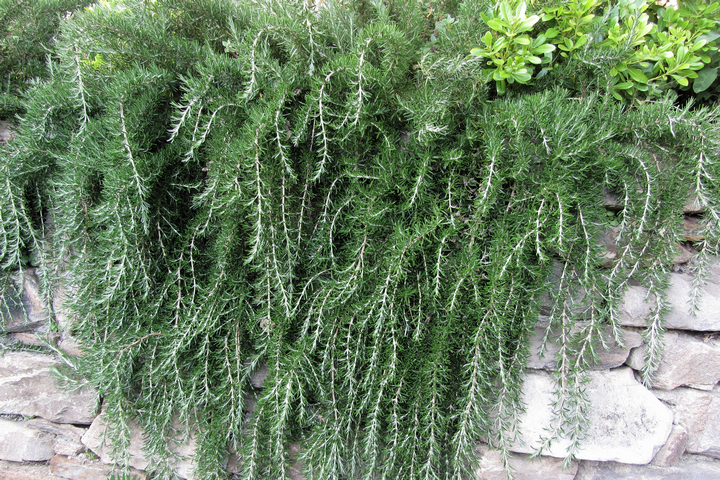
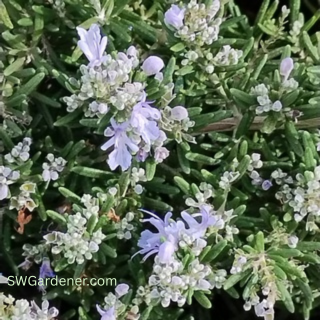
Trailing rosemary (Rosmarinus officinalis ‘Prostratus’) is a woody ground cover with highly aromatic, needle-like leaves and pastel flowers that range from light blue to lavender.
It’s a cultivar of shrubby rosemary, an herb that’s been used in cooking and as medicine for thousands of years.
Trailing rosemary is at home in the desert and tolerates its harshest conditions — full sun, poor soil, and drought. And, just like the upright parent plant, trailing rosemary’s leaves and flowers are edible.
Trailing rosemary attracts bees and butterflies. While rosemary delights the noses of humans, its scent repels deer, javelina, and rabbits, which generally leave it alone.
Why I Like This Plant
- Aromatic evergreen leaves
- Profusion of pastel flowers
- Edible!
- Low maintenance
- No thorns, low litter
- Attracts bees, butterflies
- Deer, rabbit, javelina resistant
Things to Watch Out For
Many gardeners struggle to grow rosemary, usually because they are treating it too well. While you can use trailing rosemary as an herb, you should treat it as you would any other landscape plant, not as a garden vegetable.
It’s susceptible to root rot and should not be grown in your vegetable beds along with other herbs like basil or parsley. It doesn’t like constantly moist, rich soil or humidity.
If you grow one in a container, use cactus soil and put it in a well-draining pot, ideally one made of terra cotta. Terra cotta is porous which ensures the soil will dry out completely between waterings.
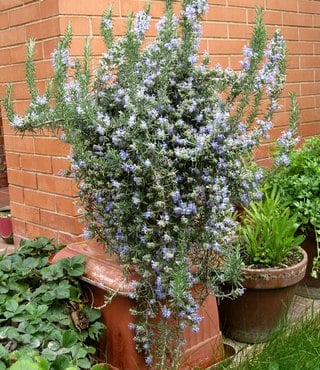
The good news is that if your rosemary makes it through the critical first year, it will probably live a long time.
Optimal Growing Conditions
If you’re thinking of adding trailing rosemary to your garden, you need to find a suitable place that will keep your plant healthy and looking good… while minimizing maintenance for you.
Here are the key factors to keep in mind.
Temperature
Trailing rosemary should be grown in USDA Hardiness Zones 8 – 11. Plants tolerate desert heat. During the winter, it stays evergreen and is cold-hardy down to 10℉.
Sun Exposure
Trailing rosemary thrives in full sun, but appreciates some afternoon shade in the hottest climates.
Size and Growth Rate
Trailing rosemary is a fast-growing ground cover that stays around 2 feet tall and spreads to 3 to 6 feet across.
It typically blooms from winter through spring, but it can flower during other seasons as well.
Soil
Trailing rosemary prefers well-draining sandy or rocky soil. It can struggle in clay.
Other Location Considerations
Trailing rosemary is a good choice for planting on slopes for erosion control. Avoid planting it where it might get walked on — plants are too woody to hold up to foot traffic.
It makes a beautiful container plant that will grow both upward and spill over the edges.
Trailing Rosemary:
The Essentials
| Common Name | Trailing rosemary |
| Scientific Name | Rosmarinus officinalis ‘Prostratus’ |
| Origin | Mediterranean (cultivar) |
| Plant Type | Evergreen ground cover |
| USDA Zones | Zones 8 – 11 |
| Cold Hardiness | To 10℉ |
| Flower Color | Blue, lavender |
| Flower Season | Winter, spring |
| Mature Size | 2′ tall x 3-6’ wide |
| Growth Rate | Fast |
| Sun Tolerance | Full |
| Water Needs | Low |
| Pests & Diseases | Spittle bug, root rot |
| Garden Friendly | No thorns, edible, low litter |
| Wildlife | Attracts bees, butterflies Critter resistant |
How to Plant
The rule of thumb when planting any ground cover is to dig a hole twice as wide as the root ball but no deeper.
Amending the soil is generally not recommended. Counterintuitively, backfilling with the same native soil you just dug up helps your plant develop a stronger root system.
However, if you know your soil is not well-draining or you have clay, consider amending it with coarse sand or small gravel.
Don’t cover the ground with organic mulch, which holds moisture. Rosemary likes it dry!
When to Plant
The best time to plant trailing rosemary is in the fall. This gives it three seasons to grow roots and get established before the following summer.
The second best time is in spring, the earlier the better. This still gives your plant time to get established before the intense heat of June arrives.
How to Care for Trailing Rosemary
Whether you’ve recently planted a trailing rosemary or have an existing one in your yard, here’s how to take care of it to keep it healthy and looking its best.
How to Water
Once you’ve got your trailing rosemary in the ground, watering is your most immediate concern. The University of Arizona recommends watering newly planted ground covers every 2 to 3 days for the first 2 to 4 weeks.
After that, water it on this schedule:
| Spring (March – May) | 10 – 14 days |
| Summer (May – Oct.) | 7 – 10 days |
| Fall (Oct. – Dec.) | 10 – 14 days |
| Winter (Dec – March) | 14 – 21 days |
How much water you should give your plant with each watering depends on the diameter of your plant and will change as it grows. You can use this chart as a guide.
| 1′ diameter | .5 gallons |
| 2′ diameter | 2 gallons |
| 3′ diameter | 3.5 gallons |
| 4′ diameter | 5 gallons |
| 5′ diameter | 7 gallons |
| 6′ diameter | 9 gallons |
Should You Fertilize?
Trailing rosemary naturally thrives in poor soil and does not need to be fertilized.
Pruning & Propagation
Trailing rosemary tolerates light pruning. You can snip new growth for cooking any time of year, and you won’t harm your plant’s health or shape.
The best time of year to do significant pruning is in the spring.
The older, lower branches that are shaded by the upper branches eventually get bare and woody. You can remove this deadwood to hopefully encourage new growth. Always cut above a set of leaves and never prune more than 1/3 of the plant at a time. If you prune it too severely, it may not grow back.
If it starts growing taller than desired, you can remove the most upright branches to maintain a spreading form.
You can minimize these problems by growing the ‘Huntington Carpet‘ cultivar (Rosmarinus officinalis ‘Huntington Carpet’). It stays lower to the ground (around a foot tall) and retains the foliage in the center of the plant better than other trailing rosemary selections.
You can use any healthy cuttings to propagate new plants. The simplest way is to place cuttings in water and wait for them to grow roots. This works best in the spring.
Pests & Diseases
Rosemary is generally not bothered by pests or diseases. You may occasionally see spittlebugs on the stems, which appear as small spots of white foam.
They won’t harm your plant, so you can let them be. Or they can easily be removed by gently wiping them with your finger or hosing them off.
Spittlebugs are most likely to appear on the spindly branches of plants that don’t get enough sun.
Plant Lover Facts
Trailing rosemary (Rosmarinus officinalis ‘Prostratus’) also goes by the commo names creeping rosemary and prostrate rosemary.
It is a cultivar of rosemary (Salvia rosmarinus, formerly Rosmarinus officinalis), an herb with an extremely long history of culinary and medicinal use. The parent plant is native to the hot, dry western Mediterranean coasts of Europe, Western Asia, and Northern Africa.
Did you enjoy this article?
Sign up for our weekly newsletter
where you’ll find more great info on creating &
maintaining a beautiful, carefree desert landscape.
Author Bio
Deane Alban is the creator of Southwest Gardener. She is a science writer with a bachelor’s degree in botany from the University of South Florida. Gardening is her lifelong passion. She’s been gardening in Tucson for over 15 years.

Photo Credit
Peter43, CC BY-SA 3.0, Wikimedia Commons