
Trailing indigo bush may look delicate, but is considered one of the toughest ground covers you can grow in desert landscapes. Here’s everything you need to know about this Chihuahuan Desert native in this complete care guide.
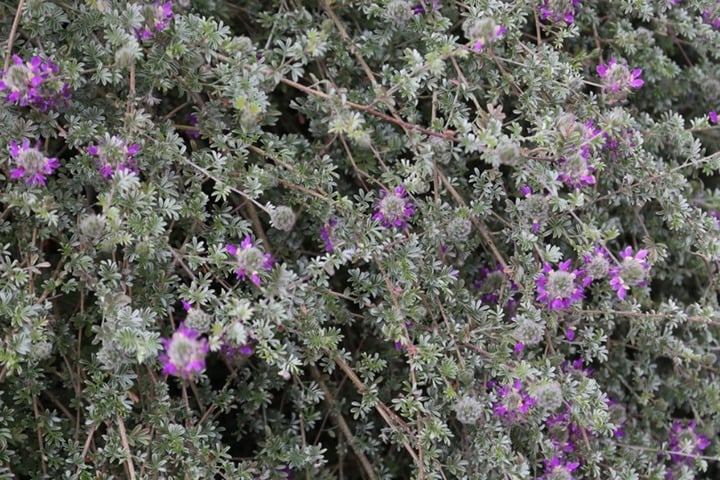
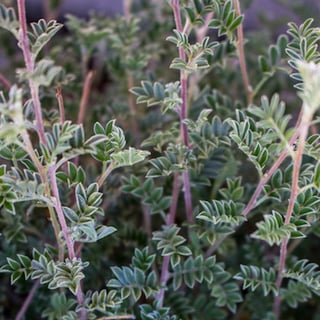
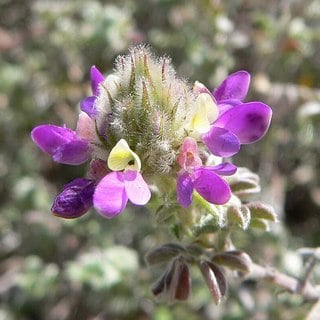
With fine, fern-like foliage and tiny, pea-like, violet flowers, trailing indigo bush (Dalea greggii) looks delicate, but looks can be deceiving. The overall effect of this sprawling ground cover is wispy and almost cloud-like.
But in fact, it is widely considered one of the toughest ground covers you can grow in desert gardens. It’s a Chihuahuan Desert native that thrives in true desert full sun, drought, and temperature extremes. When grown as a landscape plant, its biggest enemy is too much water, rather than neglect.
It’s a great plant for attracting pollinators. Its flowers attract native bees and butterflies, and it’s a larval host for several butterfly species.
It’s generally deer and javelina resistant, but rabbits seem to like it.
Why I Like This Plant
- Lacy, fern-like foliage
- Violet flowers spring through fall
- Thrives on neglect
- Prevents erosion on slopes
- No thorns, non-toxic, low litter
- Supports bees, butterflies
Things to Watch Out For
Trailing indigo bush is a vigorous, spreading ground cover that is not suitable for small spaces.
Its wiry stems are woody and do not stand up to foot traffic.
Don’t try to grow it near plants that receive moderate amounts of irrigation. Too much water is the enemy of this plant, which succumbs to root rot when overwatered.
While rabbits like its young leaves, they rarely do any serious damage, since whatever they nibble off quickly grows back.
Optimal Growing Conditions
If you’re thinking of adding a trailing indigo bush to your garden, you need to find a suitable place that will keep your plant healthy and looking good… while minimizing maintenance for you.
Here are the key factors to keep in mind.
Temperature
Trailing indigo bush should be grown in USDA Hardiness Zones 8 to 11. It’s a heat lover that thrives in the hottest spot in your yard and tolerates cold down to 15℉.
Sun Exposure
As a Chihuahuan Desert native, trailing indigo bush likes full sun and doesn’t mind reflected heat. It will grow in lightly filtered shade, such as under a sparse tree, but will get leggy with too much shade.
Size and Growth Rate
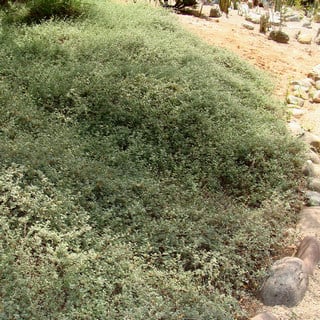
Trailing indigo bush grows moderately fast. Plants typically reach a size of 1 foot tall by 6 feet wide but can grow larger. I’ve heard of plants growing to 3′ by 15′!
It blooms mainly in the spring, but flowers can appear intermittently from May through September.
Soil
In its natural habitat, trailing indigo bush grows on dry, limestone hills. It grows well in most native soil — rocky, sandy, limestone, or gravelly — provided it’s well-draining. It does not do well in heavy clay.
Other Location Considerations
Its stems form roots wherever they touch the ground, making it an excellent choice for erosion control on banks and slopes.
Since it is non-toxic, has no thorns, and is low-litter, it’s a plant you can place near a sidewalk, driveway, pool, or patio, or anywhere else it might come in contact with people or pets.
Trailing Indigo Bush:
The Essentials
| Common Name | Trailing indigo bush |
| Scientific Name | Dalea greggii |
| Origin | Chihuahuan Desert |
| Plant Type | Shrubby ground cover |
| USDA Zones | Zones 8 – 11 |
| Cold Hardiness | To 15℉ |
| Flower Color | Violet |
| Flower Season | Spring, summer |
| Mature Size | 1-2’ high x 6′ wide |
| Growth Rate | Fast |
| Sun Tolerance | Full, reflected sun |
| Water Needs | Low |
| Pests & Diseases | Root rot |
| Garden Friendly | No thorns, non-toxic, low litter |
| Wildlife | Attracts butterflies, bees |
How to Plant
The rule of thumb when planting any ground cover in the desert is to dig a hole twice as wide as the root ball but no deeper.
Amending the soil is not recommended. Counterintuitively, backfilling with the same native soil you just dug up helps your trailing indigo bush develop a stronger root system.
When to Plant
The best time to plant trailing indigo bush is in the fall. This gives it three seasons to grow roots and get established before the following summer.
The second best time is in spring, the earlier the better. This still gives your shrub time to get established before the intense heat of June arrives.
How to Care for Trailing Indigo Bush
Whether you’ve recently planted a trailing indigo bush or have an existing plant in your yard, here’s how to take care of it to keep it healthy and looking its best.
How to Water
The University of Arizona recommends watering newly planted, low water use ground covers on this schedule.
| Weeks 1 – 4 | Every 2 – 3 days |
| Weeks 5 & 6 | Every 6 – 7 days |
| Weeks 7 & 8 | Every 10 – 14 days |
Give your indigo bush about ½ gallon with each watering.
After that, you can water it on this schedule, for the first year or so.
| Spring (March – May) | 10 – 14 days |
| Summer (May – Oct.) | 7 – 10 days |
| Fall (Oct. – Dec.) | 10 – 14 days |
| Winter (Dec – March) | 14 – 21 days |
As it grows, it will need more water with each watering, depending on its diameter. Use this chart as a guide.
| 1′ diameter | .5 gallons |
| 2′ diameter | 2 gallons |
| 3′ diameter | 3.5 gallons |
| 4′ diameter | 5 gallons |
Once your indigo bush is established, water it twice per month during the summer and once per month in spring and fall. There’s no need to water during the winter, unless you’ve experienced extreme drought.
Should You Fertilize?
Trailing indigo bush doesn’t need fertilizer. It has evolved to get all the nutrients it needs from poor, desert soil. And like all members of the legume family (Fabaceae), it fixes nitrogen, which naturally improves its surrounding soil.
How to Prune
Trailing indigo bush requires minimal pruning when given room to grow. Just remove any dead or damaged branches in early spring.
However, when it’s squeezed into the wrong spot, you can expect to prune it frequently to control its size.
Plant Lover Facts
Trailing indigo bush (Dalea greggii) also goes by the common names Gregg’s prairie clover, Gregg dalea, indigo bush, and prostrate indigo bush. It’s native to New Mexico, Texas, and Mexico.
You may be wondering, “Why all the Greggs?”
The species name greggii was named in honor of Josiah Gregg, an American naturalist and plant collector. A few other desert landscape plants named in honor of him include autumn sage (Salvia greggii) and Gregg’s mist.
The genus Dalea, not to be confused with the genus Dahlia, is named in honor of the English naturalist Samuel Dale.
Did you enjoy this article?
Sign up for our weekly newsletter
where you’ll find more great info on creating &
maintaining a beautiful, carefree desert landscape.
Author Bio
Deane Alban is the creator of Southwest Gardener. She is a science writer with a bachelor’s degree in botany from the University of South Florida. Gardening is her lifelong passion. She’s been gardening in Tucson for over 15 years.
