
‘Torch Glow’ is an eye-catching bougainvillea with magenta “flowers” and an unusual form. It stays relatively compact and grows as an upright shrub, rather than as a large sprawling vine. Here’s everything you need to know about growing this cultivar of a South American native.
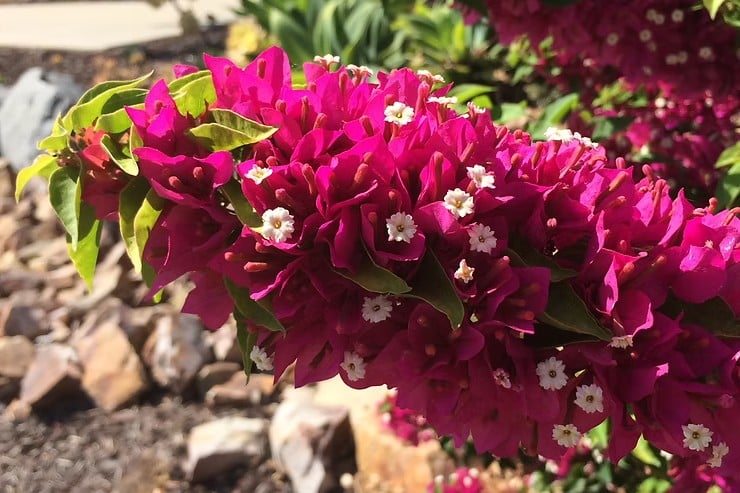
‘Torch Glow’ bougainvillea (Bougainvillea ‘Torch Glow‘) is a festive, one-of-a-kind plant. The first time I saw one, it caught my eye, but I wasn’t sure what it was. Initially, I thought it may have been a small crepe myrtle (like this one). Then I realized it was an exciting new type of bougainvillea.
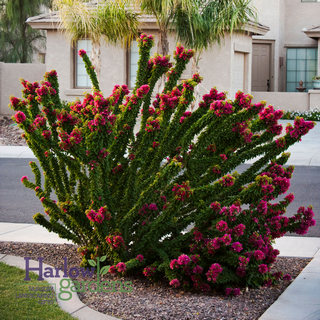
‘Torch Glow’ has an architectural, upright, spikey form. Vivid magenta bracts adorn the tip of each cylindrical branch, giving the appearance of a flaming torch.
Plant it in the hottest, sunniest spot in your garden — it thrives on neglect. If you pamper it, it will grow leaves at the expense of flowers.
‘Torch Glow’ “flowers” are modified leaves called bracts.
The true flowers are small, white, and inconspicuous.
Why I Like This Plant
- Vivid magenta “flowers”
- Unique upright form
- Thrives on neglect
- Attracts hummingbirds
Things to Watch Out For
All bougainvilleas are messy. Their colorful bracts fall off spring through fall and scatter in the wind. ‘Torch Glow’ is considered somewhat less messy because it’s a smaller plant.
And like all bougainvilleas, ‘Torch Glow’ has thorns, albeit softer and less significant than those of most bougainvilleas.
Don’t let your landscapers prune it into a ball or shear it with a hedge trimmer, which will ruin its upright shape.
Bougainvilleas do not like having their roots disturbed, so take special care when transplanting.
Optimal Growing Conditions
If you’re thinking of adding a ‘Torch Glow’ bougainvillea to your garden, you need to find a suitable place that will keep it healthy and looking good… while minimizing maintenance for you.
Here are the key factors to keep in mind.
Temperature
‘Torch Glow’ should be grown in USDA Hardiness Zones 9 – 11. This heat-loving plant will grow in the hottest spot in your garden, even against a west-facing wall.
While bougainvilleas can stay evergreen in areas with frost-free winters, they are extremely cold-sensitive and mostly semi-deciduous in the desert southwest.
‘Torch Glow’ can survive down to 20℉, but the foliage and stems suffer frost damage when the temperature dips below 30℉. However, plants quickly recover in the spring.
Sun Exposure
‘Torch Glow’ bougainvillea is a sun-loving plant that can be grown in full or reflected sun. It tolerates light shade, but it blooms most profusely in full sun.
Size and Growth Rate
It’s a moderately fast grower that’s on the small side for a bougainvillea. It typically reaches a size of 4 to 8 feet wide and tall. Unlike most landscape bougainvilleas, it grows as a shrub rather than a vine and doesn’t need support.
Soil
‘Torch Glow’ is not particular about soil. It grows well in any soil — sand, clay, loam, rocky — provided it’s well-draining.
Other Location Considerations
If you’re going for a tropical, Mediterranean, or Spanish vibe in your garden, this plant will fit right in.
Grow ‘Torch Glow’ along a hot, sunny garden wall. They don’t mind the heat in the summer, and it will help keep them warm in the winter.
This small bougainvillea can be grown in a large container. This will let you move it under cover during freezes.
‘Torch Glow’ Bougainvillea:
The Essentials
| Common Name | ‘Torch Glow’ bougainvillea |
| Scientific Name | Bougainvillea ‘Torch Glow’ |
| Origin | South America (cultivar) |
| Plant Type | Semi-deciduous shrub |
| USDA Zones | Zones 9 – 11 |
| Cold Hardiness | To 20℉ |
| Flower Color | White flowers Deep pink bracts |
| Flower Season | Spring, summer, fall |
| Mature Size | 4-8’ high x 4-8’ wide |
| Growth Rate | Moderate |
| Sun Tolerance | Full, part, reflected sun |
| Water Needs | Low |
| Cautions | Thorns, litter |
| Wildlife | Attracts hummingbirds |
How to Plant
For all their toughness, bougainvilleas are surprisingly tricky to transplant due to their fine, sensitive root system. When removing a bougainvillea from its nursery pot, cut the container away and disturb the root system as little as possible. These plants readily suffer from transplant shock and can take a long time to recover.
The rule of thumb when planting any shrub in the desert is to dig a hole three times as wide as the root ball but no deeper.
Amending the soil is not recommended since bougainvillea performs best in poor soil.
When to Plant
The best time to plant is in April, well after the last frost.
How to Care for ‘Torch Glow’
Whether you’ve recently planted a ‘Torch Glow’ bougainvillea or have an existing plant in your yard, here’s how to take care of it to keep it healthy and looking its best.
How to Water New Plants
Once you’ve got your ‘Torch Glow’ in the ground, watering is your most immediate concern. Here is the recommended watering schedule for new shrubs planted in the spring or fall.
| Weeks 1 & 2 | Every 3 – 4 days |
| Weeks 3 & 4 | Every 5 – 7 days |
| Weeks 5 & 6 | Every 7 – 10 days |
| Weeks 7 & 8 | Every 10 – 14 days |
After week 8, gradually revise your watering schedule, depending on the season.
How to Water Established Plants
Once established, ‘Torch Glow’ needs only occasional watering. Water deeply and then allow it to completely dry out.
To determine the ideal watering schedule for bougainvillea, you’ll find everything you need to know, including easy-to-use charts, at How to Water Desert Shrubs: How Often? How Much? Since it is a low water use plant, use the “Low Water Use” schedule.
Counterintuitively, plants bloom best when slightly drought-stressed. Some gardeners recommend waiting until it wilts slightly before watering again. Too much water, and plants will produce more leaves and fewer flowers.
Should You Fertilize?
Since this plant did not evolve to grow in our desert southwest soil and is a prolific bloomer, it benefits from a light application of fertilizer in the spring. Don’t overdo it and use a low-nitrogen fertilizer. Too much nitrogen results in fewer flowers.
‘Torch Glow’ not blooming?
Excess water and fertilizer encourage
leaf growth instead of flowers.
How to Prune
Remove any cold damaged growth in late winter or early spring, then refrain from pruning. Regular pruning destroys its architectural shape and inhibits the formation of flowers.
It is one of the many desert landscape plants that responds well to a hard rejuvenation prune. Cut it back to one foot in early spring every 5 years or so.
Pests & Diseases
Bougainvilleas are tough plants that are rarely bothered by pests, but whitefly or spider mite infestations are not unheard of. Blasting the bugs with a jet spray of hose water or spraying them with insecticidal soap will keep their numbers down.
If you see circular cutouts on your bougainvillea’s leaves, it’s the work of leafcutter bees. These non-aggressive, solitary bees are native to the desert southwest. They don’t eat the leaves that they cut — the females use the circles to line their nests. Bougainvillea leaves are among their favorites. These bees are important pollinators that only cause cosmetic damage, so please, “let them be.” 🐝

Plant Lover Facts
Bougainvillea is a genus of plants native to South America, almost exclusively south of the equator. Three species of Bougainvillea (B. spectabilis, B. glabra, B. peruviana) are the source of the hundreds of bougainvillea hybrids and cultivars, including ‘Torch Glow’.
You may see plant labels bearing a name that looks like this: Bougainvillea ‘Torch Glow’ PP6349. The number indicates that ‘Torch Glow’ is a patented plant. A commercial grower in California found this unique form growing among cuttings they obtained from the Philippines and received a patent on it in the 1980s.
This genus Bougainvillea is named after Louis Antoine de Bougainville, a French military officer and explorer. Some sources say he discovered the genus, while others say that it was documented by a botanist on one of his expeditions and named in his honor.
Did you enjoy this article?
Sign up for our weekly newsletter
where you’ll find more great info on creating &
maintaining a beautiful, carefree desert landscape.
Author Bio
Deane Alban is the creator of Southwest Gardener. She is a science writer with a bachelor’s degree in botany from the University of South Florida. Gardening is her lifelong passion. She’s been gardening in Tucson for over 15 years.

Photo Credits
San Diego Horticultural Society
“Megachile Centuncularis” by JRxpo is licensed under CC BY 2.0