
Sweet acacia is a tree that people either love or hate. Here’s a look at its various attributes and drawbacks so you can decide for yourself whether this tree sounds right for you. And if it is, you’ll find everything you need to know about planting and caring for this Chihuahuan Desert native in your desert garden.
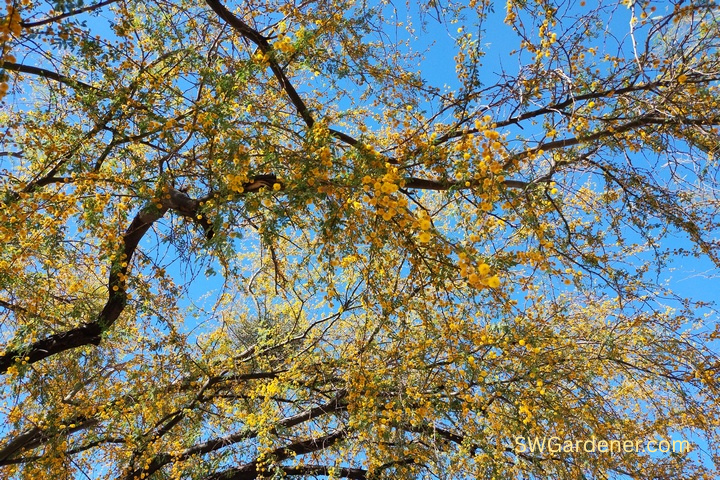
Sweet acacia (Vachellia farnesiana) is a medium size evergreen shade tree that arouses strong feelings — some people love it while others don’t. It has small green fern-like leaves that create pleasant filtered shade.
When in bloom, it’s smothered in yellow puffball flowers that smell so delightful, they are used as an ingredient in perfumes.
It’s an extremely tough tree that grows just about anywhere, even in parking lots, disturbed soil, or when surrounded by turf.
These trees provide food and shelter for wildlife. Birds use the plant for nesting and cover, and when in bloom, the nectar attracts bees, butterflies, and other pollinating insects.
Why I Like This Plant
- Evergreen fern-like foliage
- Extremely tough
- Fragrant fuzzy yellow flowers
- Attracts butterflies, bees
Things to Watch Out For
So far this tree sounds pretty good and you may be wondering, “What’s not to like?” Here are some things you should be aware of before you plant one in your yard.
Sweet acacia can be messy when it drops its pods. Deer and javelina like the pods, and you may not want to lure hungry critters into your yard.
Sweet acacia has 1″ thorns that can give you a nasty poke. This is not a tree to have around kids, pets, or high traffic areas.
The pods are non-toxic to humans but are toxic to pets.
When in bloom, trees produce pollen that triggers allergies in some people.

It naturally grows as a big shrub, and it’s not easy to prune it correctly without professional help. It frequently sends up lots of suckers that need to be kept in check.
It’s a pioneer plant, which means it readily establishes in disturbed areas and can do the same in your yard. It often reseeds and if you don’t remove the numerous volunteers, before you know it, you’ll be have an acacia forest.
It’s prone to getting mistletoe, which doesn’t kill healthy trees, but it’s not a look everyone likes on their trees.
While researching sweet acacia, I was taken aback to read what Watershed Management Group, an important non-profit environmental organization in Tucson, had to say about this tree:
“This tree was once a commonly planted ornamental in Tucson, but has fallen out of favor. It can be prone to a short life span, often sends out many fast growing suckers from its base and trunk, and portions of the tree will often die off. Many trees in Tucson are not aesthetically pleasing with dead sections, knobby trunks and branches, suckering, dark scabby branches.“
Whoa.
On the other hand, Thomas Jefferson, one of America’s earliest agronomists, was so enamored of it that he called it “the most delicious flowering shrub in the world,” and wrote that it was “the only plant besides the Orange that I would take the trouble of nursing in a green house.”
Optimal Growing Conditions
If you’re thinking of adding a sweet acacia to your garden, you need to find a suitable place that will keep your tree healthy and looking good… while minimizing maintenance for you.
Here are the key factors to keep in mind.
Temperature
Sweet acacia should be grown in USDA Hardiness Zones 7 – 11. It thrives in extreme heat and survives temperatures down to 15℉.
Sun Exposure
Sweet acacias are sun-loving. They don’t mind the reflected heat from garden walls or buildings. But they do not do well in less than full sun.
Size and Growth Rate
Sweet acacia is a moderate grower that reaches a mature size of 25’ high by 25’ wide. Unlike many acacias, it’s relatively long-lived, with a lifespan of around 50 years. (Acacias typically live 20 to 40 years.)
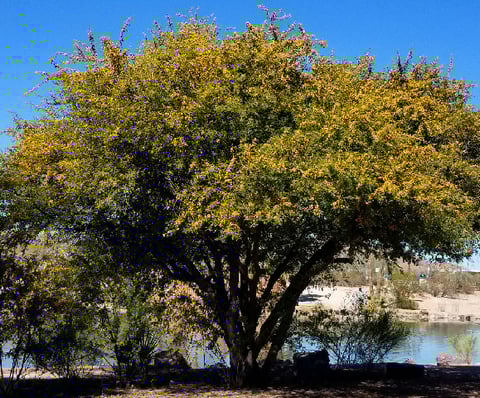
There’s a direct correlation between a plant’s growth rate and size and how much water it receives. Trees will grow faster and can get larger than this with frequent irrigation.
Soil
Sweet acacia can grow in any soil — sandy, loam, clay, alkaline, caliche — provided it’s well-draining.
In disturbed soils, it’s a pioneer species that grows where few other trees will. Pioneer species help to re-establish disturbed areas and bring life back to barren land.
Sweet Acacia:
The Essentials
| Common Name | Sweet acacia |
| Scientific Name | Vachellia farnesiana |
| Origin | Chihuahuan Desert |
| Plant Type | Evergreen tree |
| USDA Zones | Zones 7 – 11 |
| Cold Hardiness | To 15℉ |
| Flower Color | Yellow |
| Flower Season | Winter, spring |
| Mature Size | 25’ high x 25’ wide |
| Growth Rate | Moderate to fast |
| Sun Tolerance | Full, reflected sun |
| Water Needs | Low |
| Pests & Diseases | Root rot |
| Cautions | Thorns, allergenic |
| Wildlife | Attracts bees, butterflies |
How to Plant
The rule of thumb when planting any tree in the desert is to dig a hole three times as wide as the root ball but no deeper.
Amending the soil is not recommended. Counterintuitively, backfilling with the same native soil you just dug up helps your plant develop a stronger root system.
When to Plant
The best time to plant sweet acacia is in the fall. This gives it three seasons to grow roots and get established before the following summer.
The second best time is in spring, the earlier the better. This still gives it time to get established before the intense heat of June arrives.
How to Care for Sweet Acacia
Whether you’ve recently planted a new sweet acacia or have an existing one in your yard, here’s how to take care of it to keep it healthy and looking its best.
How to Water New Plants
Once you’ve got your sweet acacia planted, watering is your most immediate concern.
Here is the recommended watering schedule for new trees planted in the spring or fall.
| Weeks 1 & 2 | Every 3 – 4 days |
| Weeks 3 & 4 | Every 5 – 7 days |
| Weeks 5 & 6 | Every 7 – 10 days |
| Weeks 7 & 8 | Every 10 – 14 days |
After week 8, gradually extend the time between waterings.
How to Water Established Plants
As your tree becomes established, there are two watering factors to consider.
- First is how often to water. This will vary with the seasons.
- Second is how much water to give your tree with each watering. This depends on its current size.
To determine the ideal watering schedule for any desert tree, you’ll find everything you need to know, including easy-to-use charts, at How to Water Desert Trees: How Often? How Much?
Should You Fertilize?
Sweet acacias don’t need fertilizer. They get all the nutrients they need from native soil. And since they belong to the legume family (Fabaceae), they fix nitrogen, which naturally improves their surrounding soil.
How to Prune
Sweet acacia naturally grows as a large shrub or a small multi-trunk tree and needs a substantial amount of pruning to be trained to grow as a tree. Plants frequently send up suckers at the base and at pruning cuts that will need to be removed.
Trees grow as wide as they do tall. If you raise the canopy base too high, the trunk can suffer from sunscald.
If you think that pruning correctly sounds tricky, it is. I strongly urge you to hire a professional. Hiring an arborist (not a so-called “landscaper”) to get your tree off to the right start is an excellent investment that will result in a beautiful tree, not a problematic eyesore.
Sweet Acacia Cultivar
If the thought of cleaning up pods daunts you — sweet acacia drops a lot of them! — check out the podless variety ‘Sweet Sierra’ (Acacia farnesiana Sweet Sierra™). It has similar attributes to the parent plant, except it is virtually pod-free and is somewhat more cold-hardy, down to 5℉.
Plant Lover Facts
Sweet acacia (Vachellia farnesiana) goes by many common names including perfume acacia, mealy acacia, mealy wattle, sweet vachellia, needle bush, huisache, and Texas huisache. Huisache means “many thorns” in Nahuatl (Aztec).
Vachellia is the current correct genus for sweet acacia, but you may also see it listed as Acacia farnesiana. New genetic evidence caused an upheaval in the Acacia genus and many plants got a name change as a result.
There is some doubt as to sweet acacia’s origins. Some sources list it as a Chihuahuan Desert native, while others consider its native range to extend from South America north through Mexico, and into the southern US, to include California, Arizona, and Texas.
It has naturalized widely through warm regions of the world and can be found growing on every inhabited continent.
Sweet acacia has many other uses besides being a landscape tree. Its flowers are used to make perfume and seed pods are used to tan and dye leather. Traditionally, it was used to treat wounds and digestive disorders.
Did you enjoy this article?
Sign up for our weekly newsletter
where you’ll find more great info on creating &
maintaining a beautiful, carefree desert landscape.
Author Bio
Deane Alban is the creator of Southwest Gardener. She is a science writer with a bachelor’s degree in botany from the University of South Florida. Gardening is her lifelong passion. She’s been gardening in Tucson for over 15 years.
