
If you’re looking for a low-maintenance vine that grows in part shade and stays a manageable size, consider snapdragon vine. This charming vine grows in the canyons and on the sky islands of the southwest. Here’s everything you need to know before deciding whether it’s a good choice for your desert garden.
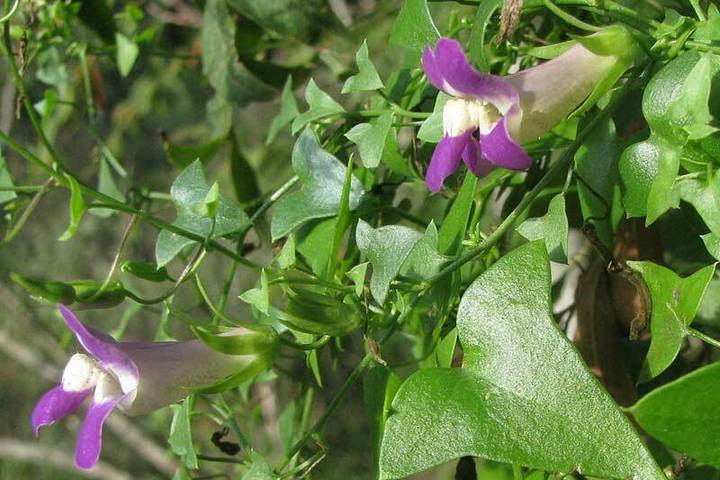
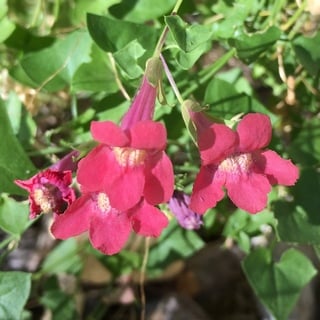
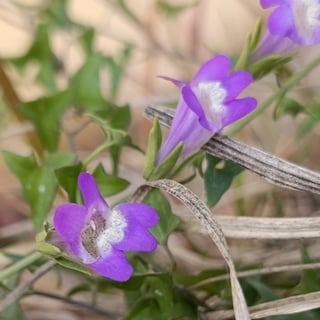
Snapdragon vine (Maurandella antirrhiniflora) is a small, deciduous vine with shiny, deep green, arrow-shaped leaves. Early spring through late fall, it produces small flowers that are reminiscent of snapdragons. Flowers are usually purple with a white throat, but can also be shades of blue, pink, or red.
This is not your typical rampant, sun-loving desert vine. This delicate looking vine stays small and performs best in part shade.
When planted in the right spot, it’s very low maintenance. It stays a compact size and doesn’t need pruning to stay in bounds. It’s low water use — in its native habitat, it can survive on as little as 8 inches of annual rainfall, but will look better with regular irrigation. It’s not fussy about soil and will even grow in caliche.
Snapdragon vine is a good choice for attracting wildlife. Its flowers attract bees and hummingbirds. It’s a larval food plant for the buckeye butterflies. Desert tortoises enjoy the foliage and flowers.
Why I Like This Plant
- Charming flowers in a variety of colors
- Grows fast but stays compact
- Low water use, minimal pruning
- No thorns
- Attracts bees, butterflies, hummingbirds
Things to Watch Out For
If you’re looking for a large vine to cover a fence or wall, this small vine isn’t it.
Snapdragon vine readily reseeds. This may be a feature or a drawback, depending on your situation.
You can expect buckeye butterfly caterpillars to chew on some of the leaves, so don’t plant this vine if you can’t tolerate some cosmetic damage.
According to the University of Arizona, it may be toxic to some animals.
Snapdragon vine can be hard to find. Your best chance of finding one is at any nursery that specializes in native plants. (Here in Tucson, I’d recommend checking with Spadefoot Nursery. They occasionally have them in stock.) Another option is too grow from seed. You can buy seeds at Native American Seed.
Optimal Growing Conditions
If you’re thinking of adding a snapdragon vine to your garden, you need to find a suitable place that will keep it healthy and looking good… while minimizing maintenance for you.
Here are the key factors to keep in mind.
Temperature
Grow snapdragon vine in USDA Hardiness Zones 8 to 10. It withstands heat, provided it gets relief from the sun and adequate water.
Snapdragon vine is usually deciduous and loses its leaves with the first frost, but it may retain its leaves in mild winters. Roots are hardy into the low to mid-teens, and new growth quickly appears in the spring.
Sun Exposure
Snapdragon vine does best when grown in part shade, particularly in areas that experience extreme heat. It will tolerate full morning sun, provided it gets relief in the afternoon.
In its natural habitat, it’s often found growing under trees or shrubs.
Size and Growth Rate
Snapdragon is a small vine that quickly reaches its mature size of 3 to 6 feet tall and wide.
Soil
Snapdragon vine grows in any desert soil type — clay, loam, sand, rocky, limestone, and even caliche — provided it’s well-draining.
Other Location Considerations
This twining vine readily grows up any nearby support structure, such as a trellis, lattice, ramada, pergola, or fence. When unsupported, it will grow as a small, sprawling ground cover.
When grown in a container, it can be trained to climb up a small trellis or allowed to cascade over the sides.
Plant it “up close” near a patio or walkway where people can see and appreciate its delicate beauty.
Snapdragon Vine:
The Essentials
| Common Name | Snapdragon vine |
| Scientific Name | Maurandella antirrhiniflora |
| Origin | US Southwest, Mexico |
| Plant Type | Deciduous vine |
| USDA Zones | Zones 8 – 10 |
| Cold Hardiness | To 10℉ |
| Flower Color | Purple, various |
| Flower Season | Spring, summer, fall |
| Mature Size | 3-6′ high x 3-6′ wide |
| Growth Rate | Fast |
| Sun Tolerance | Part shade |
| Water Needs | Low to moderate |
| Pests & Diseases | Root rot |
| Garden Friendly | No thorns |
| Wildlife | Attracts bees, butterflies, moths, hummingbirds |
How to Plant
The rule of thumb when planting any vine in the desert is to dig a hole three times as wide as the root ball but no deeper.
Amending the soil is not recommended. Counterintuitively, backfilling with the same native soil you just dug up helps your plant develop a stronger root system.
Top with organic mulch rather than gravel, which helps to retain moisture and protects the roots from temperature extremes.
When to Plant
The best time to plant snapdragon vine is in the fall. This gives it three seasons to grow roots and get established before the following summer.
The second best time is in spring, the earlier the better. This still gives your plant time to get established before the intense heat of June arrives.
How to Care for Snapdragon Vine
Whether you’ve recently planted a snapdragon vine or have an existing plant in your yard, here’s how to take care of it to keep it healthy and looking its best.
How to Water New Vines
Once you’ve got your snapdragon vine in the ground, watering is your most immediate concern. Here’s a recommended watering schedule for new vines planted in the spring or fall.
| Weeks 1 & 2 | Every 3 – 4 days |
| Weeks 3 & 4 | Every 6 – 7 days |
| Weeks 5 & 6 | Every 7 – 10 days |
| Weeks 7 & 8 | Every 10 – 14 days |
After week 8, gradually revise your watering schedule, depending on the season.
How to Water Established Plants
Here’s a recommended watering schedule for subsequent years.
| Spring & Fall | Every 10 – 14 days |
| Summer | Every 7 – 10 days |
| Winter | Every 14 – 21 days |
While plants can survive on less water, they look their best when watered regularly, especially during the summer. Plants that receive more water have more flowers.
Should You Fertilize?
Fertilizing is optional. You can feed it once in the spring as new growth appears.
How to Prune
Since snapdragon vine stays compact, it rarely needs pruning to control its size. But since it dies back after the first freeze, cut it back to the ground in late winter or early spring before new growth appears.
Plant Lover Facts
Snapdragon vine (Maurandella antirrhiniflora) goes by many common names including climbing snapdragon,
blue snapdragon vine, little snapdragon vine, violet twining snapdragon, and roving sailor. Which one of these names is not like the others? 😉 Not sure how “roving sailor” got in there, but I assume it’s because it will travel around your garden once established.
It is native to California, Nevada, New Mexico, Texas, and Arizona, where it has a broad distribution growing on slopes, canyon walls, and the “sky islands”. Outside of the US, it’s native to Mexico and Cuba.
At one time, snapdragon vine was placed in the same genus as true snapdragons, the colorful, common spiky annuals. But it has since been moved from the snapdragon genus (Antirrhinum) to its current genus (Maurandella), where it’s the only member.
Did you enjoy this article?
Sign up for our weekly newsletter
where you’ll find more great info on creating &
maintaining a beautiful, carefree desert landscape.
Author Bio
Deane Alban is the creator of Southwest Gardener. She studied journalism and received a bachelor’s degree in botany from the University of South Florida. Gardening is her lifelong passion. She’s been gardening in Tucson for over 16 years.

Photo Credits
Juan Carlos Fonseca Mata, CC BY-SA 4.0, via Wikimedia Commons
Weaver, CC BY-SA 4.0, iNaturalist.com
Jim, CC BY-SA 4.0, iNaturalist.com