
Slim bottlebrush has typical bottlebrush leaves and red flowers, but grows tall and narrow, making it an excellent option for small spaces. Here’s everything you need to know about planting and taking care of this cultivar of an Australian native.
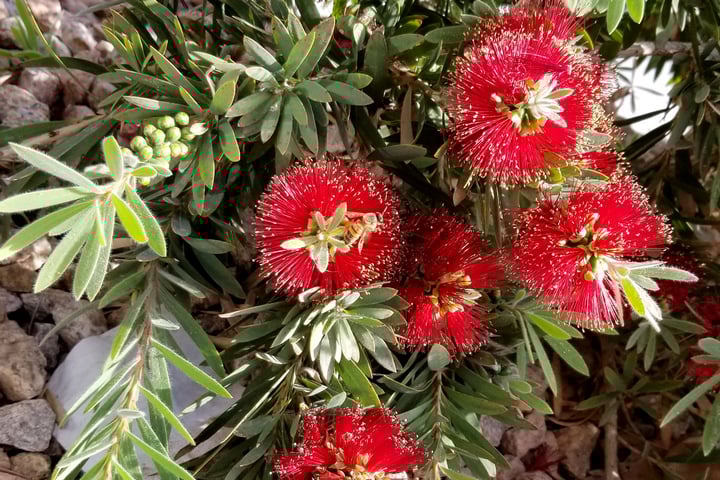
Slim™ bottlebrush (Callistemon viminalis ‘CV01’) is an aptly named, eye-catching cultivar of weeping bottlebrush (Callistemon viminalis). Like other bottlebrushes, it gets its name from its cylindrical, brush-like flowers.
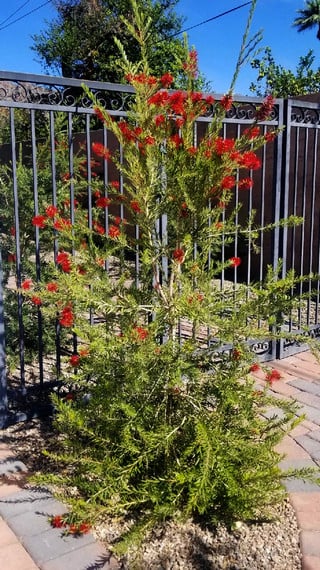
But unlike other bottlebrushes, ‘Slim’ is a patented selection with a distinctly narrow, upright, columnar form. With its fuzzy, blue-green leaves and bright red flowers, it gives off “Christmas tree” vibes all year long.
It blooms prolifically in the spring and then again in the fall, and can bloom during mild winters.
Slim bottlebrush’s unique shape makes it an excellent choice for narrow spots. Grow it in a container, or use it to create a screen along a fence or garden wall.
Its striking red flowers are highly attractive to bees and hummingbirds.
Why I Like This Plant
- Unique slender silhouette
- Show-stopping flowers
- Evergreen foliage
- No thorns, non-toxic, low litter
- Attracts bees, hummingbirds
Things to Watch Out For
Like many non-native plants, slim bottlebrush is prone to iron chlorosis, especially if overwatered.
Its brittle wood and skinny trunk make it susceptible to storm damage. I had one split in two from monsoon wind and was heartbroken. 🥹 Some gardeners leave theirs permanently staked to prevent this from happening.
Optimal Growing Conditions
If you’re still thinking of adding a slim bottlebrush to your garden, you need to find a suitable place that will keep your plant healthy and looking good… while minimizing maintenance for you.
Here are the key factors to keep in mind.
Temperature
Slim bottlebrush should be grown in USDA Hardiness Zones 9 to 11. It is cold hardy down to around 20°F and is relatively heat tolerant. However, plants struggle when daytime highs reach 110°F, as they often do in our hottest areas.
Sun Exposure
Slim bottlebrush can be grown in full sun or part shade, but will have fewer flowers in part shade.
Size and Growth Rate
Slim bottlebrush is a cultivar with a moderate growth rate that was designed to stay small. It typically reaches a height of 8 to 12 feet stays a narrow 4 to 6 feet wide.
Soil
Slim bottlebrush will grow in any type of soil — sandy, clay, loam, or rocky — as long as it’s well-draining. But it prefers slightly acidic soil and may develop iron chlorosis in alkaline desert soil.
Slim Bottlebrush:
The Essentials
| Common Name | Slim bottlebrush |
| Scientific Name | Callistemon viminalis ‘CV01’ |
| Origin | Australia (cultivar) |
| Plant Type | Evergreen shrub |
| USDA Zones | Zones 9 – 11 |
| Cold Hardy | To 20℉ |
| Flower Color | Red |
| Flower Season | Spring, summer, fall |
| Mature Size | 8-12’ high x 4-6’ wide |
| Growth Rate | Moderate |
| Sun Tolerance | Full, part sun |
| Water Needs | Moderate |
| Pests & Diseases | Iron chlorosis |
| Garden Friendly | No thorns, low litter non-toxic |
| Wildlife | Attracts bees, hummingbirds |
How to Plant
The rule of thumb when planting any shrub in the desert is to dig a hole three times as wide as the root ball but no deeper. Since it prefers fertile, acidic soil, consider amending your hole with compost or a commercial soil mix.
Top with organic mulch rather than gravel, which helps to retain moisture and reduce soil alkalinity.
When to Plant
The best time to plant slim bottlebrush is in the fall. This gives it three seasons to grow roots and get established before the following summer.
The second best time is in spring, the earlier the better. This still gives it time to get established before the intense heat of June arrives.
How to Care for Slim Bottlebrush
Whether you’ve recently planted a slim bottlebrush or have an existing plant in your yard, here’s how to take care of it to keep it healthy and looking its best.
How to Water New Plants
Once you’ve got your bottlebrush in the ground, watering is your most immediate concern. Here is the recommended watering schedule for new shrubs planted in the spring or fall.
| Weeks 1 & 2 | Every 3 – 4 days |
| Weeks 3 & 4 | Every 6 – 7 days |
| Weeks 5 & 6 | Every 7 – 10 days |
After week 6, gradually revise your watering schedule, depending on the season.
How to Water Established Plants
As your bottlebrush gets established, there are two watering factors to consider.
- First is how often to water. This will vary with the seasons.
- Second is how much water to give your shrub with each watering. This depends on the current size of your plant.
To determine the ideal watering schedule for slim bottlebrush, you’ll find everything you need to know, including easy-to-use charts, at How to Water Desert Shrubs: How Often? How Much? (Since slim bottlebrush is a moderate rather than low water use plant, use the “High Water Use” schedule.)
Once established, slim bottlebrush is fairly drought tolerant but will look better with regular irrigation.
Should You Fertilize?
As a non-native and prolific bloomer, slim bottlebrush benefits from an annual application of fertilizer in the spring.
If your plant’s leaves are turning yellow, it may have iron chlorosis. You can learn how to identify and treat iron chlorosis here.
How to Prune
When you buy your slim bottlebrush, it will be growing tall and narrow with a single trunk. You should prune yours minimally so you don’t destroy its form.
You can trim branches to keep the shape narrow and encourage new growth. You can also remove the “5 Ds” — branches that are dead, damaged, dying, dangerous, or deranged (i.e., growing in a weird angle or crossing other branches).
Occasionally, these plants are sold with lower branches pruned off form a “lollipop tree”. This is not a great idea since it makes them top heavy and even more prone to wind damage than they already are. And note that if you prune any branches at the trunk, they rarely grow back and you’ll most l likely have a permanent bare space.
Plant Lover Facts
Slim bottlebrush is a cultivar of weeping bottlebrush (Callistemon viminalis), a subtropical species native to eastern Australia that typically grows along streams and creeks. The parent plant is much larger, growing to 20 to 30 feet tall by 10 to 15 feet wide.
Slim bottlebrush is a hybrid cross between a weeping bottlebrush hybrid (C. viminalis ‘Captain Cook’) and an unnamed C. viminalis selection.
The result was a patented hybrid with the complicated name Callistemon viminalis Slim™ ‘CV01’ PP24444. Slim is its trademarked common name, ‘CV01’ is its cultivar designation, and PP24444 refers to its patent number.
Did you enjoy this article?
Sign up for our weekly newsletter
where you’ll find more great info on creating &
maintaining a beautiful, carefree desert landscape.
Author Bio
Deane Alban is the creator of Southwest Gardener. She is a science writer with a bachelor’s degree in botany from the University of South Florida. Gardening is her lifelong passion. She’s been gardening in Tucson for over 15 years.
