
Shoestring acacia is a tall, airy, pendulous tree that provides pleasing light shade. It’s relatively low-maintenance, except that it’s fairly messy. Here’s how to plant and care for this Australian native.
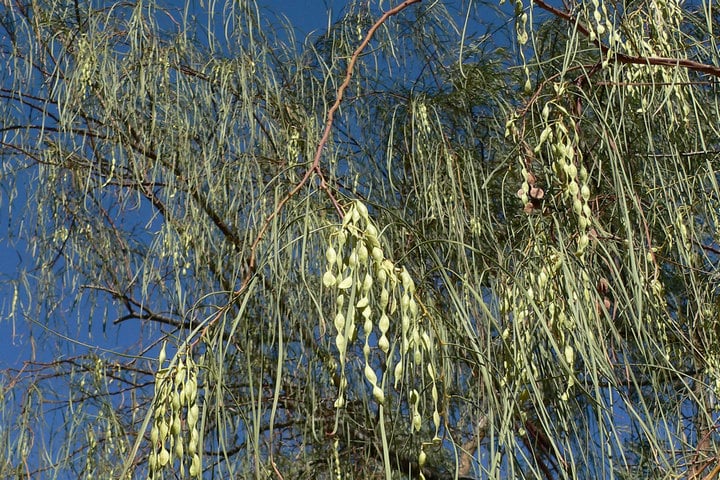
Shoestring acacia (Acacia stenophylla) is a large, thornless evergreen tree with drooping, dull, gray-green leaves that are 16″ long.
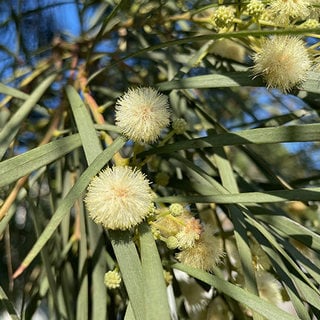
When in bloom, this tree is covered with small, cream-colored puffball flowers that are not particularly showy. Flowers are followed by 8 to 12 inch seed pods that look like strings of beads.
This Australian native thrives in the desert southwest’s extreme heat, sun, and aridity.
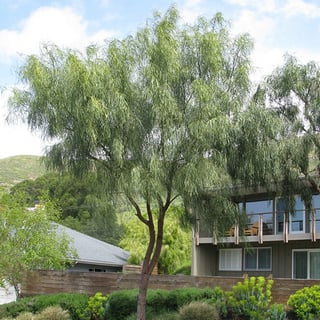
Its form is largely upright and at maturity can be twice as tall as wide, making it a tree to consider for small yards or narrow spaces.
It’s a good choice if you want some light shade in your yard fast.
Why I Like This Plant
- Evergreen foliage
- Fuzzy cream flowers
- Provides light shade fast
- Low water use
- No thorns, non-toxic
Things to Watch Out For
Shade is the main reason to grow this tree. It doesn’t have showy flowers or fruits. It’s of no known benefit to local wildlife. And it’s messy.
My first Tucson home had two. I had to sweep their debris — leaves, flower remnants, and seed pods — off my patio almost daily. (My next-door neighbor rejoiced when the new owners took these trees down.)
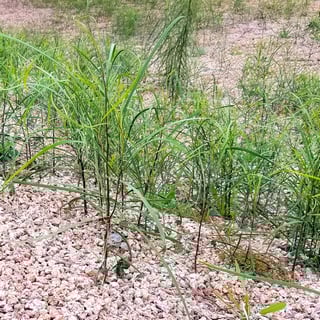
Shoestring acacia is known for aggressively reseeding in some locations. If you don’t stay on top of weeding, you’ll have a small forest. While they are considered nearly invasive in Tucson, reseeding is not as problematic in Phoenix.
Be prepared to have this tree professionally pruned while young. Unpruned trees will weep to the ground. Poor pruning can lead to structural defects that lead to branches breaking and trunks splitting.
Optimal Growing Conditions
If you’re thinking of adding a shoestring acacia to your yard, you need to find a suitable place that will keep your tree healthy and looking good… while minimizing maintenance for you.
Here are the key factors to keep in mind.
Temperature
Shoestring acacia should be grown in USDA Hardiness Zones 8 – 11. It thrives in extreme heat and survives temperatures down to 15℉.
Sun Exposure
Shoestring acacias are sun-loving and thrive in full sun. They don’t mind the reflected sun off garden walls and buildings.
Size and Growth Rate
Shoestring acacia is a fast grower that reaches a mature size of 30 to 40 feet tall by 20 feet wide.
Soil
Shoestring acacia will grow in any type of soil — sandy, clay, loam, or rocky — provided it’s well-draining. It’s prone to root rot in poor-draining soil.
Shoestring Acacia:
The Essentials
| Common Name | Shoestring acacia |
| Scientific Name | Acacia stenophylla |
| Origin | Australia |
| Plant Type | Evergreen tree |
| USDA Zones | Zones 8 – 11 |
| Cold Hardiness | To 15℉ |
| Flower Color | Cream |
| Flower Season | Spring |
| Mature Size | 30-40’ high x 20′ wide |
| Growth Rate | Fast |
| Sun Tolerance | Full, reflected sun |
| Water Needs | Low |
| Pests & Diseases | Root rot |
| Garden Friendly | No thorns, non-toxic |
How to Plant
The rule of thumb when planting any tree in the desert is to dig a hole three times as wide as the root ball but no deeper.
Amending the soil is not recommended. Counterintuitively, backfilling with only native soil helps your acacia develop a better root system.
When to Plant
The best time to plant shoestring acacia is in the fall. This gives it three seasons to grow roots and get established before the following summer.
The second best time is in spring, the earlier the better. This still gives your tree time to get established before the intense heat of June arrives.
How to Care for Shoestring Acacia
Whether you’ve recently planted a new shoestring acacia or have an existing one in your yard, here’s how to take care of it to keep it healthy and looking its best.
How to Water
In its native Australia, shoestring acacia is found mostly along river banks in areas that get 10 to 25 inches of rainfall per year. So while its water needs are low, it still needs watering, especially while getting established.
There are two factors to consider when watering any desert tree.
- First is how often to water. This will vary with the seasons.
- Second is how much water to give your tree with each watering. This depends on its current size.
To determine the ideal watering schedule, you’ll find everything you need to know, including easy-to-use charts, at How to Water Desert Trees: How Often? How Much? Since it’s a low water use tree, use the “Low Water Use” schedule.
Should You Fertilize?
Shoestring acacia doesn’t need fertilizer. And like all members of the legume family (Fabaceae), it fixes nitrogen, which naturally improves the surrounding soil.
How to Prune
Shoestring acacias need proper pruning and staking when young to get them off to a good start. I urge you to hire a certified arborist (not a guy with a truck and a chainsaw).
If left unpruned or poorly pruned, this tree will develop structural defects that imperil its appearance, health, and longevity.
Don’t Confuse Shoestring Acacia With…
Don’t confuse shoestring acacia (Acacia stenophylla) with willow acacia (Acacia salicina). Both are large Australian natives with weeping silhouettes.
However, it’s easy to tell them apart by looking at their leaves. Shoestring acacia’s leaves are very long (16 inches), while willow acacia’s leaves are much shorter, typically 4 to 6 inches.
Plant Lover Facts
Shoestring acacia is also called pencil leaf acacia. It’s native throughout the hot, dry areas of Australia.
These trees don’t have leaves — they have phyllodes, which are flattened leaf stalks that look and function like leaves. Phyllodes are common in acacias, especially the Australian species.
The Indigenous people of Australia used parts of shoestring acacia for food, and used its wood to make everyday items such as tools and boomerangs.
Did you enjoy this article?
Sign up for our weekly newsletter
where you’ll find more great info on creating &
maintaining a beautiful, carefree desert landscape.
Author Bio
Deane Alban is the creator of Southwest Gardener. She is a science writer with a bachelor’s degree in botany from the University of South Florida. Gardening is her lifelong passion. She’s been gardening in Tucson for over 15 years.
