
With deep green leaves and brilliant purple flowers, sandpaper verbena makes an eye-catching ground cover. Here’s how to grow and care for this South American native.
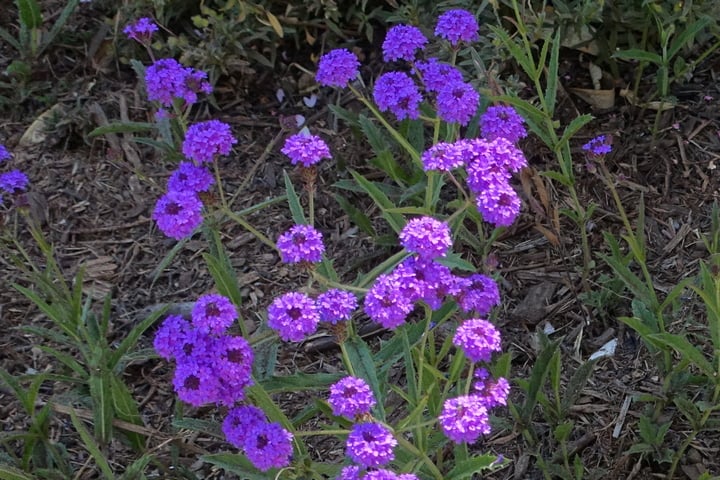
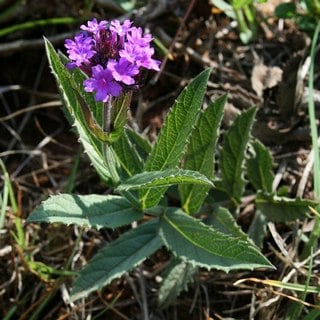
Sandpaper verbena (Verbena rigida) is a colorful, evergreen ground cover that’s carpeted with clusters of vivid purple flowers that bloom throughout the year. The slender leaves are surprisingly rough, which is how this plant gets its name. (But unlike many desert plants, it won’t harm you to touch it.)
Sandpaper verbena may look like it belongs in temperate regions, but it’s a tough plant that tolerates the desert’s temperature extremes, sun, and aridity.
Sandpaper verbena is an important source of nectar for hummingbirds, butterflies, and bees. Its scratchy leaves deter deer and rabbits, which generally leave it alone.
Why I Like This Plant
- Deep purple flowers spring through fall
- Stays evergreen in mild winters
- Low maintenance
- No thorns, low-litter, non-toxic
- Supports pollinators
Things to Watch Out For
Sandpaper verbena is a relatively short-lived perennial that declines after 3 to 5 years. However, it often reseeds in the garden, providing an ongoing supply of new plants.
This plant is not a fan of very hard water, which is common in the southwest. According to Arizona State University, sandpaper verbena is susceptible to salt burn in Phoenix due to the salinity of municipal water.
If you know your water is particularly hard or saline, and you water with drip irrigation, you might want to grow an alternative, such as Goodding’s verbena or trailing lantana. Both of these ground covers have similar clusters of flowers in various shades of purple.
Optimal Growing Conditions
If you’re thinking of adding a sandpaper verbena to your garden, you need to find a suitable place that will keep your plant healthy and looking good.
Here are the key factors to keep in mind.
Temperature
Sandpaper verbena should be grown in USDA Hardiness Zones 8 – 10. It tolerates both desert heat and cold and can survive temperatures down to 0℉. If it dies back after a cold snap, it rebounds in the spring.
Sun Exposure
Plant sandpaper verbena in either full sun or part shade. When grown in the hottest areas, it benefits from some afternoon shade.
Size and Growth Rate
Sandpaper verbena grows moderately fast and spreads by underground stems called rhizomes. When fully grown, it forms a spreading mat, typically 1 to 2 feet tall by 3 to 4 feet wide. (It is one of the largest verbenas.)
Soil
In its native habitat, sandpaper verbena grows in sandy soil, but it will grow in any type of desert soil, provided it’s well-draining.
Other Location Considerations
Sandpaper verbena is non-toxic and low litter, making it a good choice near a pool, sidewalk, or anywhere it might come in contact with pets or people.
It’s low growing form makes it a great addition to rock gardens or as an edging plant. Use it to cover banks or slopes and for erosion control.
This plant’s dark green leaves and deep purple flowers provide a beautiful contrast to plants with white flowers such as blackfoot daisy.
Sandpaper verbena can be grown in containers, and some gardeners grow it this way, treating it as a flowering annual.
Sandpaper Verbena:
The Essentials
| Common Name | Sandpaper verbena |
| Scientific Name | Verbena rigida |
| Origin | South America |
| Plant Type | Perennial ground cover |
| USDA Zones | Zones 8 – 10 |
| Cold Hardiness | To 0℉ |
| Flower Color | Purple |
| Flower Season | Spring, summer, fall |
| Mature Size | 1-2′ high x 3-4’ wide |
| Growth Rate | Fast |
| Sun Tolerance | Full, part sun |
| Water Needs | Low |
| Pests & Diseases | Root rot |
| Garden Friendly | No thorns, low litter, non-toxic |
| Wildlife | Attracts butterflies, bees, hummingbirds |
How to Plant
The rule of thumb when planting any ground cover in the desert is to dig a hole twice as wide as the root ball but no deeper.
Amending the soil is not recommended. Counterintuitively, backfilling with the same native soil you just dug up helps your verbena develop a stronger root system.
When to Plant
The best time to plant sandpaper verbena is in the fall. This gives it three seasons to grow roots and get established before the following summer.
The second best time is in spring, the earlier the better. This still gives it time to get established before the intense heat of June arrives.
How to Care for Sandpaper Verbena
Whether you’ve recently planted a sandpaper verbena or have an existing one in your yard, here’s how to take care of it to keep it healthy and looking its best.
How to Water
During the first growing season, give it about ½ gallon of water once a week while it’s establishing its root system.
The University of Arizona recommends watering newly planted ground covers every 2 to 3 days for the first 2 to 4 weeks. After that, water once a week for the next two weeks, and then every 10 – 14 days after that.
During the winter, while it is dormant, it may not need any water, provided you’ve had winter rains. If not, water every 3 to 6 weeks.
How much water you should give your plant with each watering depends on the diameter of your plant and will change as it grows. You can use this chart as a guide.
| 1′ diameter | .5 gallons |
| 2′ diameter | 2 gallons |
| 3′ diameter | 3.5 gallons |
| 4′ diameter | 5 gallons |
Should You Fertilize?
Sandpaper verbena naturally thrives in poor, sandy soil and does not need to be fertilized.
How to Prune
Since sandpaper verbena often dies back in the winter, give it a hard prune in early spring to rejuvenate it. Additionally, you can prune it occasionally during the summer to keep it looking its best.
Deadheading spent flowers encourages continuous flowering. However, wait until flowers have gone to seed if you want volunteers in your garden.
Plant Lover Facts
Sandpaper verbena (Verbena rigida) goes by many other common names including purple verbena, rigid verbena, slender vervain, and tuberous vervain.
You may see this plant’s scientific name also listed as Glandularia ridiga, but Verbena rigida is the current correct name.
Sandpaper verbena is native to Argentina, Bolivia, Brazil, Paraguay, and Uruguay but it has naturalized on every inhabited continent. In the US, it has escaped cultivation throughout the southeast, and in California and Texas.
Did you enjoy this article?
Sign up for our weekly newsletter
where you’ll find more great info on creating &
maintaining a beautiful, carefree desert landscape.
Author Bio
Deane Alban is the creator of Southwest Gardener. She is a science writer with a bachelor’s degree in botany from the University of South Florida. Gardening is her lifelong passion. She’s been gardening in Tucson for over 15 years.
